Quote of the Day: Jim Carrey on the Risk of Playing It Safe
Jim Carrey is one of the most-read people on Wikipedia this week. His page jumped to more than 45,000 views on October 1, 2026 — roughly six times its usual traffic — after a spokesperson confirmed that the actor had married his longtime partner, Min Ah, in a private ceremony in Los Angeles. But the line worth sitting with is twelve years old, from a commencement address in Iowa, where the man who chose comedy over a safe job explained the arithmetic his father taught him: You can fail at what you don’t want, so you might as well take a chance on doing what you love.
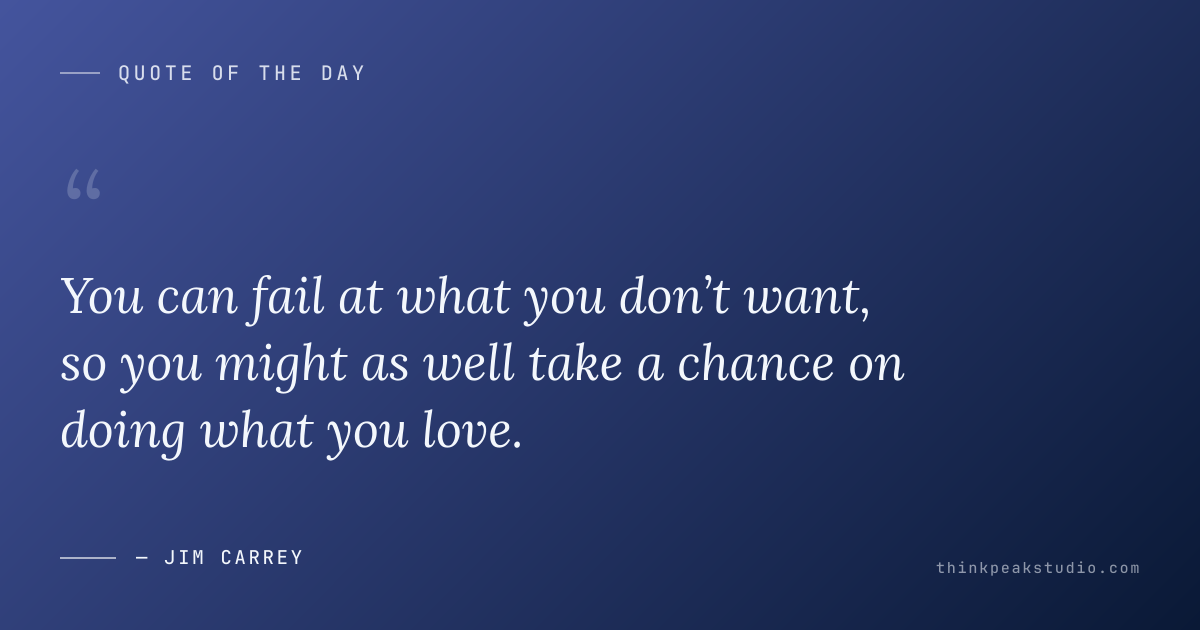
“You can fail at what you don’t want, so you might as well take a chance on doing what you love.”
What this quote means
On the surface the sentence is almost a tautology, and that is its power. Risk is not something you can opt out of by choosing carefully; it is the condition you are in whether you like it or not. The job that looks secure can disappear. The industry that looks stable can turn over. Carrey is not arguing that you should be reckless — he is pointing out that the thing we call the “safe choice” is only safer in how it feels, not in what it guarantees. And once you accept that failure is possible either way, the only variable left is what you would be failing at. If you can fail at something you don’t want, his logic runs, then at least aim the risk at something you love.
The deeper insight is that this dismantles the moral story we tell about practicality. We tend to imagine two paths: the sensible one, which is responsible and adult, and the dream, which is self-indulgent and probably doomed. We treat the sensible path as if it were free — as if choosing it costs nothing but the dream. Carrey, in the same speech, names the actual mechanism at work: “So many of us choose our path out of fear disguised as practicality.” That phrase is the load-bearing wall of the whole address. The conservative choice is often not a calculation at all; it is fear wearing the costume of good judgment. And fear, he notes, will be “a player in your life” regardless — the only question is how much of the game you hand over to it.
The reason the line lands so hard is that it is not abstract for him. The speech tells the story of his father, Percy, who “could have been a great comedian” but “didn’t believe that was possible for him,” so he made the safe choice and became an accountant instead. When Carrey was twelve, his father was let go from that safe job anyway, and the family had to do whatever it took to survive — a period in which they were homeless, living for a time in a Volkswagen van. The safe path failed. Carrey drew the conclusion that would eventually send a teenager from Scarborough to Los Angeles with a comedy act and a conviction: you can fail at what you don’t want, so you might as well take the chance. It is a lesson he says he learned from watching his father, which makes the sentence less a piece of commencement-hall optimism and more a scar turned into advice.
For most of us the choice is smaller than a career change and harder than a slogan, because it happens every week rather than once. It is the project you keep postponing, the application you never send, the class you tell yourself you’ll take when things calm down. The usefulness of Carrey’s framing is that it strips away the fake comfort of the default. It does not promise the dream will work. It only points out that the alternative was never guaranteed either — and that at least you would have spent the risk on something that meant something. He put the same idea another way in the same speech, and it is worth keeping next to this one: after the safe option has been ruled out as an illusion, there are “only ever two choices, love or fear.”
About Jim Carrey
James Eugene Carrey was born on January 17, 1962, in Newmarket, Ontario, to Kathleen, a homemaker, and Percy Carrey, a musician and accountant; he has three older siblings and was raised Catholic in a French-Canadian family whose original surname was Carré. At eight he began making faces at himself in a mirror and discovered he could do impressions. At ten he wrote to Carol Burnett to inform her that he was already a master of the craft and ought to be considered for her show — and was delighted when a form letter came back. The childhood was not easy. His family struggled financially, and in his teens they were homeless for a stretch, living in a Volkswagen van and then in a house across from the Titan Wheels tire factory, where Carrey and his brother worked eight-hour overnight shifts as janitors and security guards as part of the arrangement. He dropped out of high school on his sixteenth birthday, began performing stand-up in Toronto at fifteen, and moved to Los Angeles in 1983.
The breakthrough came slowly and then all at once. After five years as a cast member on the sketch series In Living Color, Carrey exploded in 1994 with three films — Ace Ventura: Pet Detective, The Mask (which grossed $351 million worldwide) and Dumb and Dumber — that made him the most bankable comic actor of his generation. He played the Riddler in Batman Forever in 1995, and with The Cable Guy (1996) became the first comic actor to command a $20 million upfront salary. Then he did the thing comedians were not supposed to be able to do: he turned serious, to acclaim. The Truman Show (1998) won him the Golden Globe for Best Actor in a Motion Picture – Drama; Man on the Moon (1999), in which he played the comedian Andy Kaufman, won him the Golden Globe for Best Actor in a Musical or Comedy the following year; and Eternal Sunshine of the Spotless Mind (2004) earned him a BAFTA nomination for Best Actor. He has been nominated for seven Golden Globes in total, and the Academy Award nomination that many expected for The Truman Show never came — a fact that has followed his career for decades.
In the years since, Carrey has worked less deliberately and lived more quietly. He has spoken openly about his depression and about Transcendental Meditation, and he has devoted himself seriously to painting and pen-and-ink drawing; a 2018 exhibition, IndigNation, collected 108 of his political drawings. He returned to blockbusters as the villain Dr. Ivo Robotnik in the Sonic the Hedgehog film series (2020–present), and will appear in the fourth instalment, scheduled for release on March 19, 2027. On February 26, 2026, at the 51st César Awards in Paris, he received an Honorary César — French cinema’s lifetime-achievement tribute — and delivered his acceptance speech entirely in French, thanking his father, his daughter Jane, his grandson Jackson, and his “sublime companion,” Min Ah. Less than eight months later, on September 30, 2026, the couple married in a private ceremony in Los Angeles. It is his third marriage, after Melissa Womer (1987–1995), with whom he shares Jane, and Dumb and Dumber co-star Lauren Holly (1996–1997). The private life has been hard, and he has said so; what he keeps returning to, in interviews and in that Iowa speech, is the same thing his father taught him about choosing love over fear.
Create your own quote graphic with this quote
This is a line that works best when it looks resolved rather than tentative — a steady gradient, a confident italic serif, and plenty of room around the words so the reasoning can breathe. If you want to turn this quote — or any line about the choice you are facing — into an image you can post, our free online quote maker turns it into a shareable graphic in seconds, with no signup. For advanced features like video quotes and 100+ templates, try the Quotes Creator Android app.
Editor’s note
Jim Carrey is one of the most-read people on Wikipedia this week, and the reason is a wedding rather than a film. His page, which had been drawing roughly 7,000–8,000 views a day through late September, jumped to more than 45,000 on October 1, 2026, after a spokesperson confirmed that he had married Min Ah in a private ceremony in Los Angeles on September 30. At 64, after years of saying he was done with the business, the man who built a career on refusing the safe choice has made one more leap. We are featuring this quote because it predates all of it — he said it at a college commencement in Iowa in May 2014, drawing on a lesson from his father, who gave up a comedy dream for an accounting job that failed anyway. Carrey has spent his life on the far side of that gamble, and it has not been an easy life; he has been public about the depression and the losses too. What the line offers is not a promise that doing what you love will work. It is a correction to the way we price the alternative. The “safe” option was never free; it just spent the risk somewhere you did not choose. So the question worth asking today is not whether you would fail — you might, either way. It is what you would rather be failing at, and whether the thing you keep putting off is still waiting for a sign that is never coming.
— ThinkPeak Studio Editorial Team
Tips for designing this quote
- ✓ Use a deep indigo-to-slate gradient — the Quote of the Day palette, kept dark, so the line reads as conviction rather than cheer
- ✓ Set the words in a clean italic serif; the sentence is an argument, and a serif gives it the weight of something reasoned
- ✓ Break the line after “what you don’t want” and again before “doing what you love” — the pause is where the logic turns
- ✓ Keep the attribution small and quiet; this is advice passed from a father, not a banner
- ✓ Resist adding masks, film or comedy imagery — the line is about a decision, not a filmography, and it travels further without the prop
- ✓ Export in square format for Instagram feed and portrait for Stories or Pinterest
Create your own quote graphic with this quote
Turn this line into a shareable graphic in seconds — free, no signup needed. For video quotes and 100+ templates, try the Android app.
Advertisement
Enjoyed this article? Get more like it in your inbox.


