Quote of the Day: Jim Lovell on Building Your Own Miracle
The commander of Apollo 13, the mission NASA calls its most famous “successful failure,” knew that survival was never about waiting to be saved — it was about making the rescue happen with your own hands, and with the hands of the people beside you.
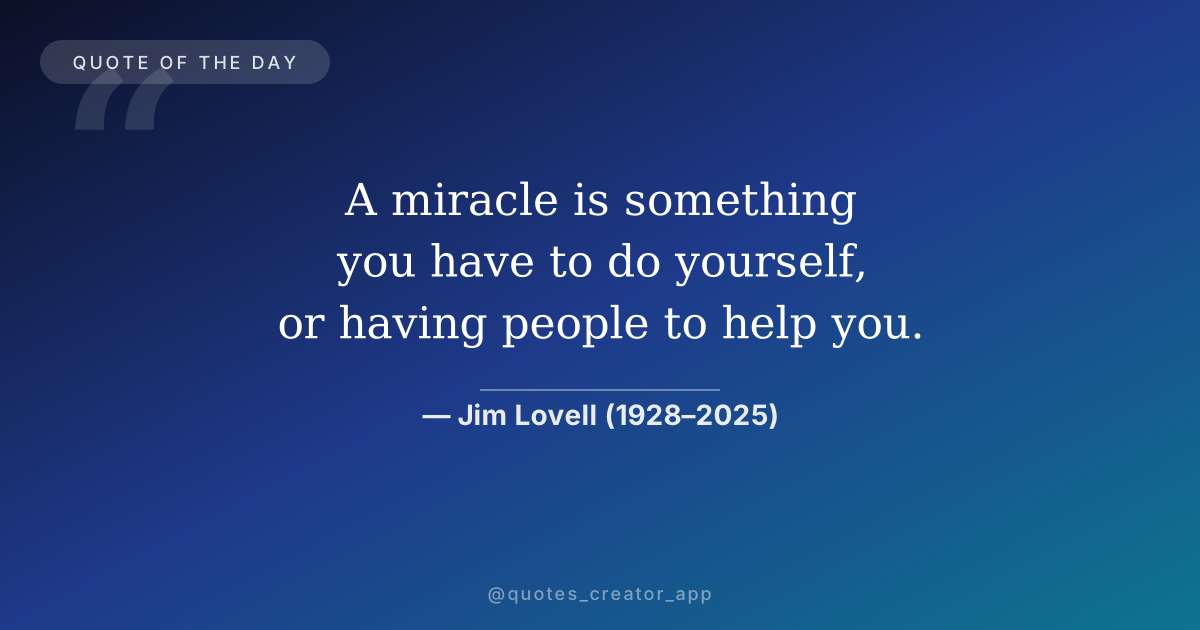
“A miracle is something you have to do yourself, or having people to help you.”
What this quote means
Most of us use the word “miracle” to describe the opposite of effort: something that arrives from outside, unearned and unexplained. Lovell spent his life disproving that. He said this on NASA’s “Houston We Have a Podcast” while looking back at April 1970, when an oxygen tank exploded in his spacecraft 200,000 miles from Earth and the three men aboard had to either solve an impossible series of engineering problems or die in silence. His point is blunt: a miracle is not something that happens to you. It is something you make happen — and you almost never make it happen alone.
That is the first layer of the quote, aimed at anyone stuck waiting for rescue. Lovell has said it even more directly elsewhere: you cannot simply close your eyes and hope a miracle shows up, because the miracle is the part you have to build yourself. It is a refusal of passivity dressed as common sense. When Apollo 13 lost power, water, and breathable air, the crew and Mission Control did not pray their way home — they improvised square carbon dioxide scrubbers with duct tape, aimed the lunar module like a lifeboat, and fired thrusters with the precision of surgeons. The miracle was cobbled together, hour by hour, out of whatever was on hand.
But notice what Lovell adds at the end: or having people to help you. The self-made miracle is rarely self-made alone. Lovell is famous for the measured words “Houston, we’ve had a problem,” but the truth of Apollo 13 is that the problem was solved by thousands of people back on Earth working in shifts — the flight controllers, the engineers, the families praying in the viewing room. The quote therefore holds two ideas in tension at once: nobody is coming to save you, and you cannot save yourself without other people. The way out is not choosing between independence and community but learning to do both at the same time — take full responsibility for the fix, and let everyone who offers a hand help you build it.
This is why the quote lands so hard beyond the space program. The parent with a sick child, the founder watching a company sink, the student facing an exam they are not ready for, the athlete down a set — they all recognize the trap of waiting for circumstances to change. Lovell’s words are a call to stop being the passenger of your own life. Before you wait for luck or rescue, ask: what can I start doing with my own hands today, and who can I ask to do it with me? The answer is usually the difference between the outcome you wished for and the outcome you built.
About Jim Lovell
James Arthur Lovell Jr. was born on March 25, 1928, in Cleveland, Ohio, to a furnace salesman father who died in a car accident when Lovell was five. Raised by his mother and later steered by a boyhood obsession with rocketry and model planes, he worked his way through the United States Naval Academy, graduating in 1952 and becoming a Navy test pilot who flew night fighters off aircraft carriers in the Western Pacific. He narrowly missed being chosen among the Mercury Seven in 1959 — rejected over a temporarily high bilirubin count — but was accepted in 1962 as one of NASA’s second group of astronauts, the “New Nine.”
Lovell went on to fly more space missions than anyone of his era: the fourteen-day endurance flight of Gemini 7 in 1965, the docking mission of Gemini 12 in 1966, and in December 1968 the Apollo 8 mission that made him, with Frank Borman and William Anders, one of the first three humans to leave Earth orbit and circle the Moon. He remains the only person in history to travel to the Moon twice — on Apollo 8 and Apollo 13 — without ever setting foot on its surface. He spent 715 hours in space across four flights, a personal record that stood until the Skylab missions.
His defining chapter began on April 11, 1970, when Apollo 13 launched toward the Fra Mauro highlands. Fifty-five hours into the flight, an oxygen tank exploded, crippling the command module Odyssey. Lovell, Fred Haise, and Jack Swigert survived by turning the lunar module Aquarius into a lifeboat, and Lovell’s calm, deliberate navigation through two manual course corrections helped steer them back to Earth. The crew splashed down safely on April 17, and what began as a near-catastrophe became the defining triumph of teamwork in the space age — the mission that gave the world its most enduring proof that calm heads and collaboration can outrun disaster. In 1994 he co-wrote the memoir Lost Moon, which became the basis for the film Apollo 13, in which he appears in a cameo.
Lovell died peacefully at his home in Lake Forest, Illinois, on August 7, 2025, at the age of 97. The day after his death, his Wikipedia page was viewed more than 234,000 times in a single day — among the most-read pages on the entire English Wikipedia — as a generation raised on the movie discovered the man behind the line. He had spent decades as a quiet businessman and a beloved storyteller of his era, and he left behind a simple, stubborn philosophy that has outlived him: the miracle is not watching for one. It is building one, together.
Create your own quote graphic with this quote
This is the kind of quote that resonates most when it is presented visually. A clean typographic layout, a fitting color palette, and readable font sizing can transform these words into a graphic that people save and share. If you want to turn this quote into an Instagram post, WhatsApp status, Pinterest pin, or reel cover, Quotes Creator gives you all the tools to do it in minutes — custom fonts, gradients, backgrounds, and export sizes ready for every major platform.
Editor’s note
Jim Lovell was one of the most-read figures on the internet the day after his death — his Wikipedia page drew more than 234,000 views on August 9, 2025, putting him among the top pages on the entire English Wikipedia. In a year that has already asked so much of us, the reasons are easy to understand: people reach for Lovell when they need proof that human beings can outthink their own disasters. His words carry the weight of a man who once improvised his way home from the far side of the Moon. The next time you feel helpless, remember his arithmetic — the miracle is not something you wait for, it is something you start building with your own hands, and you can always ask for help.
— ThinkPeak Studio Editorial Team
Tips for designing this quote
- ✓ Use deep midnight blues and steel teals to echo the vast, calm darkness of space Lovell mastered
- ✓ Keep the text centered and italic in a serif font for a timeless, weighty feel
- ✓ Let the words breathe with generous spacing between lines so they land with weight
- ✓ Add a subtle gradient background rather than a flat color for depth and dimension
- ✓ Export in square format for Instagram feed and portrait for Stories or Pinterest
Create your own quote graphic with this quote
Turn this line into a shareable graphic in seconds — free, no signup needed. For video quotes and 100+ templates, try the Android app.
Advertisement
Enjoyed this article? Get more like it in your inbox.