Quote of the Day: John Maynard Keynes on the Present Moment
Born on this day in 1883, Keynes gave us one of history’s most quoted lines — a reminder that theory must serve the living, not the abstract future.
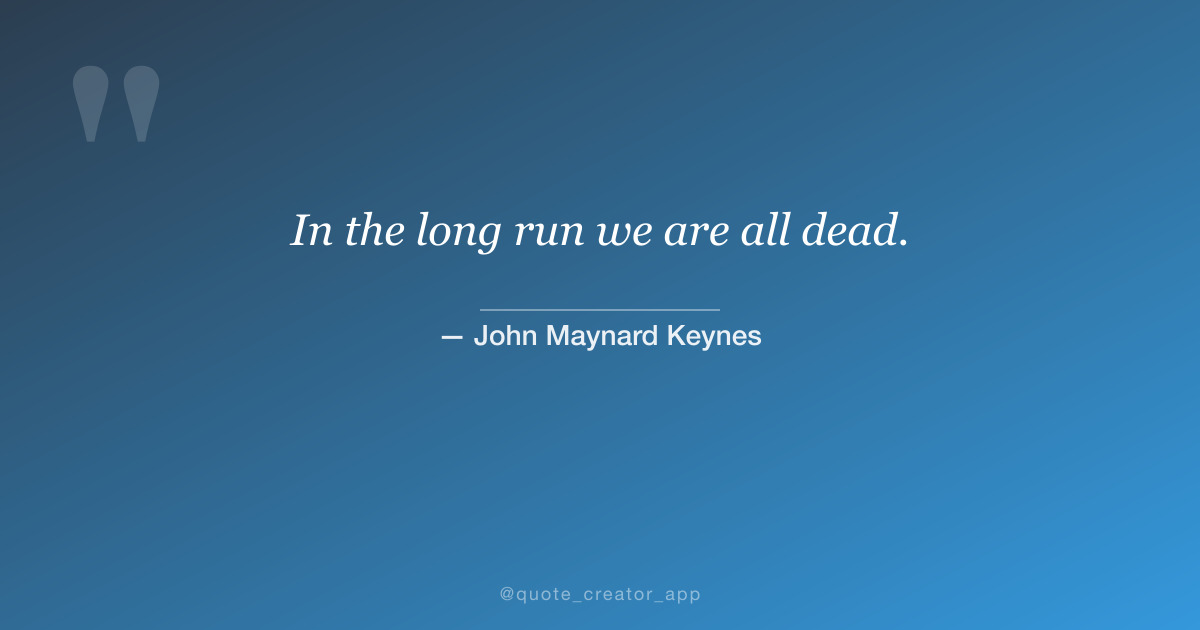
“In the long run we are all dead.”
Editor’s note
Born in 1883, John Maynard Keynes’s line — “In the long run we are all dead” — is a demand that ideas remain grounded in the present rather than retreating into distant horizons. Theories that only work across centuries are not theories that serve human beings. If this resonates, try a ten-minute, unfiltered freewrite about the line and what it brings up.
— ThinkPeak Studio Editorial Team
What this quote means
On the surface, Keynes is making a stark, almost sardonic observation: if you wait long enough, every problem eventually resolves itself — because everyone involved will be dead. He wrote this in response to economists who argued that market forces, given enough time, would correct unemployment and restore equilibrium. His point was blunt: “enough time” is cold comfort to the person who is hungry today.
The deeper insight is a plea for urgency and relevance. Theories that only work across centuries are not theories that serve human beings — they are theories that serve abstractions. Keynes was arguing that economics must be useful now, for real people in real crises, not as a reassurance that things will sort themselves out long after the suffering has passed. It is a demand that ideas remain grounded in the present rather than retreating into distant horizons.
Keynes wrote these words in 1923, in the aftermath of World War I, when Europe was struggling with inflation, debt, and economic instability. Classical economists kept pointing to long-run equilibrium as the cure. Keynes found this answer intellectually lazy and morally insufficient. His frustration produced one of the most enduring sentences in the history of economic thought — a sentence that launched a revolution in policy thinking.
Today the quote resonates far beyond economics. It applies to anyone who defers action with vague promises that things will improve eventually. Climate policy, public health, social reform — in each domain, the temptation is to trust in long-run corrections. Keynes’s challenge remains: what are you doing for the people who are alive right now?
About John Maynard Keynes
John Maynard Keynes was born on June 5, 1883, in Cambridge, England, into an academic household — his father was the logician and economist John Neville Keynes. He was educated at Eton and then at King’s College, Cambridge, where he studied mathematics before turning to economics under Alfred Marshall. His intellectual range was extraordinary: he was equally at home in philosophy, probability theory, the arts, and public policy, and he was a central figure in the Bloomsbury Group alongside Virginia Woolf, E. M. Forster, and Lytton Strachey.
Keynes’s impact on the modern world is difficult to overstate. His 1919 book The Economic Consequences of the Peace predicted, with remarkable accuracy, that the punishing reparations imposed on Germany after World War I would lead to economic collapse and political catastrophe. His 1936 masterwork, The General Theory of Employment, Interest and Money, fundamentally reframed how governments understood their role in managing economies. The idea that governments should use fiscal policy — spending and taxation — to stabilize demand during downturns became the intellectual foundation for the New Deal, post-war reconstruction, and virtually every major economic rescue programme since. He died in 1946, but Keynesian economics continues to be debated, revised, and applied in every major economy on earth.
A lesser-known dimension of Keynes is his role as a passionate arts patron. He helped found the Arts Council of Great Britain, financed a Cambridge theatre, and was married to the Russian ballerina Lydia Lopokova. He believed that a prosperous economy existed to give human beings the freedom to pursue beauty and leisure — a vision he outlined in his 1930 essay Economic Possibilities for our Grandchildren, where he predicted that by 2030 living standards would be so high that people would work only fifteen hours a week. That prediction has not come true, but the underlying ideal — that material progress should translate into human flourishing — remains as compelling as ever.
Create your own quote graphic with this quote
This is the kind of quote that resonates most when it is presented visually. A clean typographic layout, a fitting color palette, and readable font sizing can transform these words into a graphic that people save and share. If you want to turn this quote into an Instagram post, WhatsApp status, Pinterest pin, or reel cover, Quotes Creator gives you all the tools to do it in minutes — custom fonts, gradients, backgrounds, and export sizes ready for every major platform.
Tips for designing this quote
- ✓ Use a serif font (Georgia, Playfair Display) to honour the gravitas and literary feel of the quote
- ✓ Keep the quote on one or two lines — shorter display text reads better on mobile
- ✓ Pair the quote with a dark-to-blue gradient that matches the serious, philosophical tone: deep navy to slate blue
- ✓ Add the author name in a smaller, lighter weight below the quote
- ✓ Export in square format for Instagram feed and portrait for Stories or Pinterest
Create your own quote graphic with this quote
Turn this line into a shareable graphic in seconds — free, no signup needed. For video quotes and 100+ templates, try the Android app.
Advertisement
Enjoyed this article? Get more like it in your inbox.