Quote of the Day: John Steinbeck on Choosing to Be Good Instead of Perfect
He wrote novels, novellas, plays and journalism for more than four decades, had a book banned from a California county’s schools and libraries for telling the truth about them, and won the prizes most writers only dream of. But the sentence people keep returning to is not from The Grapes of Wrath. It is a single line spoken near the end of East of Eden — one that dismantles the excuse most of us hide behind, and does it in fourteen words. As Netflix’s seven-part adaptation of the novel sent readers back to Steinbeck’s page this week, his Wikipedia traffic jumped eightfold in four days.
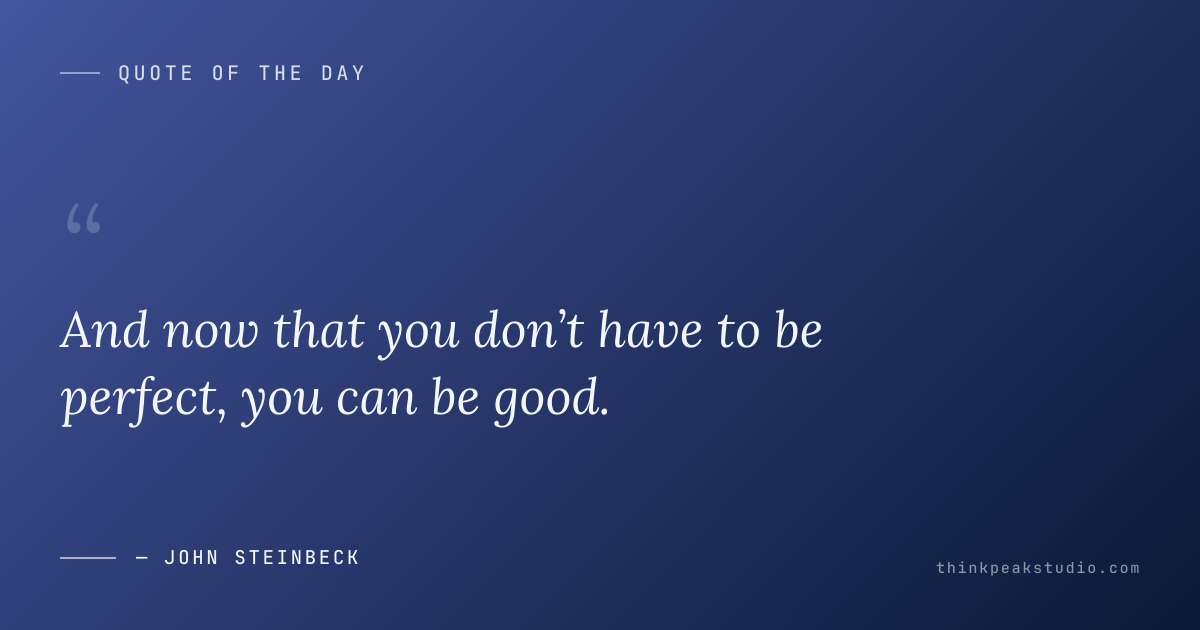
“And now that you don’t have to be perfect, you can be good.”
What this quote means
The sentence works by removing a condition. Most of us carry a private version of the same bargain: once I am good enough, then I will be allowed to be good. We treat our own decency as a reward we have to earn, withheld until the performance is flawless. Steinbeck’s line reverses the order. It does not ask you to become perfect, and it does not pretend that goodness is easy; it simply points out that the impossible standard is the thing standing in the way. Perfection and goodness are not rungs on the same ladder. They are mutually exclusive projects, and only one of them was ever available to a human being.
Notice, too, that the line is generous rather than scolding. It is spoken to someone who believes he is bad — and it does not argue with the belief so much as dissolve the framework underneath it. If you think the choice is perfect or worthless, then every failure confirms the worst about you. The moment the choice becomes perfect or good, failure stops being an identity and becomes an ordinary event. You can be a flawed person who does good things, which is, when you look around, the only kind of person who has ever done them.
The phrase lands with the whole weight of the novel behind it. East of Eden is Steinbeck’s retelling of the story of Cain and Abel — the first murder, the first brother, the first time a person decided that being told “no” was unbearable. Steinbeck builds the book around a single Hebrew word, timshel, which he renders as “thou mayest.” In the Genesis account, God tells Cain that sin “crouches at the door,” and the English translations have long divided over whether the verb means thou shalt rule over it, thou shalt not, or thou mayest. Steinbeck’s characters spend chapters chasing that verb through Hebrew scholarship, and they settle on the last reading, because it is the one that leaves a choice in human hands. Timshel is the word Steinbeck gives Adam Trask as his dying word, and it is the word the final episode of the 2026 series takes for its title. It is not a promise that you will choose well. It is only the claim that the choice is real. The perfection line is timshel stated in plain English: you do not have to be flawless, you only have to choose.
It is fitting that the words belong to Lee, the Trask family’s Chinese-American housekeeper and cook, and the wisest person in the book. Lee is the one who has read the most, who has learned Hebrew to test a translation, and who has spent his life being underestimated by almost everyone in the room. His authority does not come from power or wealth. It comes from having thought about the question longer and more honestly than the people around him. That, too, is part of the quote’s meaning: the freedom to be good rather than perfect is not handed down by the successful. It is usually spoken by someone who has already made peace with their own imperfections and has nothing left to prove to you.
About John Steinbeck
John Ernst Steinbeck was born in Salinas, California, on 27 February 1902, into a family of modest means. His father, John Ernst Steinbeck Sr., was the treasurer of Monterey County; his mother, Olive Hamilton, had been a schoolteacher and passed on a love of reading. The Salinas Valley — the long, fertile trough between the California Coast Ranges that he called “the valley of the world” — would become the landscape of nearly everything he wrote. He graduated from Salinas High School in 1919, enrolled at Stanford University, and left in 1925 without a degree, having drifted in and out of courses while writing on the side.
He went to New York to make it as a writer, failed, and came home. He worked as a caretaker at Lake Tahoe, where he met his first wife, Carol Henning; they married in 1930. That same year he met the marine biologist Ed Ricketts, whose tide-pool laboratory in Monterey became, for a decade, the centre of his intellectual life. Ricketts taught him biology and a kind of ecological philosophy — the idea that human beings are animals entangled with their environment — and became the model for the character “Doc” in Cannery Row. Steinbeck’s first novel, Cup of Gold, appeared in 1929 to little notice. His first real success came with Tortilla Flat in 1935, and from there he moved quickly into the novels of the Depression that made his name.
Of Mice and Men followed in 1937 — the Nobel committee would later call it a “little masterpiece” — and then, in 1939, The Grapes of Wrath. Steinbeck had spent months interviewing migrant families in the Hoovervilles of the San Joaquin Valley, and the novel that came out of it was both a bestseller and a scandal. It was the best-selling book of 1939, and it won the Pulitzer Prize for Fiction in 1940. In his own home county, the response was rage: the Kern County Board of Supervisors banned it from its schools and libraries, and Steinbeck received enough threats that he bought a handgun. In 1943 he served as a war correspondent in the Mediterranean, and the friendships and observations from those years fed later books including Cannery Row (1945) and The Pearl (1947).
He considered East of Eden, published in 1952, his most ambitious work, and he wrote it long-hand in a single large ledger, keeping a running journal that he addressed to his editor. It is the book in which he stopped writing about social injustice and wrote instead about the older question underneath it: whether a person can choose what to be. In 1962 he was awarded the Nobel Prize in Literature “for his realistic and imaginative writings, combining as they do sympathetic humour and keen social perception,” a decision so contentious at the time that Steinbeck himself, asked whether he deserved it, replied, “Frankly, no.” Two years later, in September 1964, President Lyndon B. Johnson presented him with the Presidential Medal of Freedom. Steinbeck was also nominated for three Academy Awards for his screenplays — Lifeboat (1944), A Medal for Benny (1945) and Viva Zapata! (1952). He died in Manhattan on 20 December 1968, aged 66, and is buried in Salinas.
Which brings the story back to this week. On 1 October 2026, Netflix released East of Eden, a seven-episode limited series written and executive produced by Zoe Kazan — the granddaughter of Elia Kazan, who directed the 1955 film version with James Dean — and starring Florence Pugh as Cathy Ames, with Hoon Lee as Lee. Garth Davis directed the first four episodes and Laure de Clermont-Tonnerre the final three, the last of which is titled “Timshel.” The show drew generally favourable reviews and sent a fresh wave of readers to the novel. According to the Wikimedia Pageviews API, Steinbeck’s Wikipedia page had been drawing roughly 4,600 to 5,000 views a day in the week before the premiere. On 1 October it climbed to 14,338; on 2 October to 25,026; on 3 October to 32,776; and on 4 October to 40,598 — an eightfold rise in four days. A seventy-four-year-old line, it turns out, is still the most current thing on the page.
Create your own quote graphic with this quote
Steinbeck’s sentence is short enough to fill a card on its own, and it rewards restraint: a warm, quiet gradient, a serif italic, and a lot of space so the two halves — the release and the permission — can breathe. If you want to turn this quote, or any quote you keep returning to, into a design worth saving and sharing, Quotes Creator gives you the fonts, gradients, backgrounds and export sizes to do it in minutes, ready for Instagram, Stories, Pinterest and everywhere else.
Editor’s note
John Steinbeck was one of the most-read writers on English Wikipedia this week, and the reason was television. When Netflix released its seven-part East of Eden on 1 October 2026, his page climbed from a steady 4,600 to 5,000 views a day to 14,338 that day, 25,026 the next, 32,776 on 3 October and 40,598 on 4 October, according to the Wikimedia Pageviews API — an eightfold rise in four days. We are featuring this quote because it is the plainest statement of what the novel is actually about. Steinbeck spent a career on the powerless — the migrant, the worker, the overlooked — and East of Eden turns that sympathy inward, onto the private question of whether a person is doomed by what they inherited or free to choose otherwise. His answer, delivered by the household cook rather than a patriarch, is that the demand for perfection is the real trap, and that goodness becomes possible the instant we stop insisting on flawlessness first. Read it as a permission slip and a challenge at the same time. You are allowed to be flawed. You are still asked to be good.
— ThinkPeak Studio Editorial Team
Tips for designing this quote
- ✓ Set the line in an italic serif so it reads as something spoken quietly, by a character rather than a slogan
- ✓ Break it so that “you can be good” lands on its own line — the release is the point
- ✓ Use a warm amber-to-slate gradient that suggests late California light, not alarm or warning
- ✓ Keep the attribution inconspicuous; let the quotation marks and the whitespace carry the frame
- ✓ Export square format for the Instagram feed and portrait for Stories or Pinterest
Create your own quote graphic with this quote
Turn this line into a shareable graphic in seconds — free, no signup needed. For video quotes and 100+ templates, try the Android app.
Advertisement
Enjoyed this article? Get more like it in your inbox.


