Quote of the Day: Julia Stiles on the Dance She Quit Because People Expected Her to Be Perfect
Julia Stiles is one of the most-read people on Wikipedia this week. Her page surged to 136,443 views on September 17, 2026 — more than ten times its usual traffic — after she made her debut on season 35 of Dancing With the Stars. But the line worth returning to is the one she said in rehearsal, to her pro partner Ezra Sosa, about why the actress famous for a dance movie had spent two decades refusing to dance: I stopped taking dance classes because people expected me to be this perfect dancer.
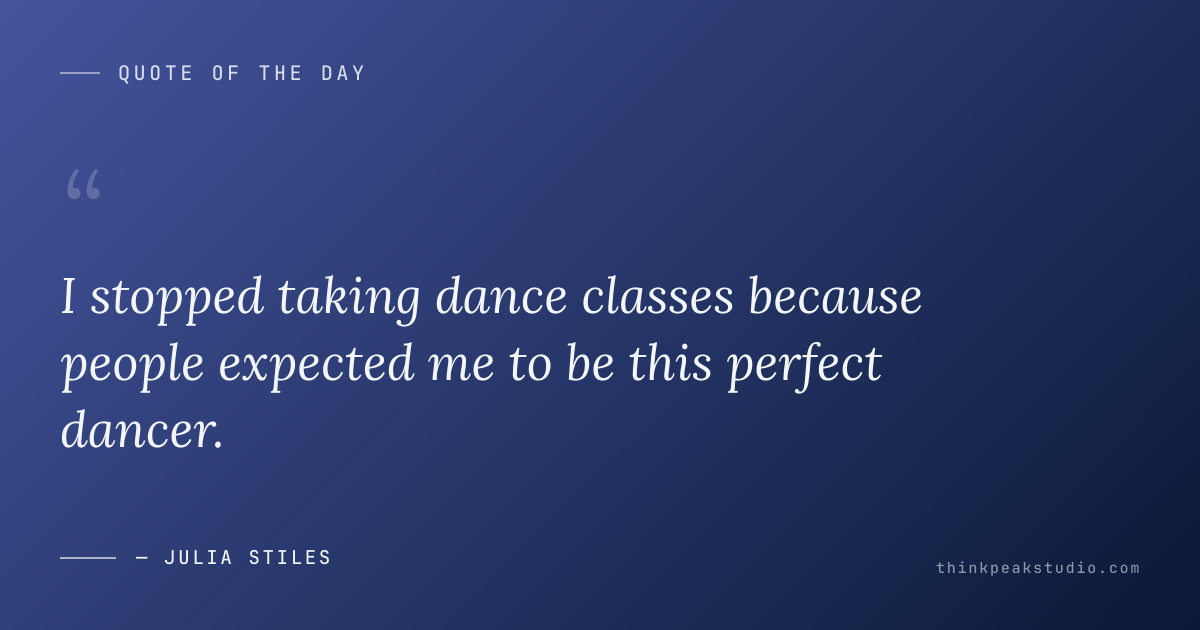
“I stopped taking dance classes because people expected me to be this perfect dancer.”
What this quote means
She said it on premiere night, September 16, 2026, in the rehearsal footage that aired before her first dance. She was explaining why Save the Last Dance — the 2001 film that made her a star — is not the advantage everyone assumes. In it she plays Sara Johnson, a ballerina chasing a place at Juilliard, but she has always been honest that the dancing was not hers. “I am not a professional dancer by any means. I just played one in a movie,” she told Sosa, and then, with a laugh: “It was doubled, by the way.” The confession is charming. The sentence that follows it is the quote, and it is not charming at all. It is a description of a tax that someone else levied on her joy — and that she kept paying long after the movie wrapped.
The expectation outlived the role. She was cast because she “had rhythm,” as she has put it, not because she had spent years in a studio. But once the film was a hit, the culture decided she was a dancer, and every class became an audition she could fail. So she did what most people do when the gap between how they are seen and how they actually feel grows too wide to carry: she removed herself from the room. “I stopped taking dance classes after that movie because I was so self conscious,” she told Us Weekly. “I can see how tense I was in that movie.” Notice the sequence, because it is the whole point. She was not told she was bad. She was told she was expected to be perfect — and those two sentences do exactly the same damage. One insults your ability; the other quietly moves the finish line out of sight and asks you to keep chasing it.
That is why a throwaway joke from 2025 could still be living in her head a year later. On his SiriusXM show, while interviewing her Save the Last Dance costar Kerry Washington, Andy Cohen asked, “Can we all just agree that Julia Stiles is not the greatest dancer on the planet?” A year after that, unprompted in the rehearsal room, she brought it up: “The quote is imprinted in my brain.” It would be easy to read that as vanity, but it is something closer to recognition. A careless remark only stays with us when it agrees with a verdict we have already passed on ourselves. Washington defended her in the moment, crediting the choreographer Fatima Robinson, and she was right — but the defence is not the voice that keeps replaying. The critique is. That is the machinery the quote is describing, and it is not unique to actresses or dancers.
Read this way, the line is not really about dancing at all. Almost everyone has a version of it: the singing you stopped, the drawing, the language you dropped, the running you quit — abandoned not at the moment of failure but at the moment you realised you were being watched and measured. What makes Stiles’s story worth telling is what she did next. She said yes to the very thing she had avoided for twenty years, and she named why: “This is my chance to free myself from all that and just enjoy the experience and learn something new with an amazing partner at the top of his game.” On September 16 she danced a quickstep to Dolly Parton’s “9 to 5.” The judges gave her 18 out of 30. When Bruno Tonioli told her she was a great dancer, she was so startled that she said she would replay the compliment later — “Sometimes performers we only hear the critique,” she explained. That is the lesson the quote is pointing at. You do not get the thing back by becoming perfect. You get it back by doing it on purpose, imperfectly, in front of everyone, and letting the critique be only one of the voices in the room.
About Julia Stiles
Julia O’Hara Stiles was born in New York City on March 28, 1981, the oldest of three children, and grew up in Greenwich Village with a mother, Judith Newcomb Stiles, who was an artist. She began acting at 11, performing with New York’s experimental La MaMa Theatre Company, and by 15 she had her first film role, in I Love You, I Love You Not (1996). Her first lead, as a troubled teenager in the thriller Wicked (1998), won her the Best Actress award at the Karlovy Vary International Film Festival — she was still a teenager, and the industry had already learned that she could carry a film.
Then came the year that fixed her in a generation’s memory. Cast at 17 as Kat Stratford, opposite Heath Ledger, in 10 Things I Hate About You (1999), she won the MTV Movie Award for Breakthrough Female Performance and the Chicago Film Critics Association’s Most Promising Actress award for a film that turned Shakespeare into a high-school comedy without losing the bite. She followed it with two more Shakespeare adaptations — Ophelia opposite Ethan Hawke in Hamlet (2000) and Desdemona in O (2001) — and then, in 2001, with Save the Last Dance, which won her another MTV award, for Best Kiss, shared with Sean Patrick Thomas, and a Teen Choice Award. She won those prizes for playing a dancer. As she has since made clear, a body double did the dancing she was credited for. That gap between the role and the reality is the seed of everything in the quote.
She spent the next two decades refusing to stay in one lane. She played CIA analyst Nicky Parsons across the Bourne franchise, growing from a small part in The Bourne Identity (2002) to a pivotal role in The Bourne Ultimatum (2007) and returning for Jason Bourne (2016); she appeared opposite Julia Roberts in Mona Lisa Smile (2003); and in 2010 she joined the fifth season of Dexter as Lumen Pierce, a performance that earned her nominations for the Primetime Emmy for Outstanding Guest Actress in a Drama Series and the Golden Globe for Best Supporting Actress. All of it happened around her studies: she graduated from Columbia University in 2005 and nearly turned down the first Bourne film because of college exams. In January 2025 she released her feature directorial debut, Wish You Were Here. She married camera assistant Preston J. Cook in September 2017.
Dancing With the Stars had come calling before. She turned it down several times, and by her own account it “took a couple of years” to say yes. When she finally joined season 35, announced on September 2, 2026, she was 45 and partnered with Ezra Sosa. On September 16 she danced her quickstep to “9 to 5,” a song Dolly Parton had personally cleared for her a couple of weeks before her death in August 2026 at 80. She scored 18 out of 30. The next day her Wikipedia page — which on an ordinary day draws somewhere between eight and thirteen thousand views — hit 136,443. At 45, decades into a career, the thing the internet wanted to read about was a woman doing something she was not the best at, because she had finally decided that was allowed.
Create your own quote graphic with this quote
This is a quote about the noise other people make in your head, so the graphic should feel like quiet after it. A soft indigo-to-slate gradient, an italic serif, and a lot of breathing room let the confession land without decoration. If you want to make a quote card from this — or any quote — our free online quote maker turns it into a shareable image in seconds, with no signup. For advanced features like video quotes and 100+ templates, try the Quotes Creator Android app.
Editor’s note
Julia Stiles was one of the most-read people on Wikipedia this week. Her page surged to 136,443 views on September 17, 2026 — more than ten times its normal traffic — after she made her debut on season 35 of Dancing With the Stars, scoring 18 out of 30 for a quickstep to Dolly Parton’s “9 to 5.” We are featuring this quote because it is the reason she was there at all. Stiles became famous for a dance movie in which, as she has always acknowledged, a double did the dancing; then she stopped taking classes because people expected her to be perfect. That single sentence explains a decade of avoidance and the decision to finally walk back into the room at 45. It is also the most universally useful thing she said this week, because almost no one quits the thing they love when they are simply bad at it. They quit when they are being watched and found wanting. Before you write off your own abandoned hobby, ask what Stiles spent years answering: did you stop because you lost interest, or because someone moved the standard out of reach? The fix is not to get perfect. It is to let yourself be seen trying, and to count the praise as loudly as the critique.
— ThinkPeak Studio Editorial Team
Tips for designing this quote
- ✓ Use a soft indigo-to-slate gradient — calm and private, not competitive, so the line reads as an admission rather than a verdict
- ✓ Keep the text centered and italic in a serif font so it feels whispered to one person rather than announced to a crowd
- ✓ Break the quote before “because people expected” so the cause and the cost sit on separate lines
- ✓ Leave generous margins and resist adding a dancer, a stage or a spotlight — the line is about a mind, not a ballroom
- ✓ Avoid high-contrast accents; a gentle vignette suggests pressure receding, which is what reclaiming the thing feels like
- ✓ Export in square format for Instagram feed and portrait for Stories or Pinterest
Create your own quote graphic with this quote
Turn this line into a shareable graphic in seconds — free, no signup needed. For video quotes and 100+ templates, try the Android app.
Advertisement
Enjoyed this article? Get more like it in your inbox.


