Quote of the Day: Karen Carpenter on the Strength You Overlook
The voice behind the Carpenters’ biggest hits had a simple explanation for why she sounded the way she did: the notes she worked hardest to develop weren’t the ones that made her famous — the quieter, lower ones were.
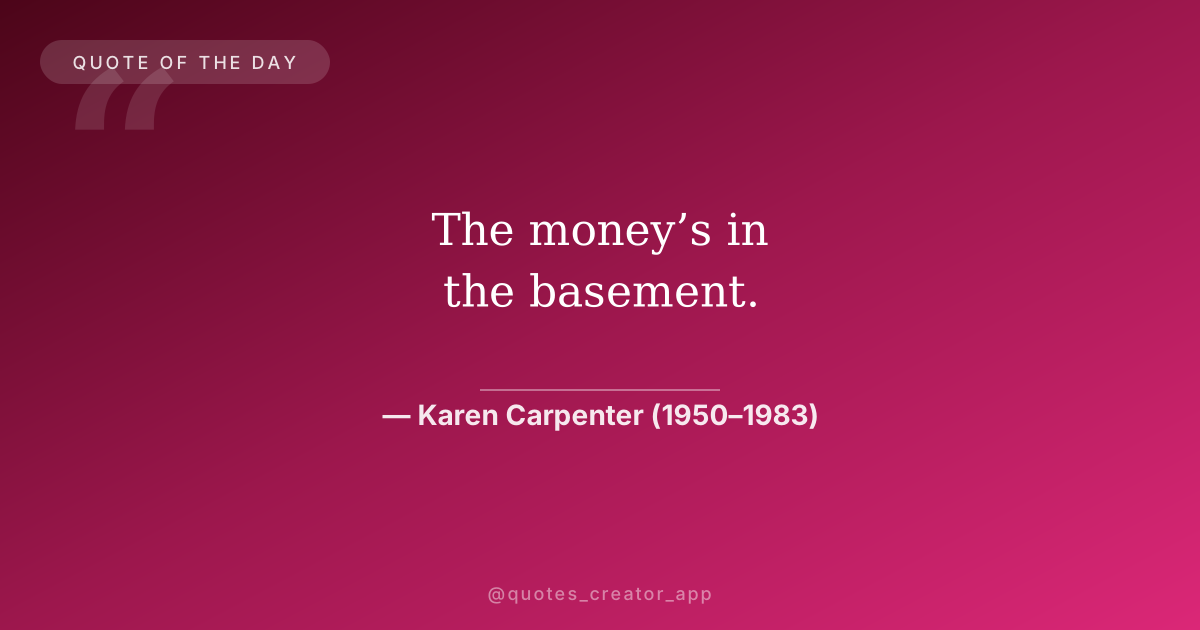
“The money’s in the basement.”
What this quote means
To understand this line, you have to know a little about how Karen Carpenter built her voice. She was born with a striking natural instrument, but she did not simply rely on it. As a teenager she studied with Frank Pooler, the Long Beach State choir director, specifically to develop her upper register so that she could command a full three-octave range — high, soaring notes that take years of patient training to reach. By most standards, that is exactly where a singer’s value would be: the impressive heights, the show-stopping peaks. Karen’s joke turns that assumption on its head. The money, she said, is in the basement — the warm, low, contralto notes near the bottom of her range that took no acrobatics and won no applause on their own. That is where the Carpenters’ sound lived, and where most of their biggest hits were actually sung.
There is a funny, humble truth hidden in the quip. Karen spent years learning to reach up, and then discovered that the world wanted her most when she stayed low. “The money’s in the basement” is a musician’s shorthand for that discovery: that the thing which made her records work — which made listeners lean in and feel something — was not the flashy register she had labored to build, but the easy, natural one she had probably taken for granted. The line lands because it refuses to boast. She could have said “my lower register is my signature and my strength.” Instead she pointed downward and made a wry, practical joke about where the value really sat, as if success were a real estate deal and she was simply sharing the honest location of the asset.
Read broadly, the quote is about the talent you underrate in yourself. Almost everyone spends energy polishing the version of their work they think looks most impressive — the high note, the big credential, the flashy skill — while the gift that actually connects with people sits quietly underneath, underexercised and undertrusted. Karen’s line is a reminder to audit your own basement: the strengths you dismiss as ordinary or unremarkable might be precisely the ones other people value most. The confidence to see that — and to say it with a smile instead of a brag — is a form of wisdom.
The quote also carries a deeper, sadder weight because of what happened to Karen afterwards. She was a woman who could joke easily about her craft while privately struggling with a crushing pressure to be thinner, smaller, and more perfect — pressure she never overcame. That she could locate her musical worth so precisely, in the low notes she sang so warmly, makes her loss harder to bear. It is a reminder that the most valuable parts of a person are often the least celebrated ones, and that the world’s idea of value — the high register, the visible peak — is not the same as the truth. Her voice still proves that every time one of her records plays.
About Karen Carpenter
Karen Anne Carpenter was born on March 2, 1950, in New Haven, Connecticut, and grew up in Downey, California. She began playing drums in high school and joined the Long Beach State choir in college, where she sang alongside her older brother Richard. In 1969, when Karen was nineteen, the duo — simply the Carpenters — was signed to A&M Records, and within two years they were among the biggest acts in the world on the strength of hits like “Close to You,” “We’ve Only Just Begun,” “Top of the World,” and “Yesterday Once More.” Karen was initially the group’s full-time drummer — one of the most visible women in an almost entirely male occupation — before she gradually stepped out from behind the kit to become the face of the group.
Her voice was the engine of the Carpenters’ success. Praised by everyone from Paul McCartney, who called it “the best female voice in the world: melodic, tuneful and distinctive,” to Elton John, who said she had “one of the greatest voices of our lifetime,” Karen’s warm, precise contralto helped the duo sell more than 100 million records. In 2010, Rolling Stone named her one of the 100 greatest singers of all time. Yet the very pressures of that fame took a devastating toll. In 1975 she began struggling with anorexia nervosa, a condition little understood outside celebrity circles at the time. She never recovered, and died on February 4, 1983, at the age of 32.
Her death changed how the world talked about eating disorders. It spurred research and public conversation about anorexia and body dysmorphia that had rarely reached mainstream audiences before, and her story has been revisited in biographies, documentaries, and films ever since. Forty years on, her records still get played, her drum solos are still marveled at, and new generations keep discovering that low, warm voice — which is exactly what happened this week, when Karen Carpenter’s Wikipedia page suddenly drew tens of thousands of daily views in the first days of August 2026, a tenfold surge that made her one of the most-read figures on the internet. The girl whose greatest gift was a few notes in the basement is, still, remarkably hard to get out of your head.
Create your own quote graphic with this quote
This is the kind of quote that resonates most when it is presented visually. A clean typographic layout, a fitting color palette, and readable font sizing can transform these words into a graphic that people save and share. If you want to turn this quote into an Instagram post, WhatsApp status, Pinterest pin, or reel cover, Quotes Creator gives you all the tools to do it in minutes — custom fonts, gradients, backgrounds, and export sizes ready for every major platform.
Editor’s note
Karen Carpenter became one of the most-read people on the internet this week — her Wikipedia page drew more than 44,000 views on August 1, 2026, and kept climbing to roughly 56,000 a day by August 3, a massive spike from her usual few thousand. Decades after her death, the world keeps coming back to her voice, which is the whole point of “The money’s in the basement.” It is a gentle, honest reminder that the strengths we overlook in ourselves — the unflashy ones, the ones we never had to strain to reach — are often exactly what other people treasure. Before you share this, ask yourself what is sitting in your own basement, waiting to be trusted.
— ThinkPeak Studio Editorial Team
Tips for designing this quote
- ✓ Use deep rose and magenta tones to echo the warm, velvet quality of Karen Carpenter’s voice
- ✓ Keep the typography clean and elegant; the understated joke deserves a minimal, confident layout
- ✓ Let the short line breathe on its own — the power of this quote is in its simplicity
- ✓ Add a subtle gradient background rather than a flat color for depth and dimension
- ✓ Export in square format for Instagram feed and portrait for Stories or Pinterest
Create your own quote graphic with this quote
Turn this line into a shareable graphic in seconds — free, no signup needed. For video quotes and 100+ templates, try the Android app.
Advertisement
Enjoyed this article? Get more like it in your inbox.