Quote of the Day: Sir Keir Starmer on Trust and Service
Sir Keir Starmer, Britain’s 58th Prime Minister, delivered these words in his first speech outside 10 Downing Street after leading Labour to a landslide victory in July 2024. They capture the central challenge of leadership in an age of fractured trust.
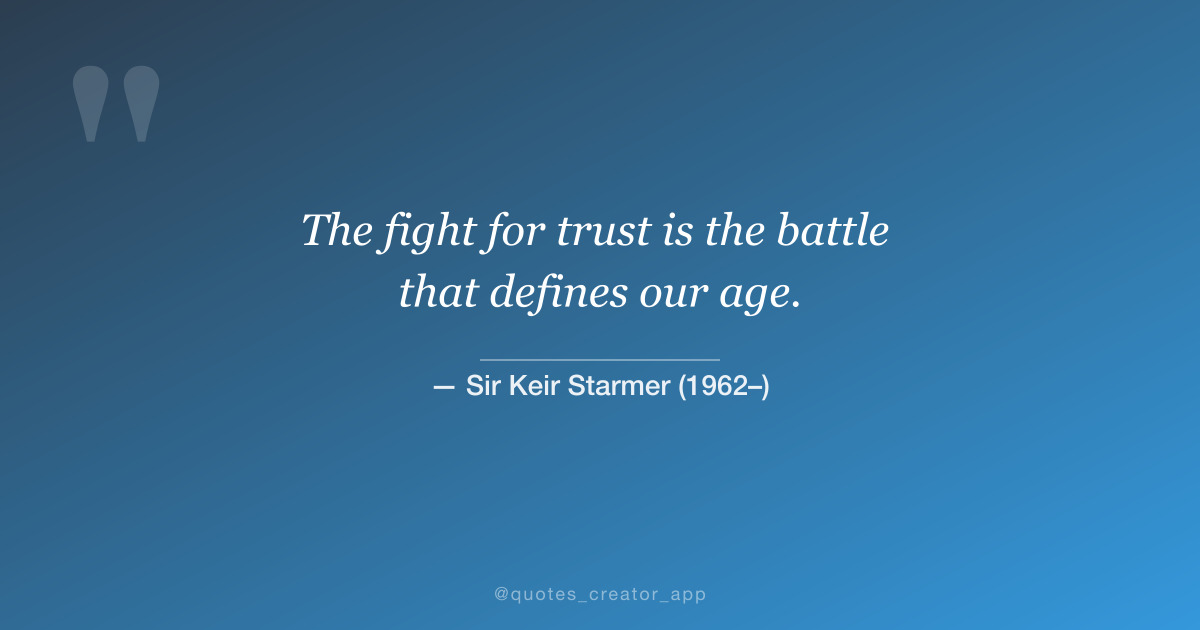
“The fight for trust is the battle that defines our age.”
Editor’s note
In a world where misinformation spreads faster than truth and cynicism about institutions runs deep, Starmer’s words land with unusual weight. He did not promise policy or prosperity in this line — he named the deeper problem. Trust. Without it, no government, no relationship, no society can function. If this resonates, try this today: identify one relationship or community where trust matters, and take one concrete step to strengthen it.
— ThinkPeak Studio Editorial Team
What this quote means
On the surface, Sir Keir Starmer’s declaration that “the fight for trust is the battle that defines our age” is a straightforward observation about the state of public life. He is saying that the most fundamental challenge facing modern societies is not economic, military, or technological — it is the erosion of trust between citizens and the institutions that serve them. The word “fight” is deliberate and unflinching: this is not a passive hope but an active struggle. And by calling it “the battle that defines our age,” he elevates the issue from a political talking point to the defining moral and civic challenge of our time.
The deeper insight here reaches far beyond politics. Trust is the invisible architecture of all human cooperation. Every transaction, every promise, every contract, every vote depends on a baseline assumption of trust. When that baseline crumbles, the cost is measured not just in broken institutions but in broken relationships, in loneliness, in the quiet despair of people who feel the system is rigged against them. Starmer, a former human rights barrister and Director of Public Prosecutions who spent his career in the pursuit of justice, understood this intimately. He was not speaking as a partisan politician but as a lawyer who had seen what happens when trust in the justice system fails — when victims do not come forward, when juries are cynical, when the public loses faith in the rule of law.
Starmer delivered these words on July 5, 2024, standing outside the black door of 10 Downing Street after Labour’s landslide general election victory. It was a moment of personal triumph but also of immense national responsibility. He had just inherited a country that had endured years of political chaos: the Brexit stalemate, the pandemic, the Truss mini-budget crisis, the cost-of-living emergency. Public trust in politics had hit historic lows. Polls showed that fewer than one in five Britons believed politicians told the truth. In this context, Starmer’s choice to lead his very first speech as Prime Minister with the theme of trust was not accidental. He was naming the wound before offering the cure — a characteristically lawyerly and honest way to begin.
Today, in an era of algorithmic disinformation, AI-generated content, polarised media, and global uncertainty, Starmer’s words have only grown more urgent. Trust is no longer just a political issue; it is a technological, social, and personal one. We are asked to trust news we cannot verify, institutions we cannot see, and leaders we have never met. The fight for trust happens every day in every interaction. This quote reminds us that rebuilding trust is not a passive hope — it is work. And it is the most important work of our time.
About Sir Keir Starmer
Sir Keir Rodney Starmer was born on September 2, 1962, in London but grew up in the small town of Oxted, Surrey. His father, Rodney, was a toolmaker at a factory; his mother, Josephine, was a nurse who suffered from Still’s disease, a rare autoimmune condition that left her in chronic pain throughout her life. Starmer has spoken often about how his mother’s illness shaped his worldview — the family relied on the NHS, and he saw firsthand the difference that public service makes. He was the first in his family to attend university, studying law at the University of Leeds before completing a postgraduate degree at St Edmund Hall, Oxford. He became a barrister specialising in human rights law, taking on cases that included defending prisoners facing the death penalty in the Caribbean and challenging the legality of the Iraq War.
In 2008, Starmer was appointed Director of Public Prosecutions (DPP) and head of the Crown Prosecution Service, the most senior prosecutorial role in England and Wales. Over five years in the role, he modernised the service, increased conviction rates for serious crimes, and introduced reforms to improve support for victims of sexual violence and hate crime. He was knighted in 2014 for his services to law and criminal justice. Entering politics relatively late in life, he was elected MP for Holborn and St Pancras in 2015, and just five years later won the leadership of the Labour Party in April 2020. His four-year project to change the Labour Party — moving it from the left-wing insurgency of the Corbyn era to a centrist, electable force — culminated in the party’s landslide general election victory on July 4, 2024, with a majority of 174 seats. On June 22, 2026, Starmer announced his resignation as both Prime Minister and Labour leader, having served just under two years in office during one of the most turbulent periods in modern British politics.
Starmer is known for his methodical, unflashy approach to leadership. Unlike many of his predecessors, he is not a natural performer — he is a lawyer who argues through evidence rather than emotion, a technocrat who believes that governance is about competence rather than charisma. He is an Arsenal season ticket holder who has been known to slip away to matches when his schedule allows. His wife, Victoria Starmer, is an occupational therapist and former NHS worker. Together they have two children, a son and a daughter, whom Starmer has steadfastly kept out of the public eye. Whether history judges his premiership as a success or a stepping stone, his diagnosis of the central challenge of our age — that trust is the battle that defines our time — is likely to endure.
Create your own quote graphic with this quote
This is the kind of quote that resonates most when it is presented visually. A clean typographic layout, a fitting color palette, and readable font sizing can transform these words into a graphic that people save and share. If you want to turn this quote into an Instagram post, WhatsApp status, Pinterest pin, or reel cover, Quotes Creator gives you all the tools to do it in minutes — custom fonts, gradients, backgrounds, and export sizes ready for every major platform.
Tips for designing this quote
- ✓ Use a serif font (Georgia, Playfair Display) to honour the gravitas of the quote
- ✓ Keep the quote on one or two lines — shorter display text reads better on mobile
- ✓ Pair the quote with a dark blue gradient that matches its tone: cool indigo for trust and stability
- ✓ Add the author name in a smaller, lighter weight below the quote
- ✓ Export in square format for Instagram feed and portrait for Stories or Pinterest
Create your own quote graphic with this quote
Turn this line into a shareable graphic in seconds — free, no signup needed. For video quotes and 100+ templates, try the Android app.
Advertisement
Enjoyed this article? Get more like it in your inbox.