Quote of the Day: Kristin Harila on Why the Mountains Keep Calling
The fastest woman to summit all 14 of the world’s 8,000-meter peaks knows that no rule, no risk and no disaster will stop people from climbing — so she is determined to make the climb safer and fairer for everyone.
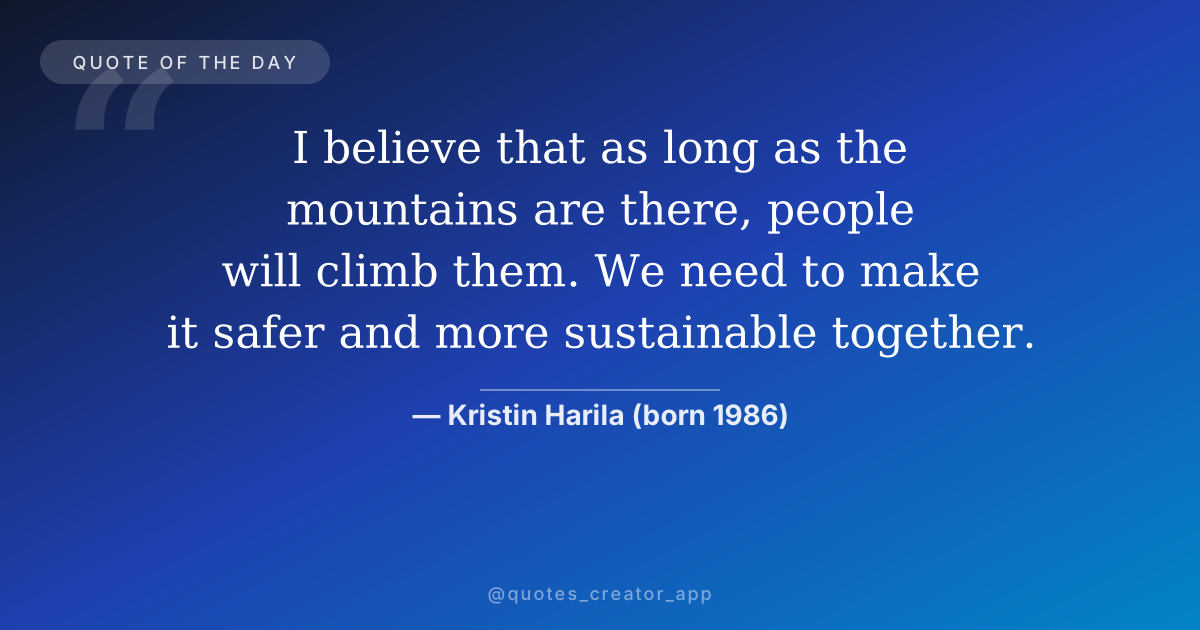
“I believe that as long as the mountains are there, people will climb them. We need to make it safer and more sustainable together.”
What this quote means
At first glance, this is a mountaineer stating the obvious: mountains are permanent, and humans are drawn to them. But Harila is not being literal. She is responding to a long, agonizing debate inside the climbing world — a debate about bodies left on the slopes, about crowded bottlenecks, about helicopters ferrying gear past Sherpas who once carried it by hand, and about a steady stream of accidents that prompt the same question every season: should people keep climbing at all?
Harila’s answer is both realistic and quietly radical. She accepts that no amount of warning, regulation, or tragedy will keep people off the great peaks. The pull is older than any rulebook. So instead of trying to stop the climb, she redirects all of her energy into the only variable she can actually change: how the climb happens. That is why she co-wrote a mountain safety guide based on the Norwegian Mountain Code, why she speaks openly about the hardest moment of her career — the night on K2 in 2023 when her team found a porter hanging in the bottleneck and could not save him — and why she founded the Lama Sherpa Foundation after her climbing partner Tenjen Lama Sherpa died in an avalanche. The quote is a mission statement in a single breath: accept what you cannot change, then work relentlessly on what you can.
This is the deeper meaning hiding inside the sentence. Harila is not romanticizing the mountains; she is de-romanticizing them. The word “sustainable” is the key. She is talking about an industry that depends on the labor, courage, and lives of Himalayan workers who historically received too little of the reward and carried too much of the risk. Making climbing sustainable means paying Sherpas fairly, insuring them properly, funding education for their families, and building safety systems that protect everyone on the mountain — not just the clients at the top. For her, the summit is only worth reaching if the people who make the climb possible are respected along the way.
The quote translates directly into everyday life. Most of us face situations we cannot eliminate — a demanding industry, a difficult family dynamic, an unfair system — and we burn energy wishing they would disappear. Harila offers a different playbook: stop fighting the thing that will not move, and start improving how you move through it. When you accept the challenge as permanent, you free yourself to make it safer, fairer, and more sustainable. That is how a person who started climbing at age 33 ended up breaking a world record at 37: not by dreaming the mountains away, but by learning to climb them better.
About Kristin Harila
Kristin Harila was born on March 28, 1986, in the flat coastal village of Vadsø, in the far north of Norway, and grew up as a Northern Sámi woman surrounded by the country’s rugged, snowbound outdoors. She was a competitive cross-country skier before she was ever a climber, racing for her home club IL Polarstjernen. Climbing arrived late. She reached the summit of Kilimanjaro in 2015, but her real story began in 2019, when she left a management job to chase a goal most people told her was impossible: to climb all 14 mountains on Earth taller than 8,000 meters — faster than anyone ever had.
What followed was a staggering run of achievements. In 2021 she became the fastest woman to summit Everest and Lhotse in a single day, a record she would break twice more, eventually cutting the time to about 8 hours. In 2022 she set the record for climbing the world’s five highest mountains in 69 days before COVID restrictions halted her first attempt at all 14. The next spring she returned with her climbing partner Tenjen Lama Sherpa, and on July 27, 2023, they stood on the summit of K2 — the 14th and final peak — having completed the entire circuit in just 92 days, shattering Nirmal Purja’s previous record of six months. She was named European Adventurer of the Year in 2022.
Her career has been marked by both glory and tragedy, and she has carried both with unusual honesty. On that record-breaking K2 ascent, her team discovered a porter, Muhammad Hassan, hanging upside down in the bottleneck in the dark; they spent hours trying to save him but the conditions were too severe. Weeks after the record, Tenjen Lama Sherpa was killed in an avalanche on Shishapangma. Harila channeled her grief into the Lama Sherpa Foundation, which works for safety, fair pay, and sustainable conditions for Himalayan porters and guides, and she funds the education of Tenjen’s two sons. In May 2026 she added another first — becoming the first woman to complete the Everest Triple Crown, summiting Nuptse, Lhotse, and Everest in a single season, with Everest and Nuptse climbed without supplemental oxygen.
Harila’s Wikipedia page spiked to roughly 24,000 views on July 31, 2026 — a jump of nearly 100 times her typical daily traffic — as readers revisited her story in the wake of the deadly 2026 Broad Peak disaster. The coincidence is poignant: the mountaineer who has spent years calling for safer, fairer climbing became one of the most-read figures on the internet at the exact moment the world was reminded of how dangerous the mountains remain. Her quote is not a warning to stay home. It is an invitation to go — and to make sure everyone who goes, comes back.
Create your own quote graphic with this quote
This is the kind of quote that resonates most when it is presented visually. A clean typographic layout, a fitting color palette, and readable font sizing can transform these words into a graphic that people save and share. If you want to turn this quote into an Instagram post, WhatsApp status, Pinterest pin, or reel cover, Quotes Creator gives you all the tools to do it in minutes — custom fonts, gradients, backgrounds, and export sizes ready for every major platform.
Editor’s note
Kristin Harila was one of the most searched people on the internet this week — her Wikipedia page drew about 24,000 views on July 31, 2026, up from a few hundred a day, after the Broad Peak disaster put Himalayan mountaineering back in the headlines. It is a somber reason to trend, but it makes her message more urgent than ever. Harila has spent the years since her record-breaking 92-day climb arguing that the mountains will never stop calling people upward — so the only responsible move is to make the climb safer, fairer, and sustainable for the workers who power it. Before you share this quote, ask yourself the question at its core: what challenge in your own life is never going away, and how can you move through it better instead of wishing it gone?
— ThinkPeak Studio Editorial Team
Tips for designing this quote
- ✓ Use deep blues and icy tones to echo the high-altitude world where Harila made history
- ✓ Keep the text centered and italic in a serif font for a timeless, cinematic feel
- ✓ Let the words breathe with generous spacing between lines so they land with weight
- ✓ Add a subtle gradient background rather than a flat color for depth and dimension
- ✓ Export in square format for Instagram feed and portrait for Stories or Pinterest
Create your own quote graphic with this quote
Turn this line into a shareable graphic in seconds — free, no signup needed. For video quotes and 100+ templates, try the Android app.
Advertisement
Enjoyed this article? Get more like it in your inbox.