Quote of the Day: Lady Gaga on the One Person Who Believes in You
The 14-time Grammy winner spent this week back in the headlines as reports spread that she and her fiancé, tech entrepreneur Michael Polansky, had welcomed their first child — news that sent her Wikipedia page from its usual few thousand views a day to more than 235,000 in a single day. Among the lines her visitors keep landing on is the most quoted sentence of her career, first spoken to her years before she was famous and repeated by her so often it became a creed: there can be a hundred people in a room, and ninety-nine of them don’t believe in you, but all it takes is one who does.
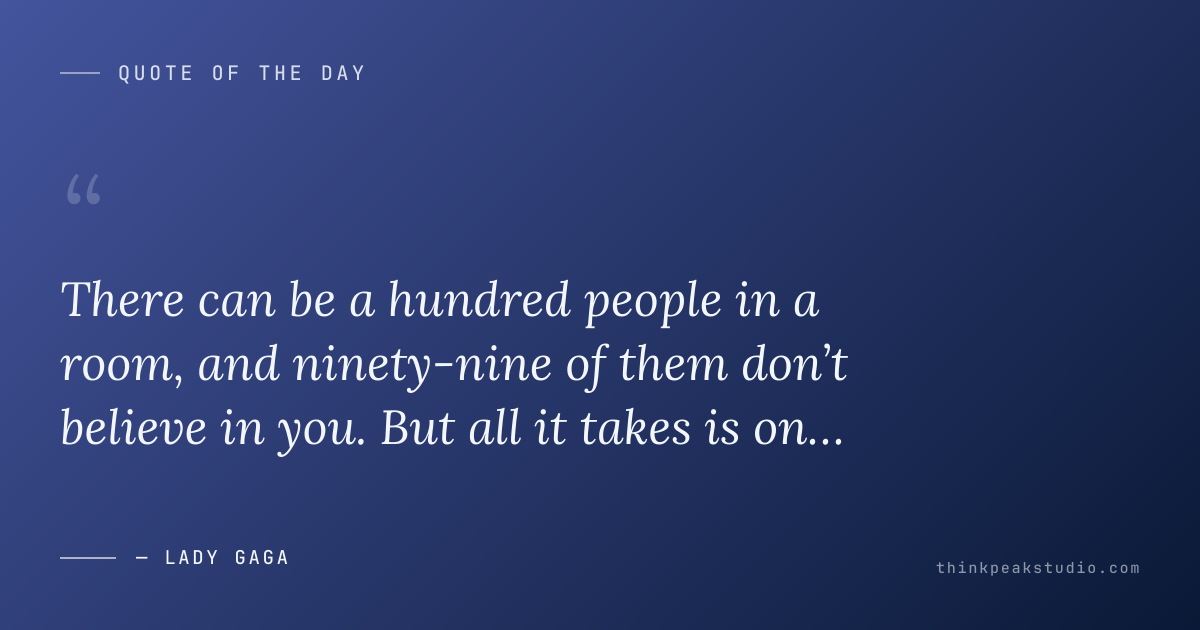
“There can be a hundred people in a room, and ninety-nine of them don’t believe in you. But all it takes is one person, and it just changes your whole life.”
What this quote means
Lady Gaga first heard these words when she was nobody. In the early 2000s, still billed as Stefani Germanotta, she was carrying demos she had recorded on a four-track Tascam cassette player from office to office in New York, taking meetings with entertainment attorneys and knocking on doors, trying to get anyone to listen. It was her vocal coach, Don Lawrence, who stopped her one day with a sentence that sounded almost like a shrug: “There can be a hundred people in the room, and ninety-nine of them won’t believe in you, but all you need is one.” She was 20 years old, playing to half-empty rooms in the Lower East Side, and she stored the line away the way a person stores a life raft.
A decade later, in the autumn of 2018, the line returned as the most repeated sentence of her awards season. She had just made A Star Is Born with Bradley Cooper, her first major film role, and she told the story of the quote everywhere — to Elle, to Vanity Fair, to every microphone on the press tour — but with a new second half. Now there were a hundred people in a room, and ninety-nine of them didn’t believe in her, “but I had this one incredible talent with me.” The one person had become Bradley Cooper, the director who cast a pop star when the industry told him to cast a movie star, and who believed in her until she believed in herself. The quote went viral precisely because of the arithmetic: it does not promise that the whole room will come around. It promises something better — that you do not need the whole room. One person is enough. And one person, multiplied across a career, is how a nobody becomes Lady Gaga.
The deeper claim hiding in the sentence is about where belief actually comes from. Read it quickly and it sounds like a plea for encouragement; read it again and it is almost ruthless self-reliance. Because the one person who believes in you is not always in the room. Sometimes it is the coach who says the thing you need to hear. Sometimes it is the partner who tells you to make the music that makes you happy. Sometimes it is a memory of someone who believed in you before you had any reason to be believed in — and that memory is enough to keep you knocking on doors, four-track tape in hand, long after the ninety-nine have gone home. Gaga has spent her entire career being the one person for other people, too — the voice on the radio telling a teenager who feels like a misfit that they were born this way. The quote is not really about the famous needing believers. It is about the fact that belief is contagious, and that almost everyone who has ever achieved anything can point to exactly one person who made the difference.
And it is why the quote escapes the world of pop stardom that produced it. Read it as a comment on life and it becomes almost suspiciously wise: most rooms you enter in a lifetime will contain people who do not believe in you — that is simply the arithmetic of the world — and your job is never to convert all of them. Your job is to find the one, or to be the one for someone else. A parent is that one for a child. A teacher is that one for a student. A friend is that one on the night it matters. This week, as reports spread that Gaga and Polansky had welcomed their first child, the quote acquired one more reading: the person who believes in you can also be the tiny new human who doesn’t yet know what a room is, but who has already changed your whole life. She spent years telling the world the line Don Lawrence gave her. Now she gets to be the one who says it to someone else — and it just changes everything.
About Lady Gaga
Stefani Joanne Angelina Germanotta was born on March 28, 1986, at Lenox Hill Hospital in Manhattan, to Cynthia Bissett, a philanthropist and business executive, and Joseph Germanotta, an internet entrepreneur, both of Italian descent, and was raised with her younger sister Natali on the Upper West Side of New York. She began playing piano at four, taught herself to compose, and wrote her first piano ballad at 13. She attended the Convent of the Sacred Heart, an all-girls Catholic school, where she was bullied for being, by her own account, “too provocative or too eccentric.” At 17 she won early admission to NYU’s Tisch School of the Arts, where she studied music and wrote essays on art, religion and society; at 19 she dropped out and moved out of her parents’ home to chase a career that would not yet take her.
She built her name the hard way: in the downtown clubs of New York, where she played Mercury Lounge and The Bitter End, and in a burlesque revue with the performance artist Lady Starlight called the Ultimate Pop Burlesque Rockshow. The name “Lady Gaga” came from producer Rob Fusari, who was struck by how closely she resembled Queen’s “Radio Ga Ga.” She was signed to Def Jam at 19 and dropped three months later, then wrote songs for other artists — Britney Spears, Fergie, the Pussycat Dolls — before Interscope signed her under the Streamline imprint. In 2008 she released The Fame and became, in the span of two years, the defining pop star of her generation: Just Dance, Poker Face, Bad Romance, Telephone, Born This Way — a run of global number ones built on hooks, theatricality and a message, aimed squarely at the misfits, that being yourself was not a flaw but a superpower.
Her music kept multiplying: Born This Way (2011), Artpop (2013), two celebrated jazz albums with Tony Bennett, Joanne (2016), named for an aunt who died of lupus at 19, Chromatica (2020) and Mayhem (2025), the dance-pop record she has said Polansky talked her back into making. She won her first Oscar for “Shallow” from A Star Is Born (2018), in which she also earned a Best Actress nomination, and became the first woman to win an Academy Award, a BAFTA, a Golden Globe and a Grammy in the same year. She won a Golden Globe for American Horror Story: Hotel, starred in House of Gucci and Joker: Folie à Deux, and headlined the Super Bowl LI halftime show. Across her career she has won 14 Grammy Awards and sold more than 170 million records, and she remains, by most accounts, one of the best-selling and most influential musicians of the 21st century.
Her life outside the stage is inseparable from the quote. In 2011 she founded the Born This Way Foundation with her mother to support youth mental health and fight bullying; in 2017 she revealed that she lives with fibromyalgia; she has spoken openly about surviving rape at 19 and living with PTSD, and about the years when a college Facebook group called “Stefani Germanotta, you will never be famous” was the ninety-nine people in the room. She met Michael Polansky, a tech entrepreneur who co-founded and leads the Parker Institute for Cancer Immunotherapy, in early 2020; they quarantined together in the first weeks of the pandemic, and she has credited him with urging her back toward the joy of pop music. They became engaged during the 2024 Paris Olympics — she told French Prime Minister Gabriel Attal, apparently unable to contain it — and she called motherhood her “next starring role.” This week, as she and Polansky were photographed walking in Northern California with their newborn, her Wikipedia page — which usually draws a few thousand views a day — surged past 235,000 on September 12. It is a fitting moment to revisit her most famous line, because she has spent her whole life living it: first the ninety-nine who didn’t believe, then the one who did — and now, at last, a whole new room of people who never will stop believing in her.
Create your own quote graphic with this quote
A quote about the one person who believes in you deserves a graphic that makes room for it. A deep indigo-to-violet gradient, a centered italic serif, and a clean restrained layout can turn these words into a card people save and share — a reminder that you never needed the whole room, only the one. If you want to make a quote card from this — or any quote — Quotes Creator gives you the fonts, gradients, backgrounds, and export sizes to do it in minutes, ready for Instagram, Stories, Pinterest, and everywhere else.
Editor’s note
Lady Gaga was one of the most-read people on Wikipedia this week. Her page surged to 235,455 views on September 12, 2026 — roughly thirty times her usual daily traffic — after reports spread that she and her fiancé Michael Polansky had welcomed their first child, their first public sighting together in months. We are featuring this quote because it is the single sentence that explains a career that went from four-track demos and dropped record deals to the Oscars: there can be a hundred people in a room, and ninety-nine of them don’t believe in you, but all it takes is one who does. It is a lesson in self-reliance, a theory of how the people we love carry us, and — this week especially — a quiet philosophy of becoming a parent: your job is to be the one. Before your next audition, your next pitch, or your next ordinary Tuesday, ask the question her whole life keeps answering: who is the one who believes in me — and who in this room needs me to be theirs?
— ThinkPeak Studio Editorial Team
Tips for designing this quote
- ✓ Use a deep indigo-to-violet gradient to echo the Quote of the Day palette — a night sky for the ninety-nine, with one warm point of light
- ✓ Keep the text centered and italic in a serif font so the line reads like a quiet conviction rather than a headline
- ✓ Break the quote so that the turn — “all it takes is one person” — lands on its own line with full weight
- ✓ Add a subtle gradient background rather than a flat color to echo the depth of a career built one believer at a time
- ✓ Export in square format for Instagram feed and portrait for Stories or Pinterest
Create your own quote graphic with this quote
Turn this line into a shareable graphic in seconds — free, no signup needed. For video quotes and 100+ templates, try the Android app.
Advertisement
Enjoyed this article? Get more like it in your inbox.


