Quote of the Day: Leopold Aschenbrenner on Seeing the Future
The 24-year-old whose essay “Situational Awareness” became the most talked-about text in AI argues that the future doesn’t arrive everywhere at once — it is visible first to the people standing where the machines are actually being built.
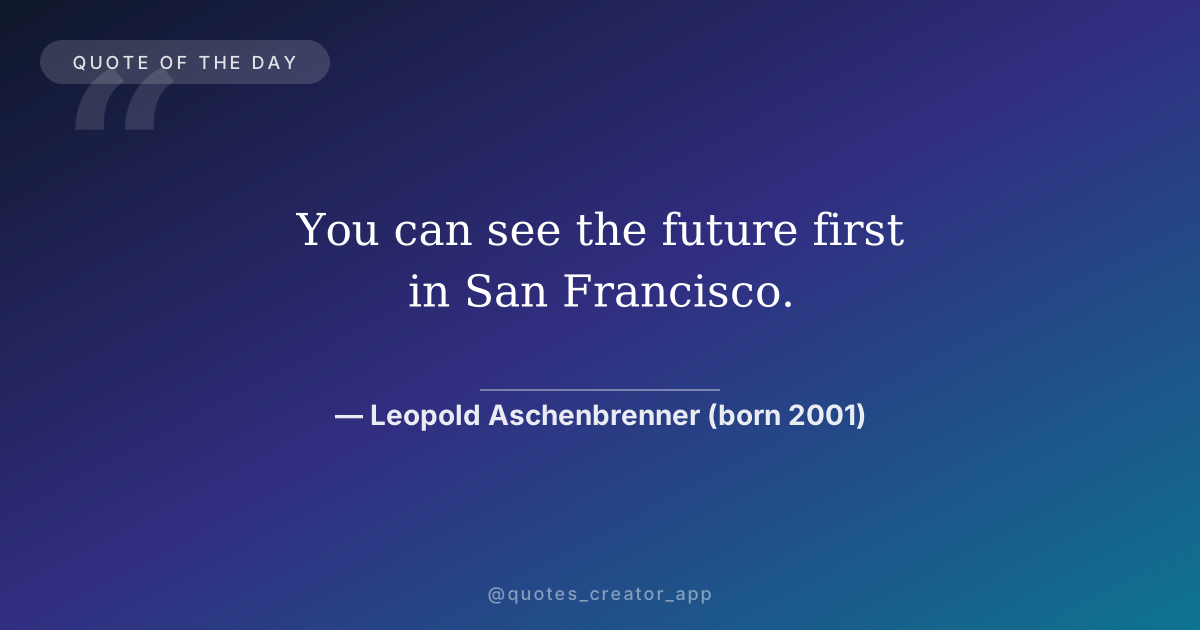
“You can see the future first in San Francisco.”
What this quote means
It is the opening sentence of a 165-page essay that changed how Silicon Valley talks about artificial intelligence, and it reads at first like travel copy: San Francisco, the city of fog and startups, is where the future shows up. But Aschenbrenner is not selling real estate. He is making a claim about how change actually happens. The future is not distributed evenly across time and space. It is built in specific rooms, by specific people, in specific cities — and it becomes visible to the rest of the world only later, when it arrives as a finished product. His point is that if you want to know what is coming, you go to where it is being made, not where it will be reported.
The sentence is doing a lot of quiet work. “You can see” — not “the future will happen.” The future is treated as something already here, waiting to be perceived, if you are in the right place and willing to look. Aschenbrenner wrote the essay after being fired from OpenAI, and the line is a defense of a particular kind of intelligence: not raw intellect, but situational awareness — the ability to read the trendlines, ignore the pundits stuck on “it’s just predicting the next word,” and see where a few hundred people in a handful of labs are steering the world. In that essay he predicts machines that think and reason by the end of the decade, and superintelligence beyond it. Whether those predictions prove right, the deeper lesson survives: most people are surprised by the future because they are not looking at the place where it is being constructed.
There is a second layer hiding in the geography. San Francisco is not incidental; it is the point. Aschenbrenner could have said “the future is coming” and been forgotten. Instead he anchored his claim to a specific place, and in doing so he made the argument testable and concrete. It is the same move great writers make when they trade abstractions for coordinates. The sentence compresses a theory of innovation into seven words: the future is a place before it is a time. Whoever is building it, where they are building it, and who is paying attention there — those are the three questions that tell you what happens next.
And the line translates cleanly into ordinary life, which is why it has spread far beyond the AI crowd. Every industry has its San Francisco: the city, the conference, the lab, the group chat, the division where the hard problems actually get worked on rather than talked about. The people who see change first are not the smartest people in the room, necessarily — they are the ones who put themselves in the room where the building happens. Aschenbrenner’s sentence is a quiet challenge to ask yourself where your industry’s future is being made, and whether you are standing anywhere near it. The future will not knock. You have to go to its address.
About Leopold Aschenbrenner
Leopold Aschenbrenner was born in Germany around 2001 to parents who were both doctors, and grew up in Berlin, where he studied at the John F. Kennedy School. He was a precocious science talent early — winning state-level honors in Germany’s Jugend forscht competition as a teenager — before moving to New York to study at Columbia University. There he graduated in 2021 as valedictorian with a bachelor’s degree in economics and mathematics-statistics, having co-founded Columbia’s effective altruism chapter and contributed to research at the economics department, Oxford’s Future of Humanity Institute, and the Global Priorities Institute. He was 19 years old.
His career moved fast. In February 2022 he joined the FTX Future Fund, the philanthropic arm of Sam Bankman-Fried’s crypto empire, and resigned the day FTX filed for bankruptcy in November 2022. The next year he joined OpenAI’s “Superalignment” team, working under Ilya Sutskever and Jan Leike on the problem of controlling AI systems smarter than humans, and co-authored the research paper “Weak to Strong Generalization.” In 2023 he wrote a memo to OpenAI’s board warning that its security was inadequate against industrial espionage — a move he says created tensions with leadership. In April 2024, OpenAI fired him over an alleged information leak, which he disputes. Weeks after the Superalignment team was dissolved, he published the essay that made his name.
“Situational Awareness: The Decade Ahead,” released in June 2024, argued that AGI is strikingly plausible by 2027 and that superintelligence could follow rapidly, warning of a national-security race with China that he likened to a Manhattan Project. The essay went viral, drawing coverage from the mainstream press, scientific journals, and think tanks on both sides of the AI debate, and was read by figures across Silicon Valley and Washington. He turned its title into a hedge fund, Situational Awareness LP, backed by Patrick and John Collison, Daniel Gross, and Nat Friedman, which grew to roughly $45 billion in assets at its peak in July 2026 — a staggering rise for a fund founded by a 23-year-old.
Then came the summer collapse. In late July 2026, the fund lost about $35 billion in a matter of days as leverage amplified a sharp decline in AI infrastructure investments. It was forced to sell its entire public stock portfolio — bought by Kenneth Griffin’s Citadel — and Aschenbrenner began soliciting new capital while holding private investments. Days later he married Avital Balwit, his long-time partner and a fellow former FTX and AI-alignment researcher, in Carmel-by-the-Sea, California. His Wikipedia page, which had drawn a few hundred to a couple of thousand views a day, spiked to 112,574 views on July 31, 2026 — roughly seventy times its average — as the world caught up with the young man who had bet everything on the future he insists is already visible in San Francisco.
Create your own quote graphic with this quote
This is the kind of quote that resonates most when it is presented visually. A clean typographic layout, a fitting color palette, and readable font sizing can transform these words into a graphic that people save and share. If you want to turn this quote into an Instagram post, WhatsApp status, Pinterest pin, or reel cover, Quotes Creator gives you all the tools to do it in minutes — custom fonts, gradients, backgrounds, and export sizes ready for every major platform.
Editor’s note
Leopold Aschenbrenner was one of the most-read people on the internet this week — his Wikipedia page drew 112,574 views on July 31, 2026, up roughly seventyfold from his typical traffic, after his $45 billion AI hedge fund lost $35 billion in a matter of days and was forced to unwind its public stock portfolio. It is a humbling coda to a meteoric story: the 24-year-old who predicted the future in a viral essay then bet his own fortune on it and watched most of it evaporate. But the opening line of that essay was never really about money. It was a warning to look up from the present — to find where the machines are being built and start paying attention. Before you share this quote, ask yourself the question at its core: where is the future of your field being made, and are you standing anywhere near it?
— ThinkPeak Studio Editorial Team
Tips for designing this quote
- ✓ Use deep midnight navy with electric cyan and indigo tones to echo the high-tech, future-facing world Aschenbrenner describes
- ✓ Keep the text centered and italic in a serif font for a timeless, cinematic feel
- ✓ Let the words breathe with generous spacing between lines so they land with weight
- ✓ Add a subtle gradient background rather than a flat color for depth and dimension
- ✓ Export in square format for Instagram feed and portrait for Stories or Pinterest
Create your own quote graphic with this quote
Turn this line into a shareable graphic in seconds — free, no signup needed. For video quotes and 100+ templates, try the Android app.
Advertisement
Enjoyed this article? Get more like it in your inbox.