Quote of the Day: Margaret Hamilton on Being a Pioneer When There Is No Field to Learn From
She was the young MIT programmer who led the team that wrote the on-board flight software for the Apollo missions — the work that gave the language the term “software engineering,” and the work that put a priority alarm in front of Neil Armstrong and Buzz Aldrin minutes before they landed. She died on 30 September 2026, aged 90. The sentence worth keeping is not about the Moon. It is about what it feels like to have to invent a field while you are standing inside it.
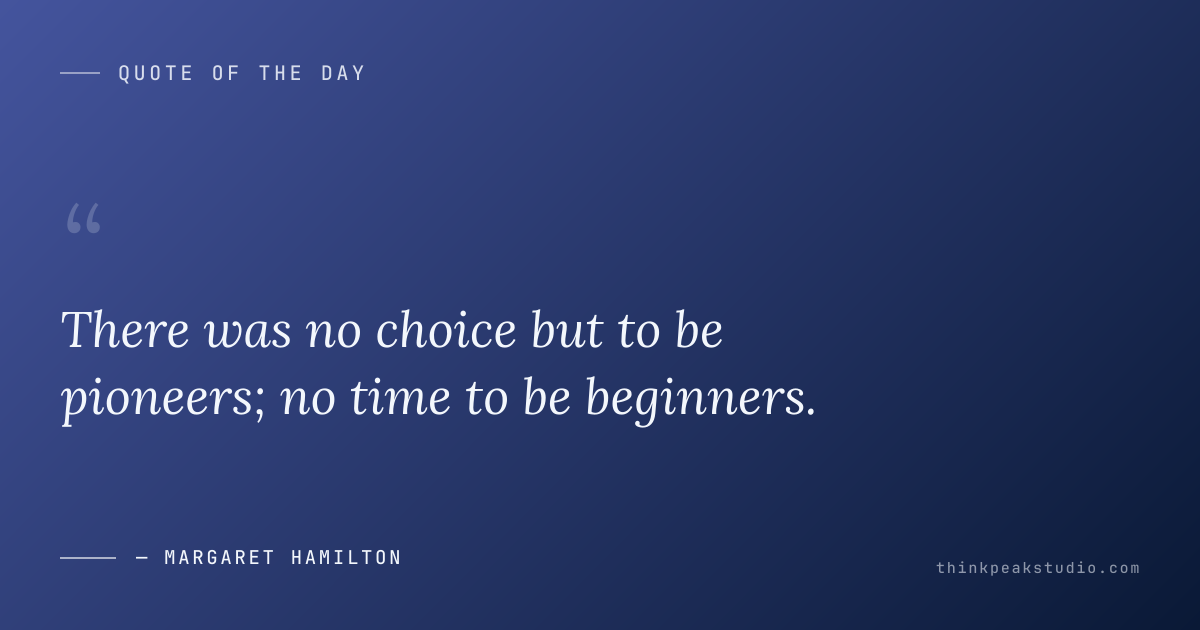
“There was no choice but to be pioneers; no time to be beginners.”
What this quote means
The sentence is usually read as nostalgia, and that is the wrong way to read it. The words just before it — “Looking back, we were the luckiest people in the world” — are not a claim that the work was easy, or that the team understood at the time what it was building. They are a claim about timing. They happened to be standing where something new was being made. The two clauses that follow carry the real argument. There was no choice but to be pioneers. That removes the option of saying no. No time to be beginners. That removes the option of practising. Together they describe a specific and uncomfortable condition: being required to do something that has never been done, with no field to learn it from and no second attempt.
The distinction between a pioneer and a beginner is sharper than it first looks. A beginner is allowed to be slow. A beginner is supposed to make mistakes, to read the manual, to be handed a smaller version of the task and told to try again next week. Pioneer strips all of that away. When Hamilton joined the Apollo software effort, there were no software-engineering courses, because there was no such discipline; there were no textbooks to consult, because the theory had not been written yet. She described the situation plainly: there was no school to attend or field to learn, and when no answers could be found, “at times we just had to make it up, and we had to design things to work the first time.” The stakes are what turned a gap in the curriculum into a fact of life. Her code ran on a spacecraft carrying three people to a place no one had ever been. You do not get to run the drill again.
There is also something the quote quietly refuses: the myth of the natural expert. Hamilton held a mathematics degree with a minor in philosophy from Earlham College, and nothing remotely like a qualification in the work she would spend her career defining. She learned on the job — at MIT, first writing weather-prediction software for the meteorologist Edward Lorenz, then air-defence software for the SAGE project, and only then the on-board flight software for the Apollo Guidance Computer. “No time to be beginners” is not a boast about a gift. It is a description of a team that had to become expert on the shortest possible notice, because the calendar would not let them stay at the starting line. Notice, too, that she says we. The luck is shared; the pioneering is plural.
That is why the line keeps outliving its moment. The Apollo programme was an extreme case, but the condition it names is now ordinary. New fields arrive faster than the training for them. The thing you are asked to do was not on any syllabus, because the syllabus did not exist when you were at school. Most people treat that as a reason to feel like a fraud. Hamilton’s sentence treats it as a reason to feel fortunate — to have arrived early enough to help shape the thing instead of inheriting it finished. Being a beginner is a luxury that stable fields can afford. Where there is no field yet, there is no beginner’s lane. You are already a pioneer whether you feel ready or not. The only question left is what you build while you are there.
About Margaret Hamilton
Margaret Heafield was born on 17 August 1936 in Paoli, Indiana, and grew up partly in Michigan, where she graduated from Hancock High School in 1954. She studied mathematics at the University of Michigan and then at Earlham College in Indiana, earning a bachelor’s degree in mathematics with a minor in philosophy in 1958. She married James Cox Hamilton that summer and moved with him to Boston, where he was to study law and she intended to begin graduate work in abstract mathematics at Brandeis University. Instead, in the summer of 1959, she took a job at MIT, working for the meteorologist Edward N. Lorenz on software that could predict the weather — the work out of which Lorenz’s ideas about chaos theory would grow. There was no computer-science degree to take. Like everyone around her, she learned by doing it.
From 1961 to 1963 she worked at MIT’s Lincoln Laboratory on SAGE, the United States’ first computerised air-defence system, writing and testing software for the prototype AN/FSQ-7 computer. It was there that she began to see software reliability as a problem in its own right: when a program crashed, lights flashed, bells rang, and everyone came running to find out whose code was misbehaving. She joined the Instrumentation Laboratory in 1965, after the lab had won the NASA contract to build the on-board flight software for Apollo, and was the first woman hired to the project’s programming team. Her earliest assignments were the least glamorous ones. She wrote the lunar landmark tables for an uncrewed mission, and discovered after launch that they had been entered in reverse. She was handed the contingency program that would run only if a mission had to be aborted — a program everyone was so certain would never be needed that she named it “Forget It.” When the unlikely scenario actually happened, she became the person who understood it.
One evening she brought her young daughter, Lauren, to the lab. Lauren liked to play astronaut in the simulators, and one night, pressing buttons at random, she triggered the pre-launch sequence known as P01 in the middle of a simulated flight and crashed the system. Hamilton worked out what had happened and asked to add a safeguard; NASA declined — there would be more code to debug, and the astronauts were trained never to make that mistake — so she settled for a written note in the operating procedures: do not select P01 during flight. In December 1968, during Apollo 8, the astronaut Jim Lovell did exactly that, and the computer’s navigation data was wiped. Hamilton’s team was called in and worked out how to reload it. The episode is one of the clearest illustrations of how she thought: an error was not an embarrassment to be buried but information about how a system could fail, and it belonged in the design.
She rose to lead the new Software Engineering Division at the Instrumentation Laboratory, responsible for the team that wrote and tested all of the on-board flight software for the Apollo Command and Lunar Modules and, later, the Skylab space station. She is credited with coining the term “software engineering,” a phrase she began using to insist that building software should be treated as seriously as building hardware. When she first used it, she said, it was considered quite amusing — a running joke for years — and the discipline eventually caught up with the word. Her team also built the error-detection and recovery routines and the “priority displays”: programs that could interrupt the astronauts’ normal screens with a critical alarm. On 20 July 1969, minutes before the lunar module Eagle reached the surface, the guidance computer was overloaded and began flashing 1201 and 1202 program alarms. Hamilton’s priority displays carried the warnings to the crew; in Mission Control the NASA engineer Jack Garman recognised the codes and told the room to keep going, and the landing continued. Hamilton was not in Mission Control — she and her colleagues followed the descent from the Instrumentation Laboratory — but she had prepared for exactly that moment years before. No on-board flight software errors were ever known to have occurred during any crewed Apollo mission. The 1969 photograph of her standing beside a stack of printed code as tall as she is has become the image people know her by; the caption her laboratory wrote to accompany it described her, simply, as standing beside listings of the software developed by the team she led.
She left MIT in the mid-1970s and founded two companies in Cambridge, Massachusetts: Higher Order Software in 1976 and Hamilton Technologies in 1986, built around a systems language called the Universal Systems Language. She published more than 130 papers, proceedings and reports. Her honours were considerable: the Augusta Ada Lovelace Award in 1986; a NASA Exceptional Space Act Award in 2003, which carried $37,200 — the largest award NASA had given to an individual; the Presidential Medal of Freedom, presented by Barack Obama on 22 November 2016; a Computer History Museum Fellow Award in 2017; and induction into the National Aviation Hall of Fame in 2022. In 2017 a “Women of NASA” Lego set turned her — and the 1969 photograph — into a minifigure, and in 2025 the Smithsonian’s National Air and Space Museum gave her its Michael Collins Trophy for lifetime achievement. Margaret Hamilton died at a hospital in Cambridge, Massachusetts, on 30 September 2026, aged 90. MIT announced her death on 7 October. As the news spread, her English Wikipedia page went from an average of roughly 600 views a day to 5,597 on 7 October and 162,739 on 8 October, according to the Wikimedia Pageviews API — a large, late measure of how many people had come to care about the woman who wrote the instructions the Moon landing ran on.
Create your own quote graphic with this quote
This is a line with two gears in it — the “no choice” and the “no time” — and the design should let the turn between them land. A deep, cool gradient, an italic serif, and a clean break at the semicolon do more here than any flourish; the sentence is about work, not triumph, so keep the type steady and the margins wide. If you want to turn this quote, or any line you keep returning to, into a design worth saving and sharing, Quotes Creator gives you the fonts, gradients, backgrounds and export sizes to do it in minutes, ready for Instagram, Stories, Pinterest and everywhere else.
Editor’s note
Margaret Hamilton was one of the most-read people on English Wikipedia this week, and the reason was her death. After MIT confirmed on 7 October 2026 that she had died on 30 September, aged 90, her page went from an average of about 600 views a day to 5,597 on 7 October and 162,739 on 8 October, according to the Wikimedia Pageviews API. We are featuring this quote because of what it says about the work rather than the glory. Hamilton was not a born expert; she had a maths degree and a minor in philosophy, and she learned software by writing software, first on weather prediction, then on air defence, then on the code that carried astronauts to the Moon. The line she left behind refuses two comfortable stories at once. It refuses the story that the Apollo engineers always knew what they were doing — they did not, because no one had done it. And it refuses the idea that being unready disqualifies you. “No time to be beginners” is not a warning. It is a description of anyone who has ever been early to a thing that did not exist yet, which today is most of us. The pioneers do not get to rehearse. They get to build. Whatever new field you are standing in this week without a map, Hamilton’s sentence suggests that the absence of a manual was never the point — being there when the map is being drawn is the luck.
— ThinkPeak Studio Editorial Team
Tips for designing this quote
- ✓ Break the line at the semicolon so “no choice but to be pioneers” and “no time to be beginners” can be read as a pair
- ✓ Use a deep, cool gradient — indigo, slate or midnight blue — and keep it restrained; the quote is about discipline, not celebration
- ✓ Set it in an italic serif and leave wide margins; two short declarative clauses need room to land
- ✓ Keep the attribution small and plain in the lower corner, with the year if you include it
- ✓ Export square for the Instagram feed and portrait for Stories or Pinterest, where quote cards travel furthest
Create your own quote graphic with this quote
Turn this line into a shareable graphic in seconds — free, no signup needed. For video quotes and 100+ templates, try the Android app.
Advertisement
Enjoyed this article? Get more like it in your inbox.


