Quote of the Day: Marilyn Monroe on Solitude and Creative Privacy
Born on this day in 1926, Marilyn Monroe left behind words far deeper than her public image suggested — a quiet wisdom about the private source of all great work.
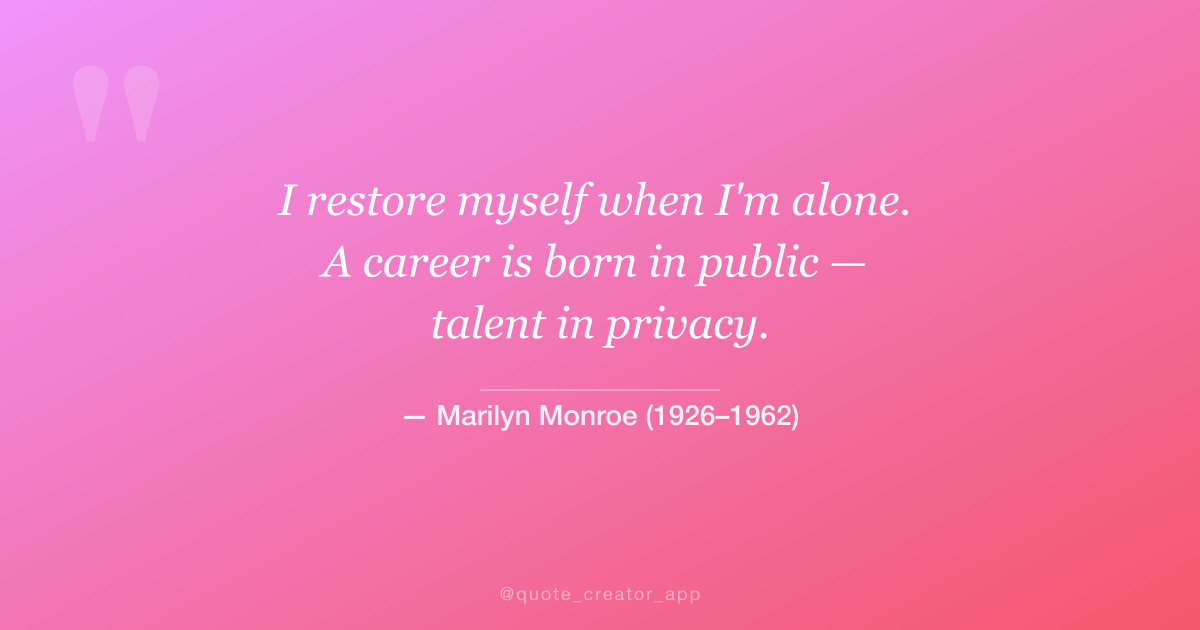
“I restore myself when I’m alone. A career is born in public — talent in privacy.”
Editor’s note
Born in 1926, Marilyn Monroe’s line — “I restore myself when I’m alone. A career is born in public” — is a reminder that solitude is not absence but a form of active restoration. Private time replenishes what public life consumes. If this resonates, step away from devices for 15 minutes tonight and note one small thought in a journal.
— ThinkPeak Studio Editorial Team
What this quote means
On its surface, Monroe is drawing a clean distinction between two separate spheres of a creative life. The public arena — performances, premieres, press junkets, the constant noise of fame — is where a career is displayed and measured. But talent, the raw material that makes any career possible in the first place, is nurtured somewhere quieter: alone, away from the crowd, in the privacy of one’s own interior world.
The deeper truth in this observation is that solitude is not absence — it is a form of active restoration. Monroe is not describing withdrawal or loneliness; she is describing a necessary rhythm. Public life consumes energy; private time replenishes it. The most enduring creative work tends to emerge not from the spotlight but from the quiet hours before and after it. This is a universal insight that applies as much to a writer at a desk or a developer at a keyboard as it did to one of Hollywood’s greatest stars.
Monroe made this remark against the backdrop of a career that had made her one of the most scrutinised human beings on earth. By the early 1960s she had virtually no private life in the conventional sense — her face appeared on magazine covers globally, her every movement was reported, and the character “Marilyn Monroe” had taken on a life entirely its own. That she could articulate, so precisely, the value of the private self amid all that noise is striking. It suggests she was far more introspective and self-aware than her public persona ever conveyed.
Today, in an age where social media has collapsed the boundary between the public and the private almost entirely, Monroe’s words carry renewed urgency. The pressure to perform constantly — to post, to be visible, to build a personal brand — can crowd out the very conditions in which genuine talent develops. Her reminder that restoration and growth happen in private is a quiet corrective to the cult of constant exposure.
About Marilyn Monroe
Marilyn Monroe was born Norma Jeane Mortenson on June 1, 1926, in Los Angeles, California. Her early life was defined by instability — she spent much of her childhood in foster homes and an orphanage after her mother was institutionalised. She began modelling in her late teens, and by 1946 had signed her first studio contract with Twentieth Century Fox, adopting the stage name by which the world would come to know her.
Over the following decade, Monroe became one of the most recognisable figures in the world. Films like Gentlemen Prefer Blondes (1953), The Seven Year Itch (1955), and Some Like It Hot (1959) established her as both a gifted comic actress and a genuine box-office phenomenon — her films had grossed $200 million by her death. Yet Monroe was never content to be merely what Hollywood wanted her to be. She studied at the Actors Studio in New York, founded her own production company, and fought — with mixed success — for more serious and complex roles.
She died on August 5, 1962, at the age of 36. The circumstances remain debated, but what is not debated is the scale of her influence. Monroe left behind not just an iconic image but a body of candid, searching observations about fame, identity, and the interior life that continue to resonate more than six decades later.
Create your own quote graphic with this quote
This is the kind of quote that resonates most when it is presented visually. A clean typographic layout, a fitting color palette, and readable font sizing can transform these words into a graphic that people save and share. If you want to turn this quote into an Instagram post, WhatsApp status, Pinterest pin, or reel cover, Quotes Creator gives you all the tools to do it in minutes — custom fonts, gradients, backgrounds, and export sizes ready for every major platform.
Tips for designing this quote
- ✓ Use a serif font (Georgia, Playfair Display) to honour the literary feel of the quote
- ✓ Keep the quote on one or two lines — shorter display text reads better on mobile
- ✓ Pair the quote with a soft gradient that matches the emotional tone: warm fuchsia-to-rose for creativity and inner life
- ✓ Add the author name in a smaller, lighter weight below the quote
- ✓ Export in square format for Instagram feed and portrait for Stories or Pinterest
Create your own quote graphic with this quote
Turn this line into a shareable graphic in seconds — free, no signup needed. For video quotes and 100+ templates, try the Android app.
Advertisement
Enjoyed this article? Get more like it in your inbox.