Quote of the Day: Moses Itauma on Taking the Outcome Into Your Own Hands
The most hyped young heavyweight in a generation grew up being told he was worth less than his neighbours. He answered by choosing the only sport in which a hundred percent effort can never be wasted by somebody else — and the line everyone is sharing this week is the one where he explains exactly why.
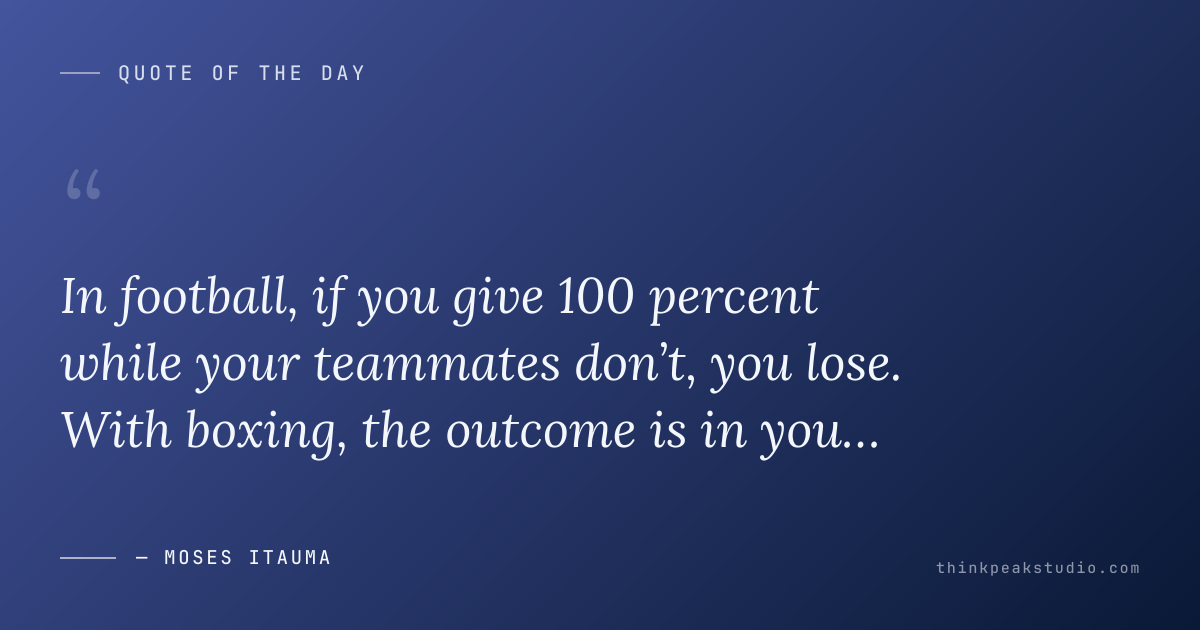
“In football, if you give 100 percent while your teammates don’t, you lose. With boxing, the outcome is in your hands.”
What this quote means
Read plainly, Itauma is drawing a line between two kinds of life and asking which one you want. In football — and he means it in the English sense, the team game he grew up kicking around in Chatham — you can do everything right and still lose, because eleven players share one result and the slowest, laziest, or unluckiest of them carries the whole team down with him. Your hundred percent can be cancelled by someone else’s fifty. In boxing, none of that applies: the two people in the ring decide the outcome between them, and whatever happens, there is no teammate to blame and no one else to thank. The outcome is in your hands. It is a sentence about accountability dressed up as a sentence about sport — and it is the closest thing to a mission statement the 21-year-old has ever given.
The depth of the line is in how quietly it rejects the comfort of shared blame. Most people, most of their lives, are drawn to exactly the arrangement Itauma says he walked away from: the group, the team, the collective where responsibility is diluted and a loss can always be handed to someone else. To prefer the opposite — to choose a discipline where your failure is entirely your own, with no cover and no excuse — is not merely a preference for individual sports. It is a refusal to outsource your life. Itauma is saying that he would rather be the only person who can decide how his story ends, even if that also means being the only person who can ruin it. That is the whole philosophy of his rise compressed into two sentences, and it explains the almost unsettling composure he has shown from the moment he turned professional at eighteen.
The line has extra weight because of where it comes from. Itauma was born in Kežmarok, Slovakia, to a Nigerian father and a Slovak mother, in a town where, in his own words, “me and my brothers got racially abused. It wasn’t a good place to be.” The family left and settled in Chatham, Kent, when he was three. A boy who grows up being told by his environment that he does not belong learns one of two lessons: that the world decides your value, or that you must decide it yourself. Itauma chose the second, and the sentence is the proof. Football asked him to trust teammates he did not yet have and to depend on circumstances he could not control. Boxing offered the opposite promise — that the only person he would ever need to make himself answerable to was himself. When he says the outcome is in his hands, he is not describing a sport. He is describing the entire logic of his life.
The quote translates far beyond the ring, which is why it has travelled so far so fast. In smaller form, the same principle applies to any craft, career, or cause where a person stops waiting to be carried and decides to carry themselves. The people who get furthest are rarely the most gifted; they are the ones who stop dividing responsibility and start owning the whole result — the entrepreneur who cannot blame the market, the artist who cannot blame the audience, the student who cannot blame the class. Itauma’s sentence is a quiet challenge to look at your own life and ask whether you are playing football or boxing: whether you are giving your hundred percent and hoping the people around you hold up their end, or whether you have built something in which the outcome, whatever it is, is finally yours. It does not promise that taking the result into your own hands makes it a good one. It only promises that it will be yours — and for a man who spent his childhood being told nothing was his, that was the whole point.
About Moses Itauma
Enriko Itauma — Moses to the world — was born on December 28, 2004, in Kežmarok, Slovakia, the younger brother of light-heavyweight boxer Karol Itauma. His father is Nigerian (from the Efik tribe), his mother Slovak, and his early childhood was spent in a town that made the family’s mixed heritage the daily subject of abuse. “I’ve got my strength from my Nigerian side and my mental toughness from my Slovak side,” he has said, and the mental toughness was forged early: the family emigrated to England partly to escape the racism and partly to find the opportunities Slovakia did not offer. He was three when they arrived in Chatham, Kent. He first tried boxing at nine because his brother Karol took him along to the gym, quit after a few hard sessions to play football with his other brother, Samuel, and then came back to St Mary’s ABC in Chatham when he decided football was boring. He was unbeaten as an amateur — 24 wins with 11 knockouts, with gold in the Schools, Juniors, Youth European, and Youth World Championships — and at sixteen he walked into a gym in his school uniform and sparred the then-world cruiserweight champion Lawrence Okolie so ferociously that eyewitnesses still talk about it.
He turned professional in January 2023 at eighteen, knocking out Marcel Bode in 23 seconds on his debut, and was immediately trailed as the boy who might break Mike Tyson’s record as the youngest heavyweight champion in history — an ambition he has admitted he realised, two months into his pro career, was “impossible.” The rise since has been relentless. In May 2024 he stopped Ilja Mezencev to win the vacant WBO Intercontinental title on the Fury–Usyk bill in Riyadh; in July he demolished the 6’7” Mariusz Wach in two rounds at the O2; in December he flattened Demsey McKean inside a round; and in 2024 The Ring named him Prospect of the Year. In August 2025 he did the fight that made the whole world pay attention, walking through the veteran Dillian Whyte in 119 seconds in Riyadh — Whyte landed exactly two jabs — to win the vacant Commonwealth title and announce himself, at twenty, as the most dangerous young heavyweight on the planet.
In March 2026 he stopped the durable Jermaine Franklin in the fifth round in Manchester, then signed to fight Filip Hrgović for the vacant IBF heavyweight title at the O2 Arena in London on August 29, 2026 — a chance to become the second-youngest world heavyweight champion in history, behind only Tyson. His Wikipedia page, which had been drawing a couple of thousand views a day through most of August, climbed to 25,935 on August 28 as fight week peaked, and the bout itself became one of the most anticipated heavyweight title fights of the year. In the fight, the 21-year-old was stopped in the ninth round by the Croatian veteran, who took the title on the night. But the sentence that best explains Moses Itauma was written months before any of that — and it is not about winning. It is about choosing the arena in which the outcome is yours. He picked that arena as a child in a town that wanted him to feel powerless, and he has been proving the choice right ever since.
Create your own quote graphic with this quote
This is the kind of quote that resonates most when it is presented visually. A clean typographic layout, a fitting color palette, and readable font sizing can transform these words into a graphic that people save and share. If you want to turn this quote into an Instagram post, WhatsApp status, Pinterest pin, or reel cover, Quotes Creator gives you all the tools to do it in minutes — custom fonts, gradients, backgrounds, and export sizes ready for every major platform.
Editor’s note
Moses Itauma was one of the most-read people on the internet this week. His Wikipedia page rose from around two thousand views a day to 25,935 on August 28, 2026 — a jump of well over twelve times his typical traffic — as the world watched a 21-year-old from Chatham take a shot at the vacant IBF heavyweight title at the O2 Arena against Filip Hrgović, chasing the record of the youngest heavyweight champion in history. The quote we are featuring is the one that explains the whole project: a boy who grew up being racially abused in Slovakia and told he did not belong, who chose the one sport where no teammate can waste your effort and no circumstance can excuse your result. We chose it because it is the rarest kind of sporting quote — one that is not about the fight at all, but about taking responsibility for your own life, win or lose. The next time you find yourself blaming your team, your luck, or your environment, ask Itauma’s question first: is the outcome in your hands? And if it is, what are you going to do about it?
— ThinkPeak Studio Editorial Team
Tips for designing this quote
- ✓ Use deep navy and amber-gold tones to echo the floodlit drama of a heavyweight title fight at the O2
- ✓ Keep the text centered and italic in a serif font for a bold, self-assured feel
- ✓ Let the words sit as four short centered lines so the two-part argument lands clearly
- ✓ Add a subtle gradient background rather than a flat color for depth and dimension
- ✓ Export in square format for Instagram feed and portrait for Stories or Pinterest
Create your own quote graphic with this quote
Turn this line into a shareable graphic in seconds — free, no signup needed. For video quotes and 100+ templates, try the Android app.
Advertisement
Enjoyed this article? Get more like it in your inbox.


