Quote of the Day: Nana Patekar on the Question He Asked Himself Before the End
He was one of the most intense and unpredictable actors Indian cinema ever produced, a man who could fill a frame with stillness or with fury. On the evening of 4 October 2026 he stood before an audience in Dona Paula, Goa, at the inauguration of a theatre club, and spoke a sentence that now reads like a farewell — four days before a cardiac arrest killed him at 75.
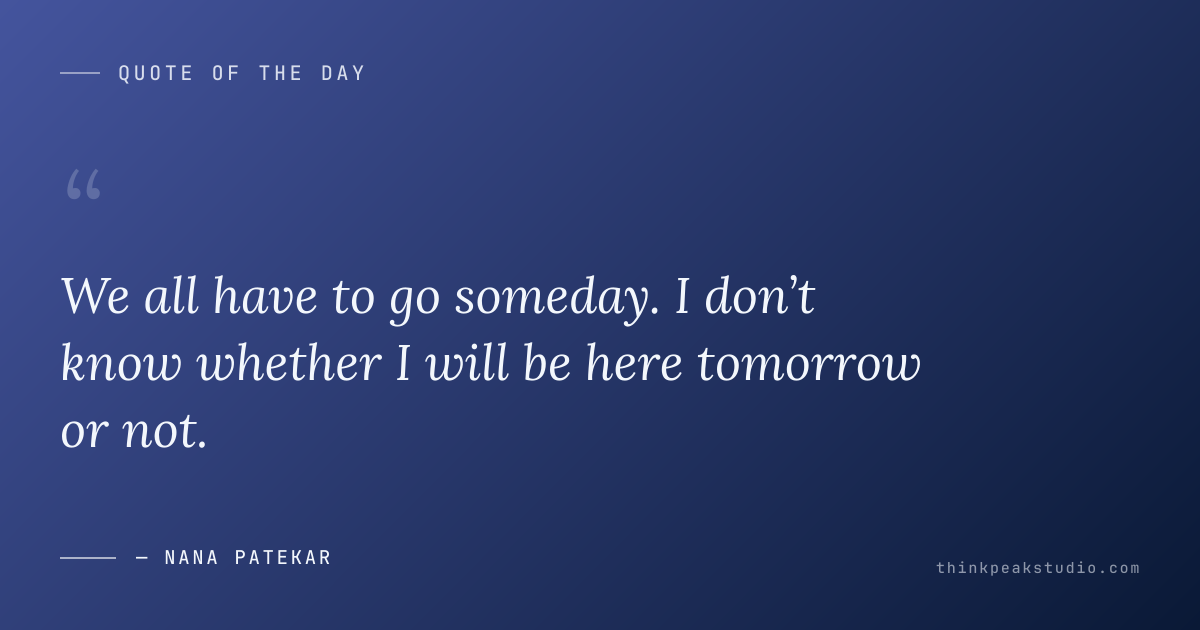
“We all have to go someday. I don’t know whether I will be here tomorrow or not.”
What this quote means
Read plainly, the sentence is not a lament. It is a statement of fact delivered without self-pity, in the direct way Patekar delivered most things — as though the truth were too obvious to dress up. Everyone dies. No one is promised tomorrow. He was 75, and he had lived long enough to have watched friends and contemporaries go before him. What is remarkable about the line is not its gloom but its calm. He is not asking for sympathy or looking for reassurance. He is clearing the table so that the harder question underneath it can be asked.
That question is the rest of what he said, and it is the reason the line keeps travelling. “Every person’s life will eventually reach that point,” he went on. “But before that happens, I have to ask myself: am I able to do what I want to do? Have I made the effort?” Then he widened it further: if his world were limited to his children, his wife and his home, he asked, what would his purpose be? “I have to give something back here, don’t I?” Death is only half the thought. The other half is obligation. The shortness of a life is not a reason to withdraw from the world; it is the reason to be useful in it while you still can. He did not say that dying gives life meaning. He said that knowing you will die should change what you do with the days you have.
There is also a distinction buried in the quote, and it is the difference between talking about mortality and living deliberately. Patekar had spent the second half of his life trying to make the two match. In 2015, after watching television footage of a farmer’s widow, he and the Marathi actor Makarand Anaspure began handing out cheques to families in Maharashtra who had lost someone to debt and drought, and then built the Naam Foundation to keep doing it. Looking back on the change, he said that despite all the awards, money and respect he had collected, he had felt “a vacuum” — and that the relief work, not the film career, was “the real Nana Patekar.” A quote about asking whether you have given something back is worth very little on its own. Spoken by a man who had already rearranged his life around the answer, it becomes an instruction.
The sentence has acquired an extra weight because of when it was said. Four days after he stood up in that Goa club, Patekar was dead. He was not predicting his own end; he had no way of knowing it was near. But the line has the shape of something a person says only after they have stopped pretending that time is infinite — and that is precisely the state most of us spend our lives avoiding. The quote does not ask you to be morbid. It asks you to notice that the deadline is real, and then to decide what you will do about it. That question was still on his lips when he died. It is now the one thing of his we can still answer for ourselves.
About Nana Patekar
He was born Vishwanath Patekar on 1 January 1951, in Murud-Janjira, a coastal town in Maharashtra’s Raigad district, into a middle-class family that slid towards poverty. He studied commercial art at Mumbai’s Sir J.J. Institute of Applied Art and, in his teens, painted film posters and hoardings for around thirty-five rupees a month while drifting towards the stage. His first professional play was directed by Vijaya Mehta. He made his Hindi film debut in the 1978 drama Gaman, then spent a decade in Marathi cinema and small character roles — including a chilling Nathuram Godse in the 1986 British television series Lord Mountbatten: The Last Viceroy — before the parts that made him famous arrived.
The breakthrough was Vidhu Vinod Chopra’s Parinda (1989), in which he played the gangster Anna; it won him his first National Film Award for Best Supporting Actor and his first Filmfare Award for Best Supporting Actor. He won the Filmfare Award for Best Villain for Angaar (1992), and then both the National Film Award for Best Actor and the Filmfare Award for Best Actor for Krantiveer (1994). A second National Film Award for Best Supporting Actor followed for Agni Sakshi (1996), and a second Filmfare Best Villain award for Apaharan (2005). In all he won three National Film Awards and four Filmfare Awards, a range across heroes, villains and character parts that few Indian actors have matched. He had also directed and starred in Prahaar: The Final Attack (1991).
Later audiences knew him for the encounter specialist of Ab Tak Chhappan (2004), for the affectionate gangster Uday Shetty in the comedy Welcome (2007) and its sequel, for the politician of Raajneeti (2010), and for the retired stage actor of the Marathi film Natsamrat (2016), a performance that won him the Filmfare Award for Best Actor – Marathi. He was awarded the Padma Shri in 2013. His connection to the Indian Army was not only on screen: he trained with the Maratha Light Infantry during the making of Prahaar, joined the Territorial Army, and in August 1999, with permission from then Defence Minister George Fernandes, spent around sixty days near the Line of Control during the Kargil War as part of a quick reaction team, returning some twenty kilograms lighter. He retired from the Territorial Army in 2013 as an honorary lieutenant colonel.
Patekar and Makarand Anaspure founded the Naam Foundation in September 2015 to help the families of farmers who had taken their own lives in drought-hit Maharashtra, distributing cheques of fifteen thousand rupees and later adopting villages and working on water conservation. He was given a state funeral in Pune. He is survived by his wife, Neelkanti, whom he married in 1978, and their son, Malhar. His record also carries an unresolved controversy: in 2018 the actor Tanushree Dutta renewed an allegation of sexual harassment against him relating to the 2008 film Horn ‘Ok’ Pleassss, which became a defining moment of India’s #MeToo movement. Patekar denied it, calling the allegation “a lie,” and a police case was registered. He was 75 when he died of a cardiac arrest at his home in Dona Paula, Goa, in the early hours of 8 October 2026, and was declared dead at about 5:20 a.m.
Create your own quote graphic with this quote
A line about the brevity of life should not shout. It works best in warm, quiet tones — a stone-and-amber gradient, an italic serif, a single unhurried break between the two sentences — so that the words feel spoken rather than posted. If you would like to turn this quote, or any line you keep returning to, into something you can save and share, Quotes Creator gives you the fonts, gradients, backgrounds and export sizes to do it in minutes, ready for Instagram, Stories, Pinterest and everywhere else.
Editor’s note
Nana Patekar was one of the most-read people on English Wikipedia this week, and the reason was his death. In the week before he died his article was drawing roughly 1,000 to 1,300 views a day; by the morning of 8 October 2026 the news of his cardiac arrest was leading bulletins across India. We are featuring this quote because of what it asks rather than what it mourns. Four days before he died, at a small theatre-club ceremony in Goa, Patekar told the room that everyone has to go someday, that he did not know whether he would be there tomorrow, and that before that day came he had to ask himself whether he was doing what he wanted to do and whether he had given something back. It is a rare thing to hear from a man whose public life had been defined by intensity and anger. It is also, in the plainest sense, a to-do list: notice the deadline, then answer the question. Whatever you are putting off — the phone call, the work, the apology, the thing you say you will get to someday — his line suggests that someday is a fiction we tell ourselves to avoid today. He did not get to finish the thought. We still can.
— ThinkPeak Studio Editorial Team
Tips for designing this quote
- ✓ Use a warm, muted gradient — stone, sand or amber — rather than a bright or celebratory one; the quote is reflective, not triumphant
- ✓ Break between the two sentences so “We all have to go someday” stands alone and the second line answers it
- ✓ Set the words in an italic serif and leave generous margins; short, serious sentences need space to breathe
- ✓ Keep the attribution small and plain in the lower corner, with the date and place if you include them
- ✓ Export square for the Instagram feed and portrait for Stories or Pinterest, where quote cards travel furthest
Create your own quote graphic with this quote
Turn this line into a shareable graphic in seconds — free, no signup needed. For video quotes and 100+ templates, try the Android app.
Advertisement
Enjoyed this article? Get more like it in your inbox.


