Quote of the Day: Nathan Fielder on the Depth Hidden in Everyone
Nathan Fielder is having a moment. On Sunday night his secret A24 documentary You Can See Everything — a three-year chronicle of Elizabeth Holmes in the weeks before she reported to federal prison — was revealed as Telluride’s surprise screening, and by Monday his Wikipedia page had surged from its usual thousand or so daily views to more than 130,000. The line people keep finding is from a 2014 interview, made years before the documentary existed: his quiet belief that if you just talk to someone long enough, almost anyone — probably everyone — has something that’s shockingly interesting.
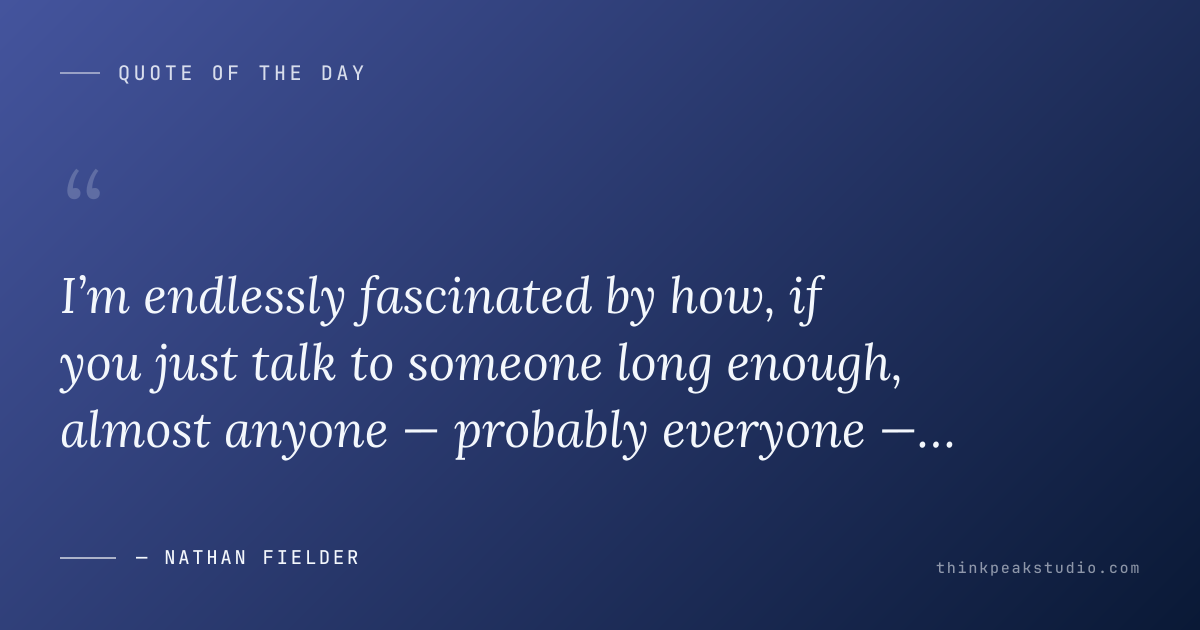
“I’m endlessly fascinated by how, if you just talk to someone long enough, almost anyone — probably everyone — has something that’s shockingly interesting. It’s just about trying to see if they’ll talk about it, or seeing whether or not it’ll come out.”
What this quote means
It is the quietest manifesto in comedy. Nathan Fielder delivers the line in his usual flat, clinical register, and it is easy to hear it as an aside — a stray observation from a strange man about why he spends so much time with ordinary people. Read closely, it is the thesis behind everything he has ever made. He has built a career not on telling people who they are, but on waiting, patiently and often excruciatingly, for them to show him. The sentence is his whole method, stated plainly: almost nobody is boring. We are just almost never patient enough to find out.
Notice the correction inside the sentence — almost anyone — probably everyone. Fielder catches himself mid-thought and widens the claim to its true size. He has said the fuller version out loud: “Everyone is really fascinating — every person on the earth, probably. There might be a few not so fascinating people.” The hedge is part of the charm, but the faith is real. Underneath the deadpan and the awkward pauses is a strikingly optimistic view of human beings: that every person contains something surprising, and that the fault is never in them but in our own impatience, our own comfort with the surface, our own willingness to leave the silence unfilled.
This is why he builds his shows the way he does. On Nathan for You he has said he likes “putting people in situations where how they respond says a lot about them” — not to embarrass them, but to get them to drop the pleasantries and reveal what is underneath. On The Rehearsal he rehearses the hardest conversations people will ever have, on the belief that practice actually changes what a person is capable of. And in You Can See Everything he spent three years inside a house with a woman the public had already decided it fully understood, watching for the person beneath the performance — the exact act this quote describes. When the film premiered he told the Telluride audience he was still struggling to understand what he had experienced. Even the man who built a career on watching admitted that one person could not be exhausted, that she was still, after three years, shockingly interesting.
The practical meaning is simpler and harder than it sounds. It asks you to treat attention as the beginning of understanding — to let the silence stay, to ask the question you almost didn’t ask, to refuse the easy verdict of “boring.” The next time you write someone off, the quote asks: what haven’t you asked yet? The most interesting thing you will find, Fielder suggests, is usually the thing you almost didn’t look at — and the person you already decided you understood is the one still waiting to be seen.
About Nathan Fielder
Nathan Joseph Fielder was born on May 12, 1983, in Vancouver, British Columbia, to parents who both worked as social workers. He attended Vancouver Talmud Torah and Point Grey Secondary School, where he was part of an improv comedy group that also included a teenage Seth Rogen. He studied business at the University of Victoria, graduating with a Bachelor of Commerce in 2005 — the business degree that would later inform the deadpan “consultant” of Nathan for You — and then moved to Toronto, where he enrolled in Humber College’s comedy program in 2006.
After winning the Tim Sims Encouragement Fund Award, he worked as a writer on Canadian Idol and landed a job as a field correspondent on CBC’s This Hour Has 22 Minutes, developing a recurring segment called “Nathan on Your Side.” In 2013 he expanded that premise into Nathan for You on Comedy Central, starring as a slightly more awkward version of himself offering elaborate business advice to struggling mom-and-pop shops. Over four seasons the show produced some of the most audacious pranks of the decade — including Dumb Starbucks, a parody coffee shop that briefly made global news in 2014 — and won Fielder a Writers Guild Award. In 2015 he founded Summit Ice Apparel, a nonprofit clothing brand raising awareness of the Holocaust whose proceeds support the Vancouver Holocaust Education Centre.
After signing an overall deal with HBO in 2019, he executive produced How To with John Wilson and created The Rehearsal (2022–present), in which ordinary people rehearse life’s most awkward moments, a show that won the Independent Spirit Award for Best New Non-Scripted or Documentary Series. Season two, centered on aviation safety, was so immersive that Fielder became an FAA-certified commercial pilot in February 2025 and now works part-time ferrying empty planes around the world. He and Benny Safdie created the scripted series The Curse (2023–2024), starring Emma Stone, and in 2023 Time named him one of the 100 most influential people in the world — with an entry written by Stone praising his ability to “move fluidly between directing, writing, acting, and producing.”
His latest project is You Can See Everything, the A24 documentary he co-directed with Lance Oppenheim. Shot in secret starting in 2023, the film follows Elizabeth Holmes and her family in the 34 days before she reported to federal prison, then continues across three years; it premiered as the surprise screening at the Telluride Film Festival on September 6, 2026, and arrives in theaters on October 16. The announcement sent his Wikipedia page from a typical baseline of roughly a thousand daily views to more than 130,000 on September 7 — a spike of well over a hundred times his usual traffic. Readers found a comedian who has spent more than a decade proving his own best line: that the people we think we already understand are, almost always, still full of surprises.
Create your own quote graphic with this quote
This is the kind of quote that works beautifully as a visual — a clean typographic layout, a quiet, clinical color palette, and generous whitespace can turn these words into a graphic people save and share as a reminder to slow down and actually look at one another. If you want to make a quote card from this — or any quote — Quotes Creator gives you the fonts, gradients, backgrounds, and export sizes to do it in minutes, ready for Instagram, Stories, Pinterest, and everywhere else.
Editor’s note
Nathan Fielder was one of the most-read people on the internet this week. His Wikipedia page surged to more than 130,000 views on September 7 — a spike of well over a hundred times his typical daily traffic — after You Can See Everything, his secret A24 documentary about Elizabeth Holmes, was revealed as the surprise screening at the Telluride Film Festival on September 6, with a theatrical release set for October 16. We are featuring this quote because it explains the entire arc of his career in one sentence: Fielder has built every show he has ever made on the belief that no one is boring if you stay in the room long enough. The line was said in 2014, long before the documentary existed, and it reads now like a mission statement he spent three years fulfilling — watching one person the public had already dismissed, and coming out saying he still hadn’t found the bottom of her. Before your next ordinary conversation, ask yourself the question his career keeps answering: how long have I actually looked at the person in front of me — and what have I been too impatient to ask?
— ThinkPeak Studio Editorial Team
Tips for designing this quote
- ✓ Use a cool slate-through-navy-to-cyan gradient to echo Fielder’s deadpan, clinical palette and the quiet, observant mood of his work
- ✓ Keep the text centered and italic in a serif font so it reads like a patient thought rather than a headline
- ✓ Break the quote so that the turn — “almost anyone — probably everyone” — lands on its own line with full weight
- ✓ Add a subtle gradient background rather than a flat color to suggest the low light of a long conversation
- ✓ Export in square format for Instagram feed and portrait for Stories or Pinterest
Create your own quote graphic with this quote
Turn this line into a shareable graphic in seconds — free, no signup needed. For video quotes and 100+ templates, try the Android app.
Advertisement
Enjoyed this article? Get more like it in your inbox.


