Quote of the Day: Navi Pillay on Why Speaking the Truth Should Not Take Courage
She grew up under apartheid as a bus driver’s daughter in Durban, was told no firm would hire her because white staff would not take instructions from “a coloured person,” and went on to become the first non-white woman on South Africa’s High Court, the judge who made rape a crime under international law at the Rwanda tribunal, and the United Nations’ top human rights official. On 9 October 2026 she won the Nobel Peace Prize. Told repeatedly that her latest report had taken courage, she asked the one question worth keeping.
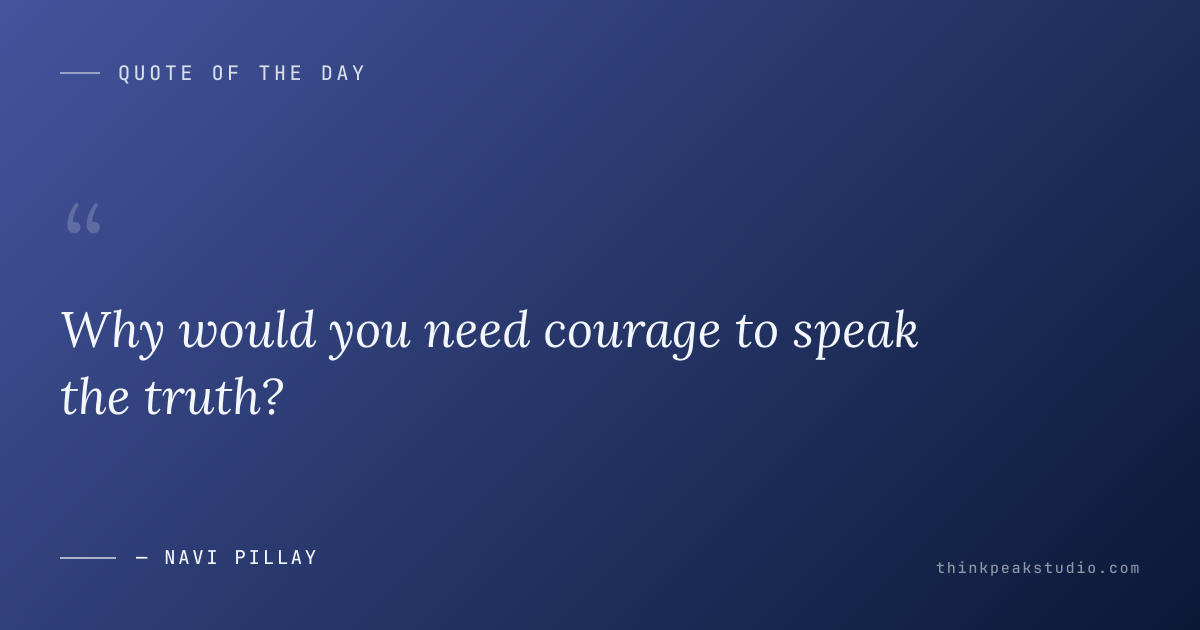
“Why would you need courage to speak the truth?”
What this quote means
The line arrived as an answer to a compliment, and that is what makes it land. Pillay was in Nuremberg — specifically in Courtroom 600, the room where the Nazi leadership had been tried after the Second World War — when the Norwegian Nobel Institute’s director pulled her aside and told her she had won the 2026 Nobel Peace Prize. The committee had not been able to reach her beforehand, so she heard the news as the world did. In her first interviews afterwards, she noted how often the reaction to her most recent work had been to praise her courage. The report she had chaired had called what is happening in Gaza a genocide. People kept thanking her for being brave. Her reply was not modest. It was a question: why would you need courage to speak the truth?
Read it slowly and it turns the compliment inside out. Courage is what we require when saying something will cost us — when the truth is dangerous, punished, or expensive. Pillay refuses the frame. A finding reached by weighing evidence and applying the law is not an act of bravery; it is an act of method. She spelled out the sequence in the same interview: “You interpret the law, you look at all the facts — so it’s an impartial decision-making.” If that is the job, then saying the result is simply doing the job. The scandal the sentence quietly names is not that she was brave. It is that reporting what the facts and the rules point to had come to be treated as something requiring nerve.
That is why the sentence travels far beyond a courtroom. Most of us are not judges, but almost everyone has been in a room that preferred comfort to accuracy — the meeting where a project is visibly late and no one says so, the family where a diagnosis is avoided, the conversation where the understood rule is that the obvious thing must not be spoken. We tend to describe the person who finally says it as courageous, and the praise is real. But the label does something subtle: it makes honesty sound exceptional, which quietly excuses everyone who stayed silent. Pillay’s question refuses that bargain. If the facts are clear, she suggests, saying them is not heroism. It is the minimum.
There is a hard edge under the line, and it is worth keeping. She is not pretending that truth-telling is costless. She spent twenty-eight years as a lawyer in a country where defending the wrong person could end your career, and she has spent decades since in courtrooms where states attack the judges who rule against them. She knows exactly what courage is, and what it costs; the Nobel committee praised her for having it. Her point is not that the world is safe for the truth. It is that it should not take exceptional bravery to state a fact — and that a world in which it does has a problem far larger than any one speaker. The line is not naive. It is a standard, held up against a reality that keeps failing to meet it.
About Navi Pillay
Navanethem Naidoo was born on 23 September 1941 in Clairwood, a working-class neighbourhood of Durban, into a family of Indian Tamil origin. Her grandparents had come from India in the 1890s as indentured labourers on the Natal sugar plantations; her father, Narrainsamy, drove a bus and fished to supplement the family income, and her mother, Santhama, raised eight children with an insistence on education that ran against the expectations of the time. Most of Pillay’s classmates were married off young; her parents sent their daughters to school alongside their sons, and when money was short her mother stitched notebooks from the blank pages of her older children’s used ones. Pillay’s first encounter with the law came at five, when she was robbed of her father’s monthly wages while carrying them to him; the thief was convicted, but the money was never returned, and the memory of a victim left worse off stayed with her. She graduated from the University of Natal with a BA in 1963 and an LLB in 1965, supported by donations from the local Indian community and a university scholarship.
She chose to practise as an attorney rather than an advocate, and after her articles under N. T. Naicker, a banned ANC member often under house arrest, she opened her own law firm in 1967. It made her the first non-white woman to run a practice in Natal province, and she has always been clear that circumstance, not ambition, drove the decision: no firm would hire her, she said, because they could not have white employees taking instructions from a coloured person. Over twenty-eight years she defended anti-apartheid activists from the ANC, the Unity Movement, the Black Consciousness Movement and Azapo, and worked to expose the torture of political detainees and the conditions of their imprisonment. When her husband, Gaby, was detained in 1971 under the Terrorism Act, she successfully sued to stop the police using unlawful methods of interrogation against him. In 1973 she won political prisoners on Robben Island, among them Nelson Mandela, the right to consult lawyers. The cases pushed her toward international law, and in the 1980s she studied at Harvard, earning an LLM in 1982 and, in 1988, a Doctor of Juridical Science — the first South African to receive one from Harvard Law School. Back home she co-founded the Advice Desk for the Abused, helped found the international women’s rights group Equality Now in 1992, and, as part of the Women’s National Coalition, pressed for the equality clause that would anchor South Africa’s post-apartheid Constitution.
In 1995, the year after the ANC came to power, President Mandela and Justice Minister Dullah Omar put her name forward, and she was confirmed to the High Court of South Africa — the first non-white woman to sit on it. Mandela telephoned to congratulate her personally, saying her appointment gave him “great personal joy.” That same year the UN General Assembly elected her to the International Criminal Tribunal for Rwanda. She served for eight years, and was elected the court’s president in 1999; for the first four years she was its only female judge. Her tenure is remembered above all for the trial of Jean-Paul Akayesu. On 2 September 1998 the tribunal convicted him of genocide and crimes against humanity, and in doing so established for the first time that rape and sexual violence could themselves constitute genocide — a precedent that reshaped international criminal law and was later taken up by the International Criminal Court. “From time immemorial, rape has been regarded as spoils of war,” Pillay said at the time. “Now it will be considered a war crime. We want to send out a strong signal that rape is no longer a trophy of war.”
She went on to serve as a judge on the International Criminal Court from 2003 to 2008, sitting in its Appeals Chamber, and in July 2008 the UN General Assembly confirmed her as High Commissioner for Human Rights, a post she held from 1 September 2008 until 2014. More recently she chaired the UN Independent International Commission of Inquiry on the Occupied Palestinian Territory from 2021 until 2025, and since 2019 has sat as an ad hoc judge at the International Court of Justice in the case in which The Gambia accuses Myanmar of genocide against the Rohingya. Her honours include the Gruber Prize for Women’s Rights in 2003, the Golden Plate Award of the American Academy of Achievement in 2009, a place as the 64th most powerful woman on Forbes’ 2009 list, the 2025 Sydney Peace Prize, and the 2026 Olof Palme Prize.
The Nobel came on 9 October 2026. Announcing the award in Oslo, the Norwegian Nobel Committee said it had gone to “a person who with exceptional courage and integrity has led the way towards a more comprehensive global legal order,” and praised her for being “instrumental in ensuring that war crimes, crimes against humanity and genocide are prosecuted.” Pillay, who was 85, became the fifth South African and the first South African woman to win the Peace Prize, following Albert Lutuli, Desmond Tutu, and Nelson Mandela and F. W. de Klerk. In her first interview afterwards she was told she had become a member of a group with only twenty women in it — the twenty-first. “It’s just so bad that there’s supposed to be equality between women and men and that I’m only the 21st recipient,” she said. She remains, at the time of writing, an active jurist and the president of the International Commission Against the Death Penalty; she is due to receive the prize in Oslo on 10 December 2026.
Create your own quote graphic with this quote
The sentence is a question, and that is the design brief: it should not read like a proclamation but like a raised eyebrow. A clean, cool gradient, an italic serif, and the whole line held on one or two lines will let the question do the work — resist adding anything that turns it into a slogan. If you want to turn this quote, or any line you keep returning to, into a design worth saving and sharing, Quotes Creator gives you the fonts, gradients, backgrounds and export sizes to do it in minutes, ready for Instagram, Stories, Pinterest and everywhere else.
Editor’s note
Navi Pillay was one of the most-read people on English Wikipedia this week, and the reason was the Nobel. According to the Wikimedia Pageviews API, her English biography drew between 38 and 63 views a day through the first eight days of October 2026 — an average of about 50. On 9 October, the day the Norwegian Nobel Committee named her the 2026 laureate, it drew 383,057. That single-day surge is the plainest measure of how many people went looking for the judge they had somehow never heard of, and it is why we are featuring her. Her life is, almost line for line, the answer to her own question: a woman who was refused work under apartheid, who defended the people the state had declared enemies, who at the Rwanda tribunal gave the world the legal sentence that rape is not a trophy of war, and who spent six years as the UN’s highest-ranking human rights official telling powerful states inconvenient things. When the world praised her courage, she asked why the truth should require it. The most useful way to honour that is to notice how often we treat plain honesty as heroism — and to stop. Courage is for the moments when telling the truth really might cost you everything. Most of the time, the facts and the rules are simply on the table, and all the situation is asking for is that someone say so.
— ThinkPeak Studio Editorial Team
Tips for designing this quote
- ✓ Keep the question mark — it is the whole point; the line is a question, not a declaration
- ✓ Hold the line on one or two lines and set it in an italic serif so it reads as speech, not signage
- ✓ Use a restrained indigo, slate or midnight gradient; the subject is law and restraint, not celebration
- ✓ Keep the attribution small and plain, with the date if you include it — Nuremberg, 9 October 2026
- ✓ Export square for the Instagram feed and portrait for Stories or Pinterest, where quote cards travel furthest
Create your own quote graphic with this quote
Turn this line into a shareable graphic in seconds — free, no signup needed. For video quotes and 100+ templates, try the Android app.
Advertisement
Enjoyed this article? Get more like it in your inbox.


