Quote of the Day: Nigella Lawson on Eating as a Celebration of Life
When Nigella Lawson made her debut as a judge on The Great British Bake Off on September 22, 2026, most of the commentary was about how she ate: slowly, deliberately, with her whole attention. It is not a quirk. It is the argument she has been making for twenty-five years, and it is stated most plainly in a single line from her book Cook, Eat, Repeat.
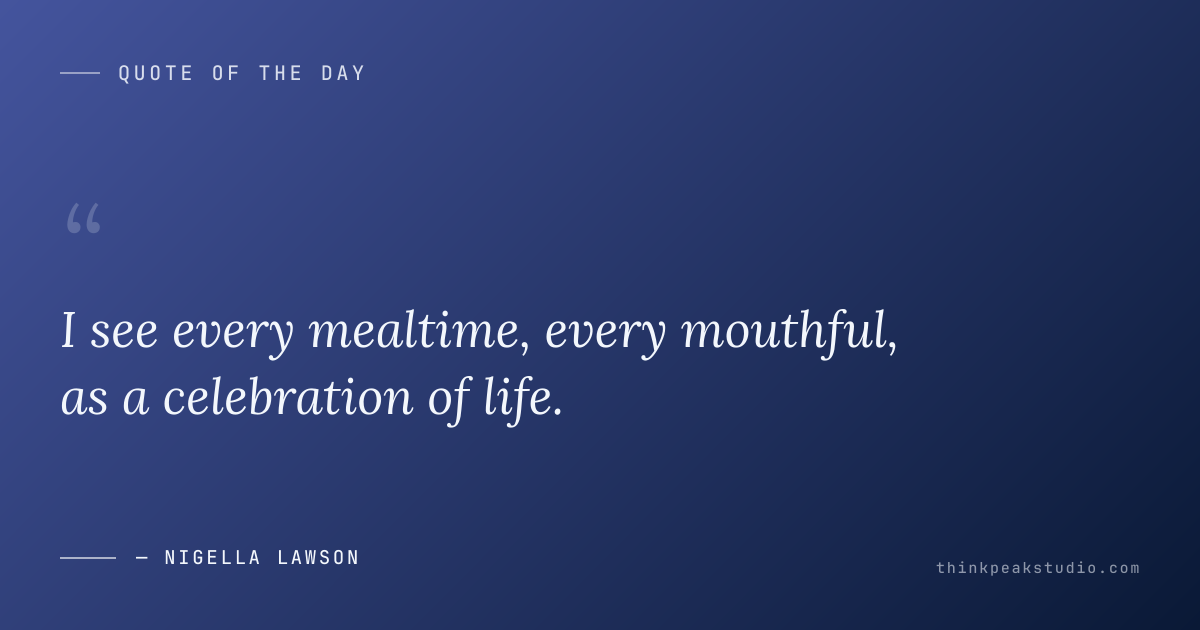
“I see every mealtime, every mouthful, as a celebration of life.”
What this quote means
Nigella Lawson is not talking about special occasions. That is the entire force of the sentence. She is not saying that a birthday dinner or a holiday table is a celebration of life, which everyone would agree with; she is saying that an ordinary Tuesday lunch, eaten standing at the counter or alone in front of a screen, is one too. Every mealtime. Every mouthful. The claim is deliberately extravagant, and she knows it, which is why she prefaces it in the book by admitting she “might seem soupy.” She then stands by it anyway.
Read closely, the line is about attention as much as appetite. Lawson has always insisted that eating well has little to do with what is on the plate and everything to do with how you meet it. In the same essay she writes that she lingers over each square of chocolate, “deciding which I will let melt slowly in my mouth, which I chomp on rapaciously, quickly, feeling how different the sensations are.” That is the practice behind the philosophy: pleasure is not something you consume as fast as possible but something you notice on purpose. A mouthful you do not taste cannot be a celebration of anything.
The line is also an argument, aimed at a specific phrase she wants abolished. Guilty pleasure, she says, is “that overused, viscerally irritating, and far-from-innocent term.” Her objection is not merely aesthetic. Calling food a guilty pleasure splits the eater in two — one self enjoying, another self standing in judgment — and poisons the experience before it begins. Her counter-claim is that the only thing worth feeling guilty about is “the failure to be grateful for that pleasure,” and that gratitude and guilt cannot occupy the same moment. To treat a meal as a celebration is to close that gap: to eat without apology, as one whole person.
There is a quiet seriousness underneath the sensuality. Lawson’s first husband, the journalist John Diamond, died of oral cancer in 2001, and she has said that watching someone lose the ability to eat changed how she understood food forever. When eating becomes impossible, it stops being ordinary. That is the emotional engine of a sentence that can otherwise sound like hedonism. A meal is a celebration of life because life is precisely what is on the table — and because no one who has watched it taken away treats a mouthful as a small thing.
About Nigella Lawson
Nigella Lucy Lawson was born on 6 January 1960 in Wandsworth, London, the daughter of Nigel Lawson (1932–2023), the Conservative politician who served as Chancellor of the Exchequer under Margaret Thatcher, and his first wife Vanessa Salmon (1936–1985), a socialite and heiress to the J. Lyons and Co. food empire. Food was part of her inheritance in more than one sense: her mother cooked, and the family business was catering on a national scale. She read medieval and modern languages at Lady Margaret Hall, Oxford, then went into journalism, interviewing and reviewing before becoming deputy literary editor of The Sunday Times in 1986 at the age of 26.
She came to food writing almost by accident. Her first book, How to Eat: The Pleasures and Principles of Good Food (1998), was written because she felt home cooking had been colonised by professional chefs and demeaned as a result; it sold 300,000 copies in the UK and made her name. Its successor, How to Be a Domestic Goddess: Baking and the Art of Comfort Cooking (2000), was the book that turned her into a phenomenon. At the British Book Awards in February 2001 she was named Author of the Year — beating J. K. Rowling, then at the height of the Harry Potter boom — a result reported at the time as the “domestic goddess” seeing off the boy wizard.
The television followed, and so did the persona that made her famous: Nigella Bites, Nigella Feasts, Nigella Express, Nigellissima, and Cook, Eat, Repeat (2020), the book and series that gave rise to both the quote above and the internet’s enduring fascination with her pronunciation of “microwave.” Across a dozen bestselling books her sales have passed 12 million copies worldwide. In 2026 she was elected a Fellow of the Royal Society of Literature, and since April of that year she has written a monthly column for the Financial Times Weekend Magazine’s food and drink section — a return, as she put it, to her “alma mater newspaper,” where she had written as a critic and op-ed columnist before food ever entered the picture.
Then came the tent. In January 2026 Dame Prue Leith announced she was stepping down as a judge on The Great British Bake Off after nine series, saying “now feels like the right time to step back.” Lawson was named as her replacement. The seventeenth series premiered on Channel 4 on 22 September 2026, with Paul Hollywood returning as the other judge and Alison Hammond and Noel Fielding as hosts, and twelve new amateur bakers. Viewers immediately noticed how Lawson tasted each bake — not a nibble but a full, unhurried bite, because, as she told Woman’s Weekly, “I like to be able to taste things properly. I’m an eater.” It is the same idea she has been writing down for a quarter of a century, performed on camera: eating is a skill, and attention is how you practise it.
Create your own quote graphic with this quote
A line about pleasure should look like it was made to be enjoyed. A warm, low-lit gradient, a generous serif for the words, and a small, confident attribution can carry the mood — somewhere between a good menu and a late-night kitchen. If you want to turn this quote — or any line you keep returning to — into something you can post, Quotes Creator gives you the fonts, gradients, backgrounds and export sizes to do it in minutes, ready for Instagram, Stories, Pinterest and everywhere else.
Editor’s note
Nigella Lawson is one of the most-read people on Wikipedia this week, and the reason is a television debut. Her page, which had been drawing roughly 4,000–5,000 views a day through mid-September, jumped to 47,744 on September 22, 2026 — the night series 17 of The Great British Bake Off began — then to 49,640 the next day, and peaked at 90,964 views on September 26 before settling above 50,000 on September 29. Much of that traffic was people looking her up after watching her eat on camera. We are featuring this quote because it is the sentence behind the mannerism. Lawson has spent her career arguing that food is not something to be ashamed of or to apologise for, and that the only real failure is to move through a meal without noticing it. In a culture that still organises much of its talk about food around guilt — around what we “shouldn’t” be eating, around treats that must be earned — her instruction is uncommonly freeing: treat the ordinary meal as the celebration it already is, taste it properly, and be grateful for it. That is not indulgence. It is attention, and it costs nothing.
— ThinkPeak Studio Editorial Team
Tips for designing this quote
- ✓ Use a warm, low-lit gradient — amber into deep brown reads like a kitchen at night, not a stage
- ✓ Set the words in a generous italic serif so the line feels spoken rather than sloganised
- ✓ Break after “mealtime” or after “mouthful” so the phrase pairs land as a rhythm, not a wall of text
- ✓ Keep the attribution small and unadorned; this is a sentence about everyday pleasure, not a monument
- ✓ Export square for the Instagram feed and portrait for Stories or Pinterest, where food quotes travel furthest
Create your own quote graphic with this quote
Turn this line into a shareable graphic in seconds — free, no signup needed. For video quotes and 100+ templates, try the Android app.
Advertisement
Enjoyed this article? Get more like it in your inbox.


