Quote of the Day: Patrice Lumumba on Dignity and Justice
Patrice Lumumba, the Congo’s first prime minister and one of Africa’s most iconic independence leaders, offers a profound reflection on the foundations of human freedom and the conditions that make it real.
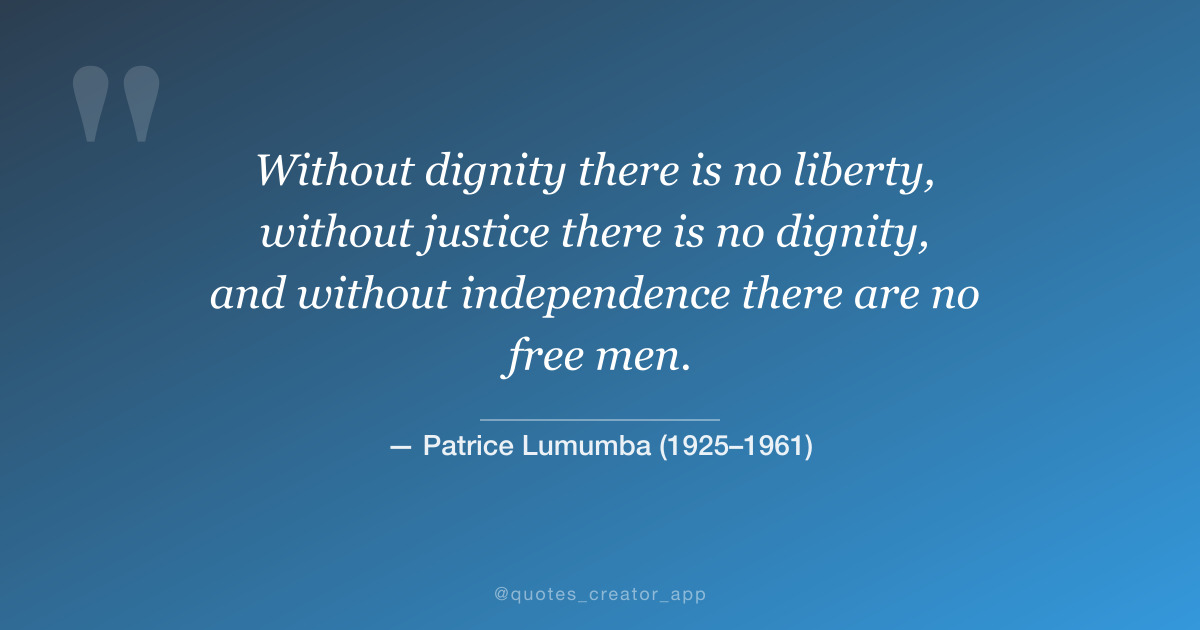
“Without dignity there is no liberty, without justice there is no dignity, and without independence there are no free men.”
What this quote means
On the surface, Lumumba lays out a clear chain of logic: without dignity, liberty cannot exist; without justice, dignity is hollow; and without independence, there are no truly free people. Each condition builds on the one before it, creating a philosophical framework for what it means to be fully human. He was not speaking in abstractions — these ideas were forged in the crucible of colonial rule, where all three were systematically denied to the Congolese people for generations.
The deeper insight is that freedom is not a single state but a layered reality built on prerequisites. You cannot enjoy liberty if you are stripped of your basic dignity — the respect and recognition every person deserves. And dignity itself is fragile without justice, without systems that treat people equally and hold power accountable. The final link — independence — is the foundation. Without the power to govern yourself and determine your own destiny, the other freedoms rest on borrowed ground. True human freedom, Lumumba argues, requires all three in precisely that order.
Lumumba wrote these words in his book Congo, My Country, which he composed during the final years of Belgian colonial rule. By the time the book reached English-speaking readers in 1962, Lumumba had been dead for over a year — assassinated at the age of 35 by a firing squad in the Katangan bush, with the involvement of foreign intelligence agencies. He was overthrown barely ten weeks after becoming the Congo’s first democratically elected prime minister. The letter from which this passage is drawn was written to his wife while he was imprisoned, and it reflects the perspective of a man who understood that independence was not just a political event, but the key that unlocked everything else.
This passage remains profoundly relevant today. Whether applied to democratic movements, workplace equality, or social justice, the same three pillars hold. Dignity, justice, and true freedom — they are not luxuries but necessities. When one crumbles, the others follow. Lumumba’s chain of logic reminds us that building a just society requires thinking not just about what people need, but about the order in which those needs must be addressed.
About Patrice Lumumba
Patrice Émery Lumumba was born on July 2, 1925, in Onalua in the Belgian Congo. He was educated at a Protestant missionary school and later worked as a clerk, a postal worker, and a journalist. Despite limited formal education, he was a voracious reader who immersed himself in the works of French and African thinkers. He entered politics through the African clerks’ association and went on to found the Mouvement National Congolais (MNC) in 1958, a party that sought independence for the Congo and unity among its diverse ethnic groups.
Lumumba was a charismatic speaker and a skilled organizer who rose with remarkable speed. In 1960, he led the Congo to independence and became its first prime minister at the age of 34. His tenure lasted barely ten weeks. His insistence on a truly sovereign Congo — free from Belgian economic control and Western military influence — put him at odds with powerful interests at home and abroad. He was deposed in a coup led by Joseph Mobutu, arrested, and assassinated in January 1961. The circumstances of his death, which implicated both Belgian and American intelligence agencies, became one of the defining scandals of the Cold War and transformed Lumumba into a global martyr for African liberation.
One of the lesser-known details of Lumumba’s life is that he began his political activism not as a radical but as a gradualist — he initially believed the Congo could achieve self-governance through negotiation with Belgium. His views hardened only after Belgian authorities responded to peaceful protests with violent repression. The most famous moment of his career was his independence day address on June 30, 1960, delivered in the presence of King Baudouin of Belgium. In a stunning departure from the scripted praise of Belgium, Lumumba spoke bluntly about the violence, humiliation, and exploitation of colonial rule, electrifying the Congolese people and forever cementing his place in history as a voice that refused to flinch.
Create your own quote graphic with this quote
This is the kind of quote that resonates most when it is presented visually. A clean typographic layout, a fitting color palette, and readable font sizing can transform these words into a graphic that people save and share. If you want to turn this quote into an Instagram post, WhatsApp status, Pinterest pin, or reel cover, Quotes Creator gives you all the tools to do it in minutes — custom fonts, gradients, backgrounds, and export sizes ready for every major platform.
Tips for designing this quote
- ✓ Use a serif font (Georgia, Playfair Display) to honour the literary feel of the quote
- ✓ Keep the quote on one or two lines — shorter display text reads better on mobile
- ✓ Pair the quote with a soft gradient that matches the emotional tone: deep blue tones for courage and conviction
- ✓ Add the author name in a smaller, lighter weight below the quote
- ✓ Export in square format for Instagram feed and portrait for Stories or Pinterest
Create your own quote graphic with this quote
Turn this line into a shareable graphic in seconds — free, no signup needed. For video quotes and 100+ templates, try the Android app.
Advertisement
Enjoyed this article? Get more like it in your inbox.