Quote of the Day: Rachel Held Evans on Radical Inclusion
Born on this day in 1981, Rachel Held Evans challenged the church to stop drawing lines and start drawing circles — to find the Gospel’s edge not in exclusion, but in the people it welcomes.
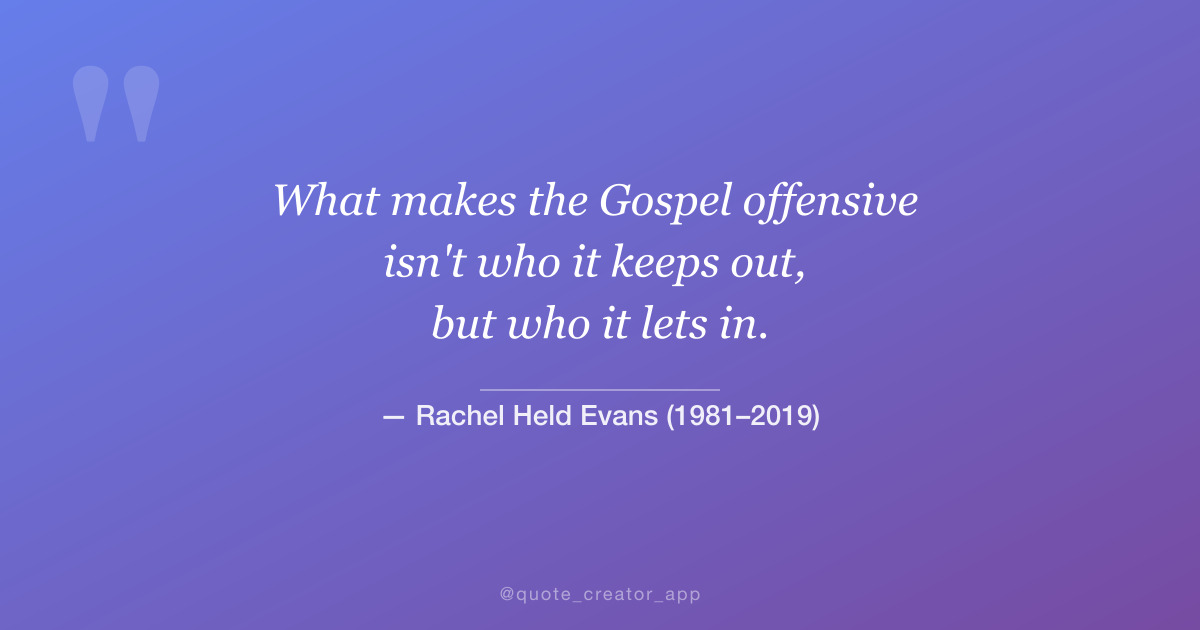
“What makes the Gospel offensive isn’t who it keeps out, but who it lets in.”
Editor’s note
Rachel Held Evans’s inversion — that the Gospel’s offence lies not in who it excludes but in who it welcomes — is a challenge to every community that draws lines. If this quote resonates, consider who in your life might need to hear that they are welcome. Sometimes the most radical thing you can do is leave a door unlocked.
— ThinkPeak Studio Editorial Team
What this quote means
On the surface, Evans is inverting the common assumption that the Gospel is a barrier — a line drawn to separate the worthy from the unworthy, the pure from the contaminated. She argues the opposite: the Gospel is not a gate but an open door, and what truly scandalises people is not who is locked out but who is invited in.
The deeper truth is about the radical hospitality at the heart of Christianity. From the very beginning, Jesus offended his contemporaries by eating with tax collectors and sinners, touching lepers, and welcoming women and outcasts into his inner circle. The Gospel doesn’t say “become worthy and you may enter.” It says “come as you are.” That insistence — that grace precedes behaviour, that belonging precedes believing — is precisely what makes it offensive. It refuses to let anyone stand comfortably on the outside of someone else’s grace.
Evans wrote these words in her final book, Inspired, published in 2018, the year before she died at age 37. She had spent the previous decade navigating the tension between her evangelical upbringing and the progressive convictions she had come to hold — on LGBTQ+ inclusion, on the ordination of women, on the authority of Scripture, on the meaning of church. This quote is distilled from that entire journey: the real Gospel doesn’t exclude; it includes, and the people it includes are the ones who make the comfortable uncomfortable.
Today, the quote challenges us wherever we draw lines between insiders and outsiders. Whether in politics, religion, or everyday community life, the instinct to police boundaries is powerful. Evans reminds us that the Gospel’s edge is not in its rigidity but in its radical openness — in the table it sets, the guests it invites, and the door it leaves unlocked.
About Rachel Held Evans
Rachel Held Evans was born on June 8, 1981, in Birmingham, Alabama, and grew up in a family that was deeply embedded in Southern evangelical culture. Her father was a church deacon; her mother was a teacher; and faith was the centre of their household life. Evans loved the church, and she loved the Bible, and for a long time those two things did not conflict — until they did. The turning point came when she began to question the rigid gender roles, the political alignments, and the narrow definitions of salvation she had absorbed. Rather than abandoning her faith, she interrogated it, publicly and relentlessly, with a combination of humility, humour, and theological seriousness that won her a readership far beyond any single denomination.
Her first book, Faith Unraveled (originally titled Evolving in Monkey Town), traced her evolution from a confident culture warrior to someone who was willing to say “I don’t know.” Her second book, A Year of Biblical Womanhood (2012), became a New York Times bestseller when she took a year to live out every command about women in the Bible — from modesty and submission to hospitality and childbearing — with satirical sincerity that revealed both the beauty and the absurdity of how the Bible has been weaponised. Her third book, Searching for Sunday (2015), offered a tender memoir of leaving and returning to the church, structured around the sacraments of communion, baptism, confession, and others.
Evans died on May 4, 2019, after a sudden illness, at the age of 37. She left behind two young children, a devoted husband, and a community of readers who saw in her a model of what faith looks like when it is honest. Her legacy continues through her books, her blog, and the countless readers who credit her with helping them find their way back to — or finally away from — a faith that no longer fit. She remains one of the most important Christian voices of her generation, and her work is as relevant now as it was when she was alive.
Create your own quote graphic with this quote
This is the kind of quote that resonates most when it is presented visually. A clean typographic layout, a fitting color palette, and readable font sizing can transform these words into a graphic that people save and share. If you want to turn this quote into an Instagram post, WhatsApp status, Pinterest pin, or reel cover, Quotes Creator gives you all the tools to do it in minutes — custom fonts, gradients, backgrounds, and export sizes ready for every major platform.
Tips for designing this quote
- ✓ Use a serif font (Georgia, Playfair Display) to match the theological and literary weight of the quote
- ✓ Keep the quote on two or three lines — let the inversion of expectations land clearly
- ✓ Pair the quote with a purple-to-indigo gradient to evoke wisdom, spirituality, and depth
- ✓ Add the author name in a smaller, lighter weight below the quote
- ✓ Export in square format for Instagram feed and portrait for Stories or Pinterest
Create your own quote graphic with this quote
Turn this line into a shareable graphic in seconds — free, no signup needed. For video quotes and 100+ templates, try the Android app.
Advertisement
Enjoyed this article? Get more like it in your inbox.