Quote of the Day: Samantha Smith on Sharing the World
One autumn evening in 1982, a ten-year-old in Maine looked at a magazine cover, asked her mother a question about war, and then sat down to write it to the most powerful man in the Soviet Union. The letter that followed made Samantha Smith a symbol of childhood hope in the middle of the Cold War — and it all began with a sentence about sharing the world.
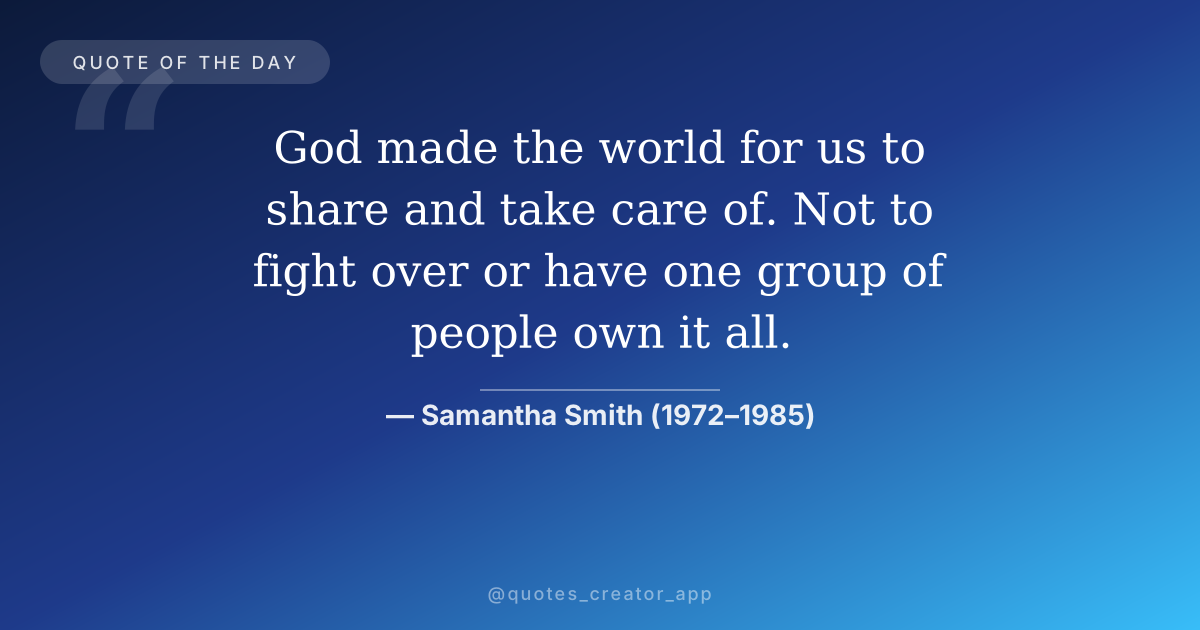
“God made the world for us to share and take care of. Not to fight over or have one group of people own it all.”
What this quote means
The line comes from one of the most remarkable documents of the late Cold War. In November 1982, Samantha Smith — ten years old, living in Manchester, Maine — watched her family discuss the face staring from the cover of Time magazine. It was Yuri Andropov, the new General Secretary of the Soviet Union, a man the Western press was describing as a fresh threat to global stability. Samantha asked her mother a question that cut through all the geopolitics: if people are so afraid of him, why doesn’t someone write a letter asking whether he wants to have a war or not? Her mother replied, simply, “Why don’t you?” So Samantha sat down and wrote to Andropov herself.
Her letter is striking precisely because it has no strategy, no spin, no adult hedging. She congratulates him on his new job. She tells him she has been worrying about Russia and the United States getting into a nuclear war. And then she delivers the sentence at the heart of the letter: God made the world for us to share and take care of. Not to fight over or have one group of people own it all. It is a child’s theology, simple and unassailable — the world was given to everyone, so why would anyone fight to take it from someone else? In a handful of words, she reframes the most dangerous standoff in human history not as an inevitable clash of empires but as a failure to share a gift.
There is also a sharp moral logic buried in that plainness. Samantha does not argue about missiles or ideology or the map of Europe. She makes the case at the level where children and saints and prophets all operate: ownership. The whole Cold War, she implies, is really a fight over who gets to own what was never meant to be owned. Her words quietly undermine the very idea of conquest — why would you want to conquer the world when the world was made for everyone? Decades of nuclear doctrine, containment theory, and balance-of-power politics dissolve, for a moment, against a ten-year-old’s insistence that the whole arrangement is simply wrong.
And the remarkable thing is that it worked. Andropov answered her in a personal letter that treated her question with total seriousness, invited her to the Soviet Union, and in the summer of 1983 she went — spending two weeks as his guest, staying in the Artek pioneer camp on the Black Sea, and telling a Moscow press conference that the Russians were “just like us.” The quote endures because it is proof, in the most inconvenient possible package, that asking a sincere question can do what armies and treaties sometimes cannot: it can make the other side human. Sixty years after the missile crisis taught the world to be afraid of the question, Samantha Smith’s letter is a reminder that the question itself — posed in good faith, to a human being — is still the most powerful instrument of peace we have.
About Samantha Smith
Samantha Reed Smith was born on June 29, 1972, in Houlton, Maine, on the Canadian border, to Arthur Smith, a teacher, and Jane Goshorn, a social worker. She was a bright, curious child who, at age five, wrote a letter to Queen Elizabeth II to say how much she admired her. In 1980 her family settled in Manchester, Maine, where she attended Manchester Elementary School — the same schoolgirl who, two years later, would change the course of her own life, and briefly the tone of the Cold War, with a single letter.
Her 1982 letter to Andropov was published in the Soviet newspaper Pravda, and on April 26, 1983, she received a personal reply from the Soviet leader himself — who compared her to Becky from Tom Sawyer, told her that the Soviet Union wanted peace, and invited her to visit that summer. She arrived in Moscow on July 7, 1983, and for two weeks the world watched a ten-year-old American do what adult diplomats could not: she met Soviet children, learned Russian songs and dances, swam in the Black Sea, and at Artek famously chose to sleep in the dormitory with the Soviet girls rather than accept privileged quarters. At a Moscow press conference she delivered her most famous verdict: the Russians were “just like us.”
Back home she became a media figure — interviewed by Ted Koppel and Johnny Carson, flown to Japan in December 1983 for a children’s symposium where she suggested that Soviet and American leaders exchange granddaughters for two weeks every year, so that no leader would want to bomb a country where his granddaughter was visiting. She wrote a book about her journey, Journey to the Soviet Union (1985), hosted a Disney Channel special on the 1984 election, and landed a co-starring role on the ABC series Lime Street opposite Robert Wagner. She seemed destined for a life no one could have predicted two years earlier.
On August 25, 1985, returning home to Maine from filming, Samantha and her father boarded Bar Harbor Airlines Flight 1808. The plane crashed short of the runway at Auburn-Lewiston Municipal Airport, killing all six passengers and both crew members. She was thirteen years old. The world mourned — Ronald Reagan and Mikhail Gorbachev both sent condolences, and about a thousand people attended her funeral. In the decades since, her legacy has been extraordinary: a monument in Moscow, a Soviet postage stamp, an asteroid named 3147 Samantha, a diamond, a mountain, and a tulip cultivar named in her honor; Maine’s first Monday in June is officially Samantha Smith Day; and in 2008 she was posthumously awarded the Peace Abbey’s Courage of Conscience Award. In 2023, a bronze monument was unveiled in her honor at Artek. Forty-one years after a ten-year-old asked a great power why it couldn’t share the world, her question still has not been answered — which may be why, this week, the world went looking for her again.
Create your own quote graphic with this quote
This is the kind of quote that resonates most when it is presented visually. A clean typographic layout, a fitting color palette, and readable font sizing can transform these words into a graphic that people save and share. If you want to turn this quote into an Instagram post, WhatsApp status, Pinterest pin, or reel cover, Quotes Creator gives you all the tools to do it in minutes — custom fonts, gradients, backgrounds, and export sizes ready for every major platform.
Editor’s note
Samantha Smith is one of the most-read figures on the internet this week. Her Wikipedia page drew roughly 43,500 views on August 22, 2026 — nearly 80 times its typical daily readership of a few hundred — as the 41st anniversary of her death on August 25 approaches and renewed fears of great-power conflict sent readers back to the story of the ten-year-old who asked the leader of the Soviet Union whether he wanted war. We are featuring this quote because it is the moral core of her famous letter, and because it has lost none of its force. In a year when headlines are again full of talk of superpower rivalry, nuclear risk, and contested resources, a child’s reminder that the world was made to be shared rather than owned lands with the weight of an old, unkept promise. Samantha Smith died before she could see what her question grew into, but the question outlived her. It is still the one worth asking — and, more than ever, the one worth asking out loud.
— ThinkPeak Studio Editorial Team
Tips for designing this quote
- ✓ Use deep navy and sky-blue tones to echo the Cold War night sky and a hopeful dawn
- ✓ Keep the text centered and italic in a serif font for a timeless, earnest feel
- ✓ Let the words breathe as four short centered lines — the pacing mirrors a child speaking
- ✓ Add a subtle gradient background rather than a flat color for depth and dimension
- ✓ Export in square format for Instagram feed and portrait for Stories or Pinterest
Create your own quote graphic with this quote
Turn this line into a shareable graphic in seconds — free, no signup needed. For video quotes and 100+ templates, try the Android app.
Advertisement
Enjoyed this article? Get more like it in your inbox.