Quote of the Day: Sarvepalli Radhakrishnan on the Danger of Thinking We Know
The philosopher-statesman who served as the first Vice President and second President of India spent most of his life in the lecture hall, not the parliament — and he made his birthday, September 5, a day for teachers rather than himself. Every year since, India celebrates Teachers’ Day on that date, and on September 5, 2026, his Wikipedia page surged past 100,000 views in a single day. The line new readers keep finding is a six-word warning that cuts straight to the difference between education and arrogance: when we think we know, we cease to learn.
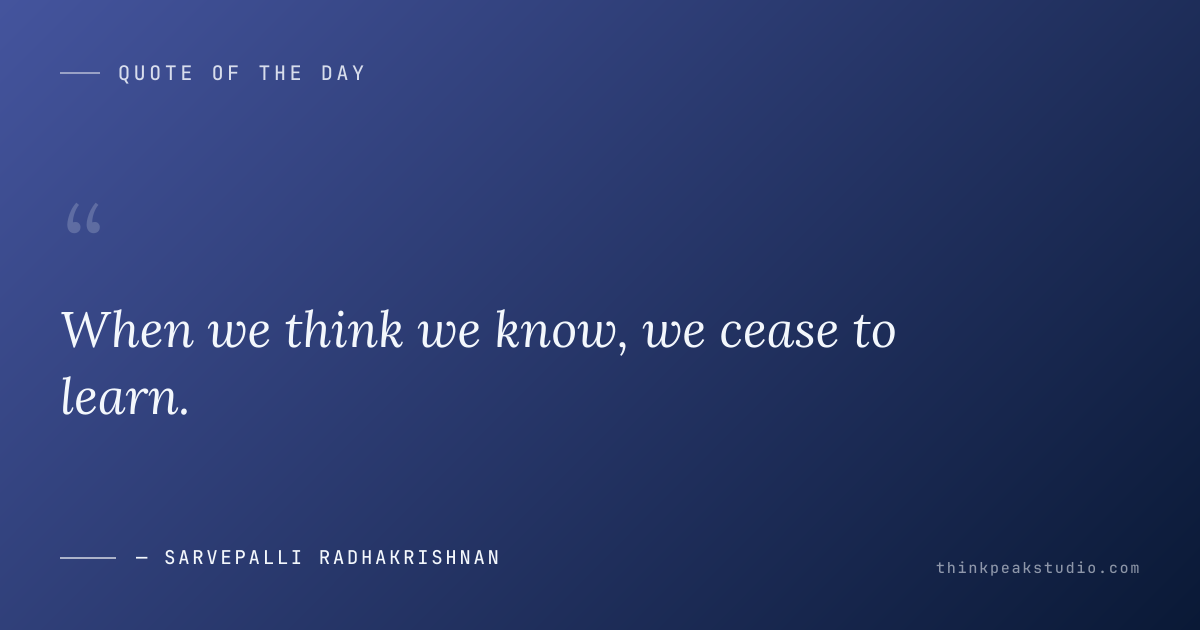
“When we think we know, we cease to learn.”
What this quote means
Radhakrishnan said these six words the way a teacher of fifty years would — not as a clever aphorism but as a warning, the distilled experience of watching brilliant minds go still. The sentence describes a precise mechanism. Learning requires the sense that there is something you do not yet know, a gap between what you understand and what the world still holds. The moment you believe the gap is closed — the moment you decide that you have the answers, that your field is mastered, that the version of things you learned years ago is the final version — the engine of inquiry stalls. You do not stop learning because you know everything. You stop because you have told yourself you do. Certainty is the off switch.
The sentence is also quietly radical about what knowledge is. Radhakrishnan, a philosopher of Advaita Vedanta, spent his career arguing that the deepest truths are not finished things you possess but experiences you keep living into. In his account of the Upanishads, the ultimate reality — Brahman — is by definition beyond any finite description, and every human formulation of it is an approximation, a finger pointing at the moon. If that is the structure of the most important knowledge there is, then humility is not a virtue tacked onto wisdom; it is the load-bearing wall. The mind that believes it has grasped the absolute has, by definition, grasped something smaller. “Tolerance,” he wrote, “is the homage which the finite mind pays to the inexhaustibility of the infinite” — the same instinct, at a different scale, as the warning that thinking you know is the end of learning.
On a practical level, the quote is a defense of education against its own institutions. Radhakrishnan believed that the purpose of teaching was not to fill students with conclusions but to start them on a path of inquiry that would outlast any classroom. He held the Spalding Chair of Eastern Religion and Ethics at Oxford and the King George V Chair of Mental and Moral Science at Calcutta, served as Vice-Chancellor of both Andhra University and Banaras Hindu University, and was famous for answering a student’s question with another question rather than a verdict. “The true teachers are those who help us think for ourselves,” he said — and you cannot help anyone think for themselves if you hand them a finished system and ask for it back unchanged. A conclusion you inherit and never test is not knowledge; it is furniture. The sentence is a challenge to the way all of us — students, professionals, entire industries — confuse having an opinion with having thought.
Read today, in an age of expert overconfidence and confident algorithms, the line lands with almost uncomfortable force. The people who stop learning are rarely the people who know nothing; they are the people who know a great deal and have decided that is enough. Every field has its version of this — the veteran who has seen it all, the founder who knows the playbook, the professional whose credentials have become a shield against new evidence. Radhakrishnan’s sentence reframes it: knowledge is not a destination you arrive at but a discipline you maintain, and the discipline begins with keeping a small, permanent hole in your confidence where new learning can get in. The mind that knows it does not fully know is the only mind that can still grow.
About Sarvepalli Radhakrishnan
Sarvepalli Radhakrishnan was born on September 5, 1888, in Tiruttani, a temple town in the Madras Presidency of British India (today in Tamil Nadu), into a Telugu-speaking Brahmin family. His father, Sarvepalli Veeraswami, was a subordinate revenue official, and money was tight; Radhakrishnan and his five siblings relied on scholarships to get an education. He had wanted to study mathematics, but a cousin handed down his old philosophy textbooks, and Radhakrishnan — a financially constrained student — took them. Philosophy was the subject that chose him, and he never looked back. He graduated from Madras Christian College with a master’s degree, and at twenty wrote a thesis on “The Ethics of the Vedanta and its Metaphysical Presuppositions” that was meant, he said, as a reply to the charge that the Vedanta system had no room for ethics.
His academic career became, in effect, a forty-year bridge between two worlds. He taught at Presidency College and then at Mysore, and in 1921 took the King George V Chair of Mental and Moral Science at the University of Calcutta. In 1936 he became the Spalding Professor of Eastern Religion and Ethics at the University of Oxford — the first Indian to hold a chair at Oxford — and was elected a Fellow of All Souls College. Across those years he wrote the works that made him the most famous living interpreter of Indian philosophy in the world: Indian Philosophy, the landmark two-volume history; The Hindu View of Life; An Idealist View of Life; and translations of the Bhagavadgita and the principal Upanishads. He was knighted in 1931 (a title he later stopped using after independence), nominated sixteen times for the Nobel Prize in Literature and eleven times for the Nobel Peace Prize, and received the Bharat Ratna, India’s highest civilian honor, in 1954.
His philosophy grew out of an encounter with criticism. As a student at a missionary college, Radhakrishnan watched Christian teachers dismiss Hindu thought, and the experience roused — in his own words — “my pride as a Hindu.” His life’s work became the defense of Hinduism against what he called uninformed Western criticism, and the articulation of Advaita Vedanta — the nondualist school that sees the deepest reality as a single undivided consciousness — in terms the modern world could understand. He rejected the idea that Vedanta was world-denying or escapist; for him the nondual vision issued directly in ethics, because if every other being is finally one with you, then “every other individual is to be regarded as your co-equal, and treated as an end, not a means.” He was not building an ivory-tower system but a practical one: the oneness you realize in contemplation is the oneness you are obligated to act on in the street.
Radhakrishnan entered politics late, after a lifetime in universities, and rose to the very top of the new republic. He represented India at UNESCO, served as ambassador to the Soviet Union from 1949 to 1952, and was elected the first Vice President of India in 1952, then the second President in 1962 — a role he held through the Sino-Indian War, the deaths of two prime ministers, and a time of profound national strain. He was a sponsor, alongside Albert Einstein, of the Peoples’ World Convention, and late in life he helped found HelpAge India. His Templeton Prize money, awarded months before his death, he donated in full to Oxford University. He died on April 17, 1975, in Madras, at the age of 86.
But the legacy he asked for is not a palace or a monument; it is a school year. When his students and friends asked to celebrate his birthday, Radhakrishnan replied that instead he would count it a proud privilege if September 5 were observed as Teachers’ Day. Since 1962, India has done exactly that. Every September 5 the country honors the profession he called the seedbed of all others — “teachers should be the best minds in the country,” he believed — and on September 5, 2026, his Wikipedia page drew more than 100,000 views in a single day as a new generation looked him up. What they found there was a man who spent his whole life on one side of a single sentence: the side that is still learning. The six words he left behind are the test he would have set us all — a question to carry into every conversation, every job, every new year of life: when you think you know, have you actually stopped listening?
Create your own quote graphic with this quote
This sentence deserves a frame as luminous as the mind that spoke it. A deep indigo-to-amber gradient, a serif italic set generous with whitespace, and a clean centered layout can turn these words into a graphic people save and share — a small reminder to keep a gap in your confidence where new learning can get in. If you want to make a quote card from this — or any quote — Quotes Creator gives you the fonts, gradients, backgrounds, and export sizes to do it in minutes, ready for Instagram, Stories, Pinterest, and everywhere else.
Editor’s note
Sarvepalli Radhakrishnan was one of the most-read people on Wikipedia this week. His page, which usually draws a couple of thousand views a day, surged past 100,000 views on September 5, 2026 — Teachers’ Day in India, the date of his birth — and entered the daily top twenty articles on the site. We are featuring this quote because it is the quiet thesis of his entire life: that education does not end when you leave school but the moment you decide you know enough to stop listening. It is a sentence addressed to experts and beginners alike, and in an age of confident answers it reads almost like a dare. As you go into your week, take it as a question: what is one thing you are so sure of that you have stopped testing it — and what would you learn if you opened it back up? Your next lesson is waiting exactly where your certainty begins.
— ThinkPeak Studio Editorial Team
Tips for designing this quote
- ✓ Use a deep indigo-to-amber gradient to echo the scholar’s lamp — the night-blue of the study and the warm gold of the classroom
- ✓ Keep the text centered and italic in a serif font so it reads like the considered sentence it is — a warning, not a slogan
- ✓ Break the quote at the turn — “we cease to learn” — so the sting of the conclusion lands on its own line
- ✓ Add a subtle gradient background rather than a flat color to suggest depth and something beyond the visible
- ✓ Export in square format for Instagram feed and portrait for Stories or Pinterest
Create your own quote graphic with this quote
Turn this line into a shareable graphic in seconds — free, no signup needed. For video quotes and 100+ templates, try the Android app.
Advertisement
Enjoyed this article? Get more like it in your inbox.


