Quote of the Day: Saul Bellow on Memory and Identity
Born on this day in 1915, Saul Bellow was one of the 20th century’s greatest novelists — a Nobel laureate whose words on memory, identity, and the human condition continue to resonate with readers around the world.
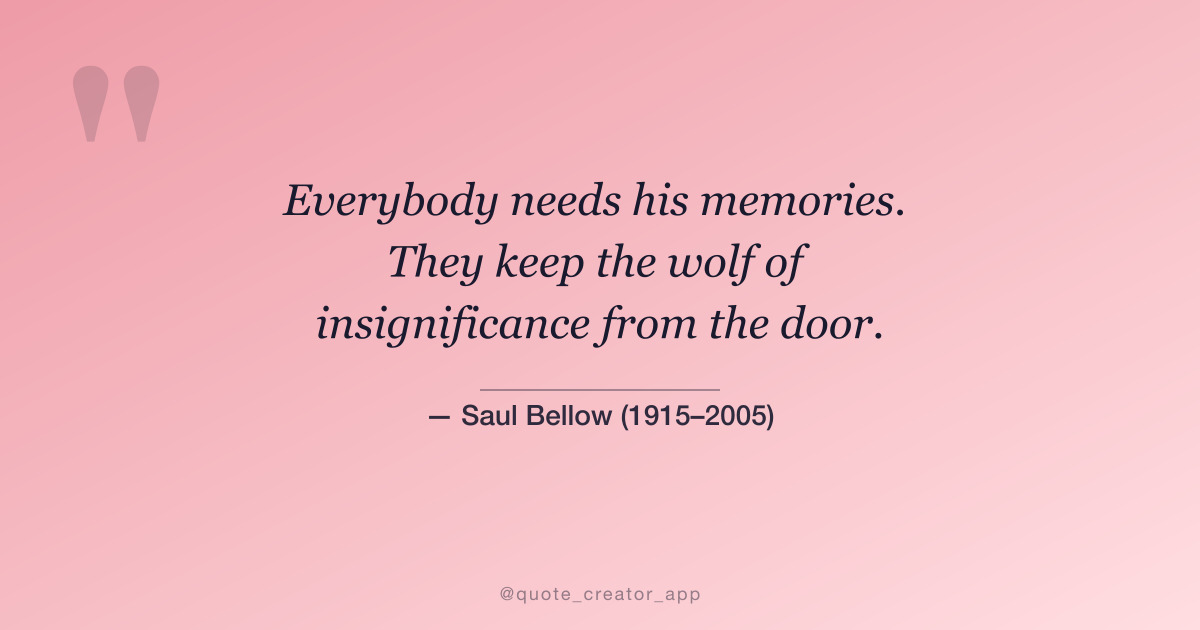
“Everybody needs his memories. They keep the wolf of insignificance from the door.”
Editor’s note
Born in 1915, Saul Bellow wrote this line in Mr. Sammler’s Planet, a novel about an elderly Holocaust survivor navigating a world that appears to have lost its historical memory. The quote is a reminder that memory is not nostalgia — it is the thread that stitches our days together into a meaningful life. If this resonates, try setting aside ten minutes tonight to write down one memory you haven’t thought about in years. Notice how the act of remembering changes the shape of your present.
— ThinkPeak Studio Editorial Team
What this quote means
On its surface, Bellow’s words identify a simple psychological truth: memories protect us from the feeling that our lives do not matter. The “wolf of insignificance” is the existential dread that gnaws at the edges of human consciousness — the fear that we are small, replaceable, and ultimately forgettable. Memories, he suggests, are not just recollections of the past but shields against this creeping sense of futility.
The deeper insight is that memory is the foundation of identity. Without our accumulated experiences and the stories we tell ourselves about them, we would be adrift — anonymous specks in an indifferent universe. Memories anchor us. They provide continuity between who we were, who we are, and who we are becoming. Bellow implies that the act of remembering is itself an act of self-preservation, a quiet rebellion against meaninglessness.
Bellow wrote Mr. Sammler’s Planet in 1970, a time of profound social upheaval in America. The novel’s protagonist, Artur Sammler, is an elderly Polish-Jewish intellectual who survived the Holocaust and now finds himself in the turbulence of late-1960s New York — a world of protest, sexual liberation, and generational rupture. Through Sammler, Bellow explores what happens when a society loses its connection to the past. The quote reflects his concern that without memory — both personal and collective — we surrender to chaos and become vulnerable to the forces that would diminish us.
In our own era of infinite scrolling, constant notifications, and digital amnesia, Bellow’s words feel more urgent than ever. We carry cameras in our pockets yet rarely pause to reflect. We document everything but remember little. This quote is an invitation to reclaim the practice of memory — through journaling, storytelling, or simply sitting quietly with our own history. Because the wolf, as Bellow reminds us, is always at the door.
About Saul Bellow
Saul Bellow was born on June 10, 1915, in Lachine, Quebec, to Russian-Jewish immigrant parents. He grew up in the slums of Montreal and later moved to Chicago, a city that would become the soul of his fiction. The youngest of four children, Bellow taught himself to read at age three and developed an early passion for literature. He studied at the University of Chicago and Northwestern University, graduating in anthropology — a discipline that gave him a keen eye for the rituals and absurdities of social life.
Bellow is one of the most decorated American novelists of the 20th century. He won the Nobel Prize in Literature in 1976, the Pulitzer Prize, the National Medal of Arts, and remains the only writer to win the National Book Award for Fiction three times — for The Adventures of Augie March (1953), Herzog (1964), and Mr. Sammler’s Planet (1970). His novels are known for their intellectual depth, dark humour, and unflinching portrayal of modern urban life. He wrote about intellectuals, dreamers, and misfits — characters who think too much and fit too little, struggling to find meaning in a world that often refuses to cooperate.
Beyond his awards, Bellow was known for his fiercely independent voice. He stood outside literary fashions and refused to be categorised. A lifelong reader of philosophy, he once remarked that “a novel is balanced between a few true impressions and the multitude of false ones that make up most of what we call life.” He taught at the University of Chicago for decades, mentoring generations of writers, and continued writing well into his eighties. He died on April 5, 2005, at the age of 89, leaving behind a body of work that continues to challenge, comfort, and provoke.
Create your own quote graphic with this quote
This is the kind of quote that resonates most when it is presented visually. A clean typographic layout, a fitting color palette, and readable font sizing can transform these words into a graphic that people save and share. If you want to turn this quote into an Instagram post, WhatsApp status, Pinterest pin, or reel cover, Quotes Creator gives you all the tools to do it in minutes — custom fonts, gradients, backgrounds, and export sizes ready for every major platform.
Tips for designing this quote
- ✓ Use a serif font (Georgia, Playfair Display) to honour the literary feel of the quote
- ✓ Keep the quote on one or two lines — shorter display text reads better on mobile
- ✓ Pair the quote with a soft gradient that matches the emotional tone: warm rose-pink for memory and reflection
- ✓ Add the author name in a smaller, lighter weight below the quote
- ✓ Export in square format for Instagram feed and portrait for Stories or Pinterest
Create your own quote graphic with this quote
Turn this line into a shareable graphic in seconds — free, no signup needed. For video quotes and 100+ templates, try the Android app.
Advertisement
Enjoyed this article? Get more like it in your inbox.