Quote of the Day: Song Yadong on Silencing Every Prediction
For months, everyone in mixed martial arts said the same thing: Umar Nurmagomedov was the best fighter in the division, the inevitable future champion. Song Yadong, the 28-year-old from Harbin fighting in front of a roaring Shanghai crowd, answered every one of those predictions with a single uppercut — and then with two sentences that became the quote of the weekend.
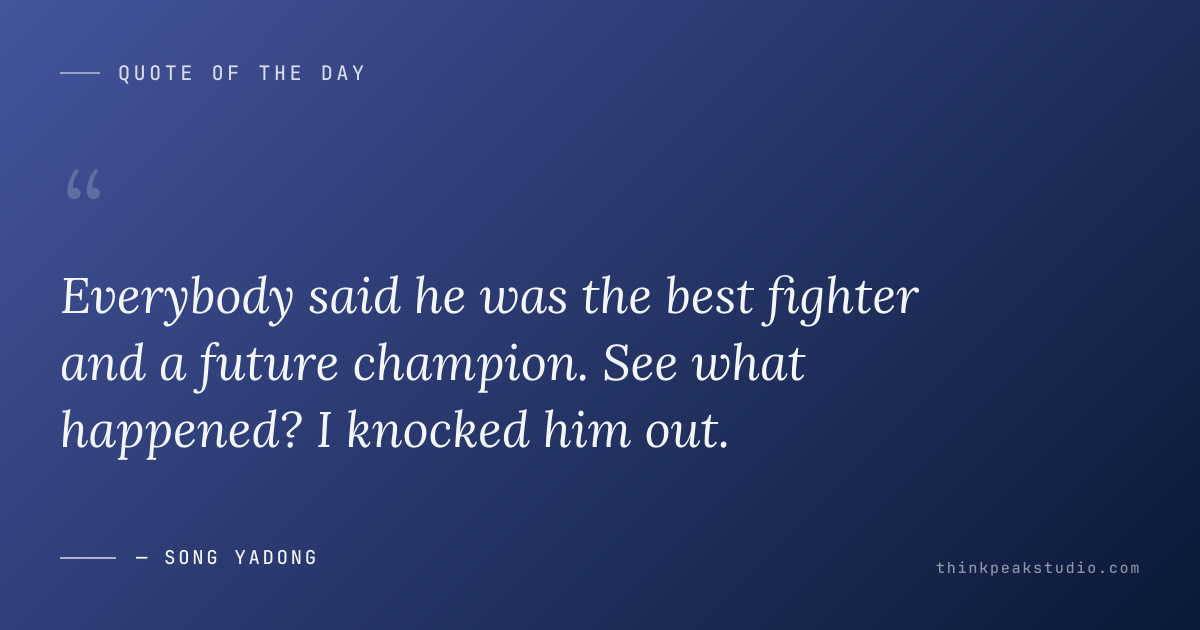
“Everybody said he was the best fighter and a future champion. See what happened? I knocked him out.”
What this quote means
Read it closely and the sentence is doing something far more interesting than celebrating a win. Song Yadong is not really talking about himself at all — he is talking about the consensus. For the entire buildup to UFC Shanghai, the story everyone repeated was that Umar Nurmagomedov was a generational talent: undefeated, trained alongside Khabib and the rest of the most decorated fighting family in the sport, a man the oddsmakers made a minus-350 favorite and the pundits made a future champion. Yadong opens with that consensus, names it plainly — “everybody said” — and then delivers the punchline that dismantles it: “See what happened? I knocked him out.” The quote is not a boast about his own ability, although it is partly that. It is a quiet demolition of the whole idea that other people’s opinions are a form of destiny.
There is a particular courage in the way he says it, because the sentence required him to have believed it before the fight, not after. Anyone can knock a man down and then announce that they always knew they would. Yadong’s line only carries weight because he was the one man in the building, aside from his own corner, who refused to accept the verdict everyone else had already reached. His boxing coach Rudy Hernandez told him before the fight that he could finish Nurmagomedov with an uppercut, and Yadong said he carried the uppercut in his mind the whole night, waiting for the moment — which came when Nurmagomedov dropped his level for a takedown and ran his chin straight into it. The quote is the outward statement of an inward position he had to hold for weeks against every voice telling him he was about to lose. It is a sentence about the gap between what the world expects and what one person knows is possible.
The line works far beyond the cage, which is why it has travelled so fast. Every life contains a version of Nurmagomedov: the competitor, the institution, the accepted wisdom, the name everyone assumes is unbeatable — a promotion panel, an industry incumbent, a diagnosis, a reputation. Most people look at that wall and quietly agree with the consensus, because disagreeing with it privately costs nothing and acting on the disagreement costs everything. Yadong’s quote is the antidote to that surrender. “Everybody said” is the passive voice of a crowd; “See what happened?” is the active voice of a person who decided the conversation was not over until he had spoken in it. It does not promise that the upset always comes. It promises that the consensus is not a law of physics — that it is just a collection of opinions, and opinions can be changed by a person willing to throw the uppercut.
There is also a deeper layer to the quote that makes it stick. Yadong was not a favorite before the fight and he has not been one for most of his career. He lost decisions to Petr Yan and Sean O’Malley, was stopped by a doctor’s stoppage against Cory Sandhagen, and has spent years being described as a talented Chinese fighter who could not quite break through against the sport’s elite. When he says “everybody said he was the best fighter,” the sentence carries a shadow of all the times everybody said the opposite about him — the outsider, the underdog, the one expected to lose. That is why the quote resonates with anyone who has ever been underestimated: it is not the statement of a man who has always been told he is great. It is the statement of a man who was told he was not, heard it, and went and found out for himself. The best moment of his life, he said afterwards, was not the moment he was crowned or ranked. It was the moment he proved the world wrong.
About Song Yadong
Song Yadong was born on December 2, 1997, in Harbin, the capital of Heilongjiang province in northeast China, a city better known for its brutal winters and its ice festival than for producing prizefighters. He began training mixed martial arts at thirteen — before he had a driver’s license, before most of his peers had finished school — and made his professional debut before his sixteenth birthday, fighting on small Chinese cards in 2013. To survive before fighting paid him anything, he worked as a street vendor and a security guard, and he has named Bruce Lee as his hero: the man who, in Yadong’s words, “let the world know Chinese Kung Fu.” That lineage matters to him. He fights under the nickname “The Kung Fu Kid,” and he has described his UFC dream in almost missionary terms — that on the biggest stage in the sport he wanted to “show the world what I’m capable of.”
In November 2017 he made his UFC debut in Shanghai, of all places, stepping in on short notice to submit Bharat Khandare with a first-round guillotine choke and win the first of what would become seven Performance of the Night bonuses — a tally that ties him for the fourth-most in UFC history. He relocated to Sacramento to train at Team Alpha Male, the gym founded by Urijah Faber, and spent the next eight years climbing the bantamweight division in a long, crooked line: wins over Marlon Vera, Marlon Moraes, Ricky Simón and a head-kick knockout of Julio Arce, broken up by a majority draw with Cody Stamann, a doctor’s stoppage loss to Cory Sandhagen, and unanimous-decision losses to Petr Yan at UFC 299 and to Sean O’Malley at UFC 324. In May 2026 he submitted the former two-division champion Deiveson Figueiredo with a guillotine choke in Macau, and on August 29, 2026, in the main event of UFC Shanghai, he produced the moment that rewrote his career.
Umar Nurmagomedov entered that fight ranked #2 in the world and unbeaten, a 20–1 record with his only loss a decision against the reigning champion Merab Dvalishvili, and the betting public made him a heavy favorite. Yadong was a plus-260 underdog fighting at home, and for a round he was losing — Nurmagomedov controlled the grappling, exactly as everyone said he would. Then, in the second round, Nurmagomedov changed levels for a takedown, and Yadong’s waiting uppercut met him on the way down. The knockout came at 1:48 of round two, a $100,000 Performance of the Night bonus followed, and by the next morning Song Yadong was the #2-ranked bantamweight in the world and one of the most searched names on the internet — his Wikipedia page, which had been drawing a modest trickle of readers, jumped to more than 114,000 views on August 30 as the world looked up the man who had just broken the consensus. “Amazing. I’m feeling amazing,” he told the UFC’s cameras. “I feel like this is the best moment in my life, right now.” He has already named his next ambition: a rematch with Petr Yan, the man who beat him by decision in 2024, who he says he can now knock out too. For a fighter who spent a decade being told what he could not do, the sentence everyone is sharing is the one where he finally answered.
Create your own quote graphic with this quote
A quote this short and this defiant is built to be seen, not just read. A clean typographic layout, a bold gradient, and strong contrast can turn these two sentences into a graphic that people save, share, and come back to the next time they are told they can’t win. If you want to make a quote card from this — or any quote — Quotes Creator gives you the fonts, gradients, backgrounds, and export sizes to do it in minutes, ready for Instagram, Stories, Pinterest, and everywhere else.
Editor’s note
Song Yadong is one of the most-read people on Wikipedia this weekend. His page, which normally draws a small fraction of the traffic it received this week, jumped to more than 114,000 views on August 30, 2026 — the day after he knocked out Umar Nurmagomedov in the second round of the UFC Shanghai main event, in front of a roaring home crowd, as a heavy underdog. We are featuring this quote because it captures something rarer than a victory speech: it is a sentence about refusing to accept the verdict other people write for your life. “Everybody said” names the consensus; “I knocked him out” answers it. Whether your Nurmagomedov is a rival, an institution, or your own doubt, the lesson is the same — other people’s predictions are not your ceiling. Carry the uppercut in your mind, wait for your moment, and when it comes, make sure you are ready to throw it.
— ThinkPeak Studio Editorial Team
Tips for designing this quote
- ✓ Use deep crimson and gold tones to echo the floodlit Shanghai arena and the colours of a Chinese victory night
- ✓ Keep the two-part structure on separate lines so the setup and the punchline land with maximum impact
- ✓ Set the quote in an italic serif so it reads like a defiant statement, not a soundbite
- ✓ Let the words breathe with generous whitespace around each line
- ✓ Export square for Instagram feed, portrait for Stories and Pinterest, and wide for a desktop wallpaper
Create your own quote graphic with this quote
Turn this line into a shareable graphic in seconds — free, no signup needed. For video quotes and 100+ templates, try the Android app.
Advertisement
Enjoyed this article? Get more like it in your inbox.


