Quote of the Day: Stephen Hawking on Doing What You Can, However Difficult Life Seems
At 21 he was told he had about two years to live. He lived another 55. In the final pages of his last book, the Cambridge cosmologist who rewrote our picture of black holes left behind the plainest possible instruction for anyone facing a wall: whatever the difficulty, there is still something you can do, and you can do it well. This week, as the first authorised biography of him arrives, readers are returning to his page by the tens of thousands.
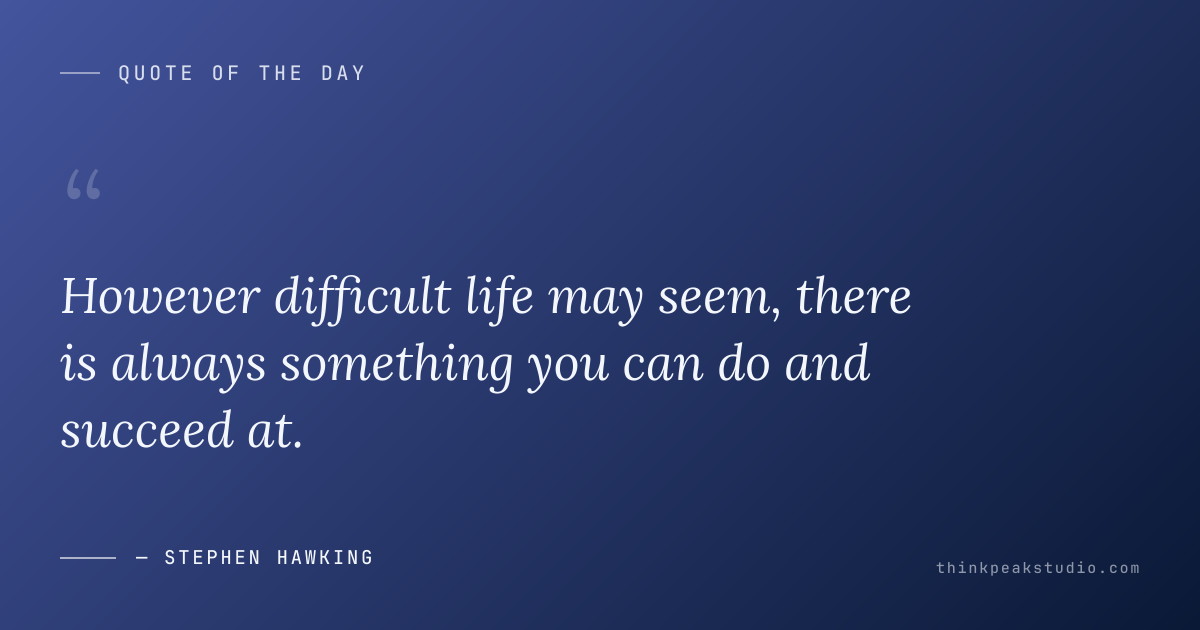
“However difficult life may seem, there is always something you can do and succeed at.”
What this quote means
These are among the last words Stephen Hawking chose to leave in print. They close Brief Answers to the Big Questions, the book he was still assembling when he died in March 2018 and which his family and academic colleagues completed and published that October. But the sentence is older than the book. Hawking first offered this advice to his three children, Lucy, Robert and Tim, and related it in a 2010 interview with ABC’s Diane Sawyer. In its full form he begins with the famous line — “remember to look up at the stars and not down at your feet” — urges curiosity, and then arrives here, at the sentence that does the real work.
Read it slowly and notice what it does not say. It does not say that life is easy, or that difficulty is an illusion, or that a positive attitude will dissolve it. Hawking knew better than almost anyone that difficulty is real and often permanent. What he says is narrower and braver: there is always something you can do. Not everything. Not the thing you had planned, or the thing others expect of you, or the thing that would have been possible a year ago. Just something. When the body narrows, the field of action narrows with it — but it does not close completely, and Hawking spent his whole adult life refusing to treat a smaller field as an empty one. He kept doing physics after he could no longer hold a pen, kept writing after he could no longer speak, kept travelling after he could no longer walk.
Then comes the second half, which is just as carefully chosen: and succeed at. Success, in this sentence, is not measured against the life you wanted or the people you are compared with. It is measured against the difficulty in front of you. If you can do the thing that is still available to you, and do it as well as you can, that is success — complete and sufficient for the day. This is not a slogan about grit. It is a working method. Hawking was told he had about two years; he proceeded as though each stretch of time might hold a piece of work, and the result was fifty-five more years of discovery. The instruction is portable to a bad week, a diagnosis, a grief, a stalled career: stop asking whether the whole problem can be solved, and ask what the next doable thing is. Then do it, and count it.
About Stephen Hawking
Stephen William Hawking was born in Oxford on 8 January 1942, the son of Frank and Isobel Hawking. He studied physics at University College, Oxford, graduating with a first-class degree in 1962, and went on to Trinity Hall, Cambridge, for a doctorate in physics, which he completed in 1966 under the supervision of Dennis Sciama. It was while he was beginning postgraduate work, in 1963, that he was diagnosed with amyotrophic lateral sclerosis, a form of motor neurone disease. He was 21. Doctors gave him about two years to live. He married Jane Wilde in 1965, and the couple had three children; the marriage ended in divorce in 1995, and a second marriage, to Elaine Mason, lasted from 1995 to 2006.
His science changed how we think about the universe. Working on general relativity and cosmology, Hawking showed in the early 1970s that the universe must have begun in a singularity, and in 1974 he made the discovery that made his name: black holes are not entirely black. Quantum effects near the edge of a black hole cause it to radiate particles and slowly lose mass — a process now called Hawking radiation. The result, which linked general relativity with quantum mechanics in a place the two were thought impossible to reconcile, helped earn him election as a Fellow of the Royal Society in 1974, at the age of 32, one of the youngest in the society’s history. He became Professor of Gravitational Physics at Cambridge in 1977, and in 1979 was appointed Lucasian Professor of Mathematics, the chair once held by Isaac Newton, a post he held until 2009. He was made a CBE in 1982 and a Companion of Honour in 1989, received the Royal Society’s Copley Medal in 2006, and was awarded the US Presidential Medal of Freedom in 2009.
Then there is the book that made him a household name. A Brief History of Time: From the Big Bang to Black Holes was published in 1988, an attempt to explain the origins of the universe without mathematics. It has sold more than 25 million copies in 40 languages, and it spent a total of 264 weeks on the Sunday Times bestseller list — longer than any other book in the list’s fifty-year history. In 2024 the Sunday Times named it the top-ranked book of its first half-century. Three years before publication, in 1985, Hawking had contracted pneumonia on a trip to CERN and undergone a tracheostomy that cost him his natural voice; from then on he spoke through a speech-generating device, and that synthesised voice became one of the most recognisable in the world. His final book, Brief Answers to the Big Questions, was published posthumously on 16 October 2018, completed with the help of his family and colleagues, and it ends with the sentence above.
Hawking died at his home in Cambridge on 14 March 2018, at the age of 76 — 55 years after his diagnosis. He had been the longest-lived person known to have lived with motor neurone disease, and he used the years he was not expected to have to write, lecture, campaign on the risks of artificial intelligence and the future of space travel, and answer the questions strangers sent him from all over the world. In September 2026, more than eight years after his death, the first authorised biography — Hawking: His Life and Work by Graham Farmelo, published in the UK on 24 September and in the US in November — sent readers back to his Wikipedia page in the tens of thousands. Its subject would not have been surprised. He had already explained, in the advice he left his children, exactly how to live when the odds are bad: look up, stay curious, do the thing that is still possible, and call it enough.
Create your own quote graphic with this quote
Hawking’s words are short, plain and unusually suited to a quiet typographic treatment — a deep indigo or midnight-blue background, a clean serif for the quote, and plenty of space around it so the sentence can breathe. If you want to make a quote card from this line, or from anything else you have been carrying around, Quotes Creator gives you the fonts, gradients, backgrounds and export sizes to do it in minutes, ready for Instagram, Stories, Pinterest and everywhere else.
Editor’s note
Stephen Hawking is one of the most-read people on Wikipedia this week. His page, which usually draws between six and eight thousand views a day, climbed past 15,000 on 17 September and past 13,000 again on 23 September, as Hawking: His Life and Work by Graham Farmelo — the first authorised biography, drawn on the family’s archives, letters and diaries — reached bookshelves in the UK. Interest was sharpened by a second thread: a clip of Hawking’s 2017 warning that artificial intelligence, if allowed to design itself, could slip beyond human control, reshared as the heads of several leading AI laboratories called for the pace of development to be slowed. Eight years after his death, both conversations lead back to the same man. We are featuring this quote because it is the shortest true account of how he lived. He was given two years and he took fifty-five, not by denying the difficulty but by refusing to let it define the size of the next task. Look up, be curious, do what can still be done — and let that count as success. Before your next hard morning, ask what Hawking would ask: not whether the whole thing can be fixed, but what the next doable thing is.
— ThinkPeak Studio Editorial Team
Tips for designing this quote
- ✓ Use a deep indigo or midnight-blue gradient to echo the night sky Hawking spent his life looking into
- ✓ Set the quote in a clean serif or a light geometric sans, and keep it large — the sentence is short enough to fill the frame
- ✓ Break the line so “there is always something” sits on its own, since that is the hinge of the whole thought
- ✓ Keep the attribution small and quiet in the lower corner, letting the words carry the design
- ✓ Export in square format for the Instagram feed and portrait for Stories or Pinterest
Create your own quote graphic with this quote
Turn this line into a shareable graphic in seconds — free, no signup needed. For video quotes and 100+ templates, try the Android app.
Advertisement
Enjoyed this article? Get more like it in your inbox.


