Quote of the Day: Steve Gleason on a World That Doesn’t Have to Shrink With the Body
He is the former Saints safety who became a symbol of a city’s recovery with a single blocked punt, and then, five years later, the face of a disease with no cure. Twenty years on from that night in the Superdome, and fifteen years into life with ALS, the sentence worth keeping is not about endurance for its own sake. It is about refusing to let a body set the borders of a life — and it arrives at the exact moment the world was looking him up again.
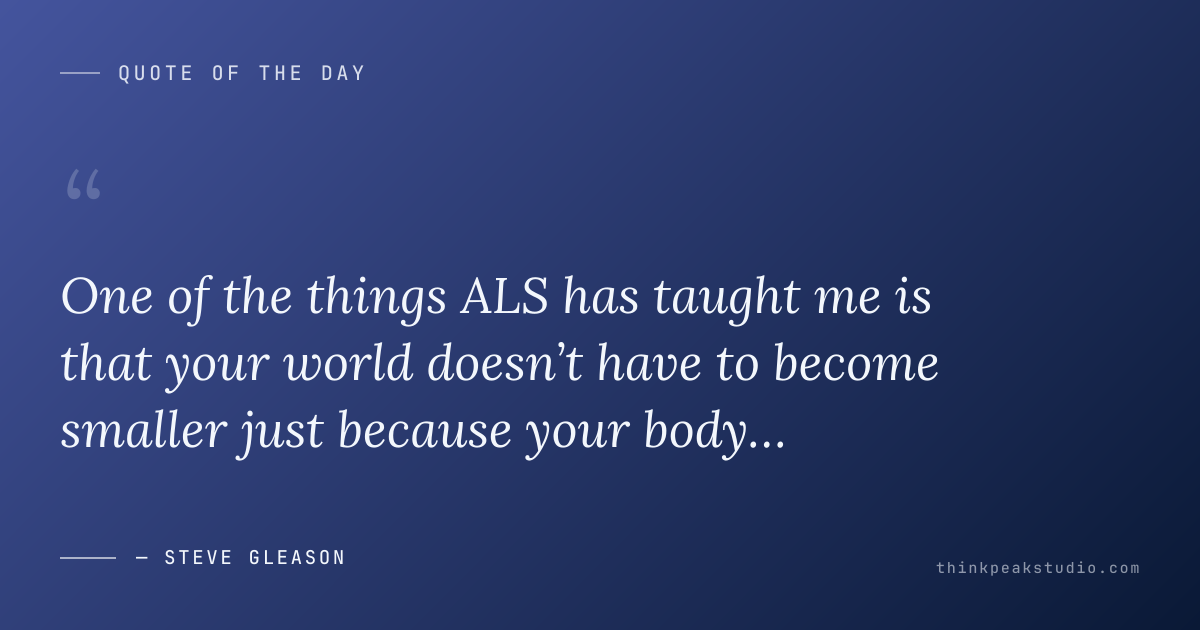
“One of the things ALS has taught me is that your world doesn’t have to become smaller just because your body does.”
What this quote means
The sentence does something rare: it separates two things that grief and illness usually fuse together. The body and the world. For most of us, and certainly for anyone living with a degenerative disease, those two feel like the same thing — as the body narrows, the world is assumed to narrow with it. Gleason’s line cuts the assumption in half. One part is a fact he cannot argue with, and does not pretend to. The other part is a decision, and he refuses to hand it over. Your world doesn’t have to become smaller just because your body does. The whole weight of the quote sits on the word have. It is not a promise that nothing is lost. It is a refusal to let loss be the only thing that is allowed to happen next.
Notice, too, that he says world and not life. Life, in his case, has been visibly, brutally reduced: he cannot move, speak, eat or breathe without assistance, and he has not hugged his children. He does not paper over any of that. But a world is made of things a body does not own — the people you love, the ideas you turn over, the music you make, the questions you keep asking. Those can keep expanding even when the body is closing. That is the distinction the quote protects, and it is why the line is not denial. It is triage. It says: here is the part that is genuinely out of your hands, and here, on the other side of it, is everything that is not.
What makes the sentence credible rather than decorative is the evidence attached to it. At forty-nine, fifteen years after his diagnosis, Gleason communicates by moving his eyes across a tablet, breathes through a ventilator, and lost even the ability to blink in 2022. And in the same season he released Rebirth, a twelve-song album — his poetry set to music by New Orleans players — on the twentieth anniversary of the punt block that gave both him and his city a second life. He told The Spokesman-Review that where “No White Flags” was once his daily mantra, “Keep Exploring” now fits him better. The quote is not a slogan he arrived at from a safe distance. It is his working method, reported from inside the thing itself.
And it is useful precisely because almost no one reading it is facing what Gleason faces. Most of us shrink our worlds voluntarily and for much smaller reasons — a fear of being seen, a job we stay in too long, a door we don’t knock on because someone might say no. That is the quiet gift of a sentence like this. It is spoken by a man who has lost nearly every freedom we take for granted, and it does not ask for pity. It just makes our own excuses look as small as they are.
About Steve Gleason
Stephen Michael Gleason was born on 19 March 1977 in Spokane, Washington. He attended Gonzaga Preparatory School, where he played football and baseball, and went on to Washington State University as a two-sport athlete for the Cougars. He was a starting linebacker on the Washington State team that reached the Rose Bowl at the end of the 1997 season, and a four-year baseball player in centre field. He was not a star with a guaranteed future; he signed with the Indianapolis Colts in 2000 as an undrafted free agent, was released after the preseason, and joined the New Orleans Saints’ practice squad that November. Over the next several years he turned himself into a special-teams mainstay, appearing in 83 games for New Orleans between 2000 and 2006.
Then came the night that made him a permanent part of the city’s memory. On 25 September 2006, the Saints played their first home game in New Orleans since Hurricane Katrina had devastated the city and the team. Early in the first quarter, Gleason blocked a punt by Atlanta’s Michael Koenen; Curtis Deloatch recovered the ball in the end zone for a touchdown, and New Orleans went on to win 23–3. The play became known as the “Rebirth,” and a nine-foot bronze statue of Gleason mid-block was unveiled outside the Superdome in July 2012.
Five years after that block, in 2011 — three years after he left the NFL — Gleason revealed that he had been diagnosed with amyotrophic lateral sclerosis, the progressive and incurable disease also known as Lou Gehrig’s disease. He was thirty-three. He and his wife, Michel, founded Team Gleason that same year under the motto “No White Flags.” The foundation has since provided more than $65 million in technology, equipment, care services and adventures to people living with ALS, and his advocacy helped produce the Steve Gleason Act of 2015, which secured access to speech-generating devices for people who need them.
The honours followed, and they are unusual both in number and in kind. Gleason received the George Halas Award for courage in 2015 and was named one of Sports Illustrated’s Inspirations of the Year in 2014. In January 2019 he became the first NFL player ever to be awarded the Congressional Gold Medal, Congress’s highest civilian honour; the medal was presented to him at a ceremony in Washington, D.C., in January 2020. In 2022 he received the NCAA Inspiration Award, and in 2024 the Arthur Ashe Award for Courage at the ESPYS. He is also the author of the 2024 memoir A Life Impossible, written with the sports columnist Jeff Duncan entirely by eye-tracking technology, and the subject of the 2016 documentary Gleason, which premiered at Sundance.
Which brings the story to this month. On 5 October 2026, marking twenty years since the “Domecoming,” Gleason returned to the Superdome, spoke to ABC’s Good Morning America, appeared on ESPN’s ManningCast, and released Rebirth — a twelve-song album, announced in late September and issued episodically through October, with collaborators including Marc Broussard, Trombone Shorty, PJ Morton and Pearl Jam’s Mike McCready, and with the first two tracks, “Soul Is Invincible” and “Sonic Boom,” out on 1 October. The effect on his readership was immediate. According to the Wikimedia Pageviews API, his English Wikipedia page had averaged roughly 6,600 views a day over the previous week; on 5 October it drew 64,171 — about ten times its usual traffic. Two decades after a punt he barely remembers, the world is still, plainly, getting larger.
Create your own quote graphic with this quote
This is a line that rewards space. It has two halves — the body, the world — and the design should let them sit apart so the turn between them lands. A calm, open gradient, a serif italic, and a single break after “body does” does more than any flourish. If you want to turn this quote, or any quote you keep returning to, into a design worth saving and sharing, Quotes Creator gives you the fonts, gradients, backgrounds and export sizes to do it in minutes, ready for Instagram, Stories, Pinterest and everywhere else.
Editor’s note
Steve Gleason was one of the most-read people on English Wikipedia this week, and the reason was an anniversary. Twenty years after his blocked punt helped carry New Orleans back into the Superdome, he returned to the building, gave interviews on Good Morning America and ESPN’s ManningCast, and released Rebirth, an album of his poetry set to music. His page drew 64,171 views on 5 October 2026, against an average of about 6,600 a day the week before, according to the Wikimedia Pageviews API. We are featuring this quote because of its precision. Gleason does not say suffering is good, or that everything happens for a reason, or that a positive attitude can outrun a terminal disease. He says something far more disciplined: that a body can shrink without a world having to. It is a distinction most of us never have to make so sharply, and it is exactly why we should. Whatever is narrowing your life this week — and something always is — ask whether it is genuinely the body, or only the excuse. One of those you cannot choose. The other is the whole point.
— ThinkPeak Studio Editorial Team
Tips for designing this quote
- ✓ Break the line after “body does” so the two halves — the body, the world — can be read against each other
- ✓ Set it in an italic serif to keep the tone reflective rather than motivational-poster loud
- ✓ Use a calm, open gradient — soft green or deep slate — and leave generous margins around the text
- ✓ Make “world” and “body” the visual anchors; everything else can recede
- ✓ Keep the attribution small and quiet, and export square for the feed and portrait for Stories or Pinterest
Create your own quote graphic with this quote
Turn this line into a shareable graphic in seconds — free, no signup needed. For video quotes and 100+ templates, try the Android app.
Advertisement
Enjoyed this article? Get more like it in your inbox.


