Quote of the Day: Thomas Hardy on Facing Reality
Born on this day in 1840, Thomas Hardy left us a challenge that cuts to the heart of human progress: true improvement demands an honest reckoning with the worst of things.
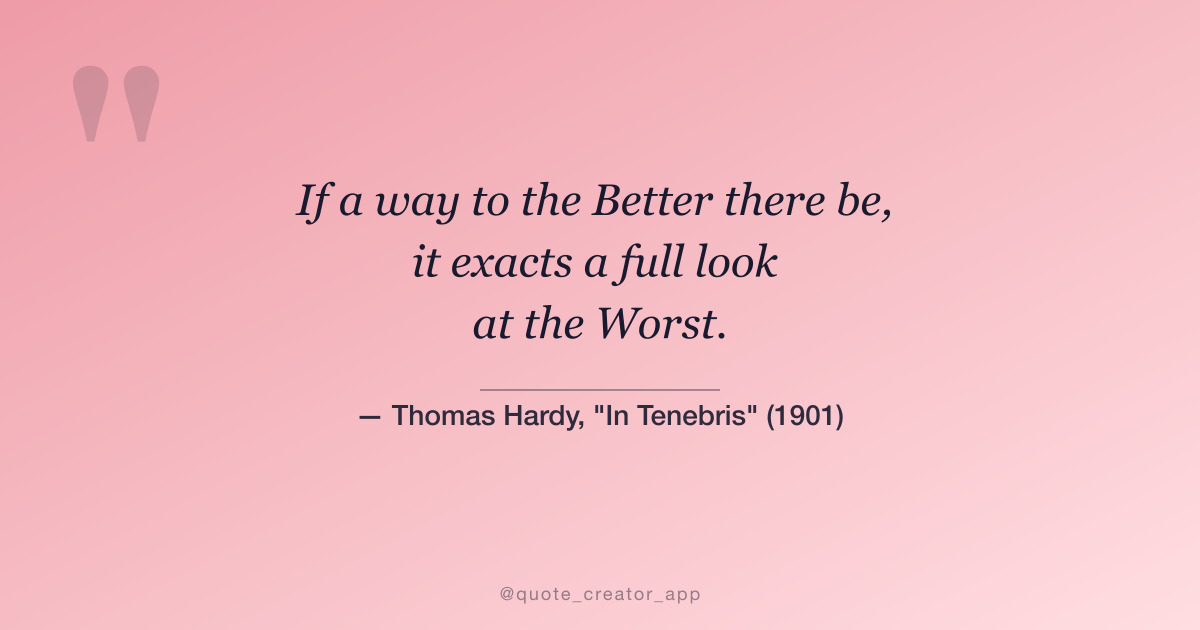
“If a way to the Better there be, it exacts a full look at the Worst.”
Editor’s note
Thomas Hardy’s challenge to face the worst before reaching the better is a bracing corrective in an age of curated feeds and relentless positivity. Real progress requires the courage to stare at suffering and darkness without flinching. If this resonates, try a ten-minute, unfiltered freewrite about the line and what it brings up.
— ThinkPeak Studio Editorial Team
What this quote means
On the surface, Hardy is making a simple but demanding claim: improvement is not free. If you genuinely want things to get better — in your life, in society, in yourself — you cannot look away from what is genuinely wrong. The path forward runs directly through an honest assessment of the worst of the current situation, not around it.
The deeper truth here is about the human instinct for comfortable avoidance. We are naturally drawn to optimism, to the hopeful story, to the reassuring half-truth. Hardy insists that this softening of reality is not kindness — it is an obstacle. Real progress requires the courage to stare at suffering, failure, and darkness without flinching, because it is only in that clear-eyed confrontation that genuine remedies can be found.
Hardy wrote these words in “In Tenebris,” a sequence of poems composed during one of the darkest periods of his life — his first marriage had grown cold and his novel Jude the Obscure had been savaged by critics and even publicly burned. He was writing from experience, not theory. The “full look at the Worst” was something he had been forced to take himself, and he had found — paradoxically — that it was survivable, even clarifying.
Today, this idea applies as powerfully as ever. In an age of curated feeds and relentless positivity, Hardy’s challenge is a bracing corrective. Whether you are working through a personal crisis, trying to fix a broken team, or grappling with larger social problems, the same principle holds: diagnosis before prescription, honesty before hope.
About Thomas Hardy
Thomas Hardy was born on June 2, 1840, in Higher Bockhampton, a small hamlet in Dorset, England. The son of a stonemason, he trained as an architect before turning to literature in his late twenties. His novels — set in a fictional region he called Wessex, based on the rural southwest of England — brought the lives of farmers, dairymaids, labourers, and village tradespeople into vivid, serious literary focus at a time when such characters were rarely treated as fit subjects for great fiction.
Hardy’s major novels — Far from the Madding Crowd (1874), The Return of the Native (1878), The Mayor of Casterbridge (1886), Tess of the d’Urbervilles (1891), and Jude the Obscure (1895) — established him as one of the greatest Victorian novelists. After the hostile reception to Jude the Obscure, he abandoned prose fiction entirely and devoted the second half of his career to poetry, producing more than nine hundred poems. He is now regarded as one of the most important English poets of the late nineteenth and early twentieth centuries as well.
Hardy died on January 11, 1928, at the age of 87. His heart was buried in the churchyard of Stinsford, Dorset, beside his first wife Emma — a quietly poignant ending for a man who had written so memorably about love, loss, and the passage of time. His ashes were interred in Poets’ Corner, Westminster Abbey, among the greatest writers in the English language.
Create your own quote graphic with this quote
This is the kind of quote that resonates most when it is presented visually. A clean typographic layout, a fitting color palette, and readable font sizing can transform these words into a graphic that people save and share. If you want to turn this quote into an Instagram post, WhatsApp status, Pinterest pin, or reel cover, Quotes Creator gives you all the tools to do it in minutes — custom fonts, gradients, backgrounds, and export sizes ready for every major platform.
Tips for designing this quote
- ✓ Use a serif font (Georgia, Playfair Display) to honour the literary feel of the quote
- ✓ Keep the quote on one or two lines — shorter display text reads better on mobile
- ✓ Pair the quote with a soft rose-to-pink gradient that matches its reflective, melancholic tone
- ✓ Add the author name in a smaller, lighter weight below the quote
- ✓ Export in square format for Instagram feed and portrait for Stories or Pinterest
Create your own quote graphic with this quote
Turn this line into a shareable graphic in seconds — free, no signup needed. For video quotes and 100+ templates, try the Android app.
Advertisement
Enjoyed this article? Get more like it in your inbox.