Quote of the Day: Walt Whitman on Containing Multitudes
The father of free verse on embracing contradiction as the signature of a genuinely lived life.
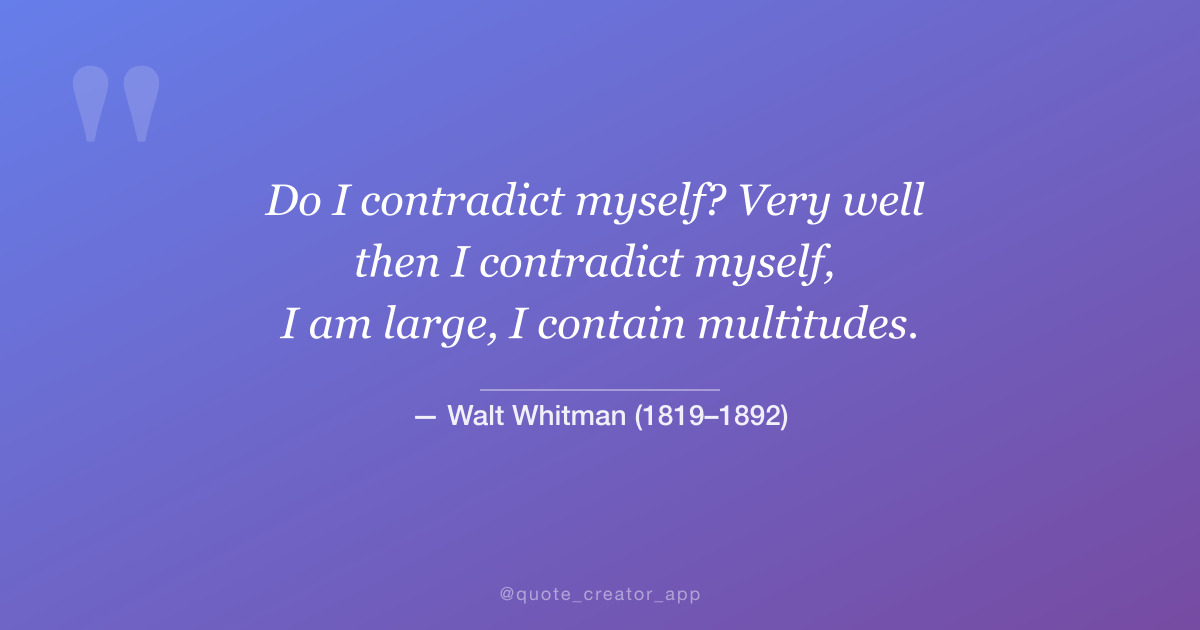
“Do I contradict myself? Very well then I contradict myself, I am large, I contain multitudes.”
Editor’s note
Born in 1819, Walt Whitman’s declaration that he contains multitudes remains one of the most liberating lines in American poetry. It reminds us that contradiction is not weakness but the signature of a genuinely lived life. If this resonates, try a ten-minute, unfiltered freewrite about the line and what it brings up.
— ThinkPeak Studio Editorial Team
What this quote means
On the surface, this passage — drawn from Section 51 of “Song of Myself,” the final and most celebrated poem in Leaves of Grass — is Whitman’s direct, unapologetic response to the charge of self-contradiction. He asks the question himself: “Do I contradict myself?” — and answers with breezy, almost gleeful confidence: “Very well then I contradict myself.” Rather than mounting a defence or offering explanations, he simply embraces the inconsistency. The last line delivers the full force of the argument: “I am large, I contain multitudes.”
The deeper truth here is a radical declaration of human complexity. At a time when nineteenth-century society — and especially its literature — prized moral consistency and rational orderliness, Whitman insisted that the human soul is not a narrow, predictable thing. To contain multitudes is to hold within yourself all the contradictions of lived experience: joy and grief, certainty and doubt, compassion and anger, faith and skepticism. The quote refuses the false choice between one version of yourself and another. It says: you need not pick. You are all of it. This is perhaps the most liberating idea in all of American poetry.
When Whitman published Leaves of Grass in 1855, the literary establishment was baffled and often hostile. The book had no clear precedent — it was not epic poetry, not proper Victorian lyric verse. It spoke openly about the body, democracy, and the working class in ways that scandalized polite society. “Song of Myself” is the collection’s enormous centrepiece: a sprawling, ecstatic 52-section poem in which the speaker — “Walt Whitman, a kosmos, of Manhattan the son” — identifies himself with every human being, every creature, every atom of the universe. The lines where this quote appears are his final, defiant send-off. He is not going to explain himself to critics; he is going to dissolve into the world and invite the reader to follow.
Today, in an age of social media where consistency of personal “brand” is constantly demanded — where people are expected to hold fixed opinions, never evolve, never change their minds — Whitman’s words cut with particular force. We are expected to be legible: to fit a category, maintain a coherent identity, never contradict our past selves. This quote is a reminder that contradiction is not weakness. It is the signature of a genuinely lived life, a mind still growing. Every person who has ever evolved in their thinking, or simply held two truths at once, will find permission in Whitman’s voice.
About Walt Whitman
Walter Whitman Jr. was born on May 31, 1819, in West Hills, on Long Island, New York, into a large family of modest means. His father was a farmer and carpenter; his mother, Louisa Van Velsor, came from a Dutch Quaker family known for warmth and good humour. Whitman left school at eleven to help support the family, working successively as an office boy, a printer’s apprentice, a schoolteacher, and eventually a journalist and newspaper editor. Through voracious self-education in Brooklyn’s libraries and bookshops, he absorbed Shakespeare, Homer, Dante, the King James Bible, and the works of Ralph Waldo Emerson — texts that would echo through every line of his mature poetry.
Whitman’s masterwork, Leaves of Grass, first appeared in 1855 as a slender, self-published volume of twelve untitled poems. Over the next four decades he revised and expanded it continuously through nine editions — a lifelong act of self-reinvention that mirrored the very theme of his greatest quote. He is today universally called the “father of free verse,” having abandoned the strictures of formal meter and rhyme in favour of long, muscular, biblical lines that matched the sprawl and democracy of the American experience. Ralph Waldo Emerson, upon receiving a copy, wrote to Whitman that he found it “the most extraordinary piece of wit and wisdom that America has yet contributed.” His influence on American and world literature — from Allen Ginsberg and Langston Hughes to Pablo Neruda and Federico García Lorca — is incalculable.
During the Civil War, Whitman served as a volunteer nurse in Washington D.C. military hospitals, visiting and comforting tens of thousands of wounded soldiers at his own expense. The experience transformed both the man and the poet, producing his haunting elegies for Lincoln (“O Captain! My Captain!”) and the deeply humane war poems collected in Drum-Taps (1865). In later life, partially paralyzed by a stroke, Whitman continued to write and receive literary admirers from around the world at his modest home in Camden, New Jersey. He died on March 26, 1892, at age 72, and was buried in a tomb he had personally designed — as characteristically grand and self-made as everything else about him.
Create your own quote graphic with this quote
This is the kind of quote that resonates most when it is presented visually. A clean typographic layout, a fitting colour palette, and readable font sizing can transform these words into a graphic that people save and share. If you want to turn this quote into an Instagram post, WhatsApp status, Pinterest pin, or reel cover, Quotes Creator gives you all the tools to do it in minutes — custom fonts, gradients, backgrounds, and export sizes ready for every major platform.
Tips for designing this quote
- ✓ Use a serif font (Georgia, Playfair Display) to honour the literary feel of the quote
- ✓ Keep the quote on two or three lines — shorter display text reads better on mobile
- ✓ Pair the quote with a cool indigo gradient that matches the tone of wisdom and depth
- ✓ Add the author name in a smaller, lighter weight below the quote
- ✓ Export in square format for Instagram feed and portrait for Stories or Pinterest
Turn this quote into a stunning graphic
Download Quotes Creator and design a shareable image from this quote in under a minute. Choose from dozens of templates, custom fonts, and backgrounds.
Create your own quote graphic with this quote
Turn this line into a shareable graphic in seconds — free, no signup needed. For video quotes and 100+ templates, try the Android app.
Advertisement
Enjoyed this article? Get more like it in your inbox.