Quote of the Day: Wendell Berry on Rising Joyful and Falling Without Regret
The Kentucky farmer-poet who spent six decades arguing that the care of the earth is our most worthy responsibility died at his home in Port Royal on August 31, 2026, at the age of 92. In the days since, readers around the world have returned to his books — and to this two-line prayer from The Mad Farmer Poems, which sums up a life lived in love with a place: rise joyful like a bird, fall without regret like a leaf.
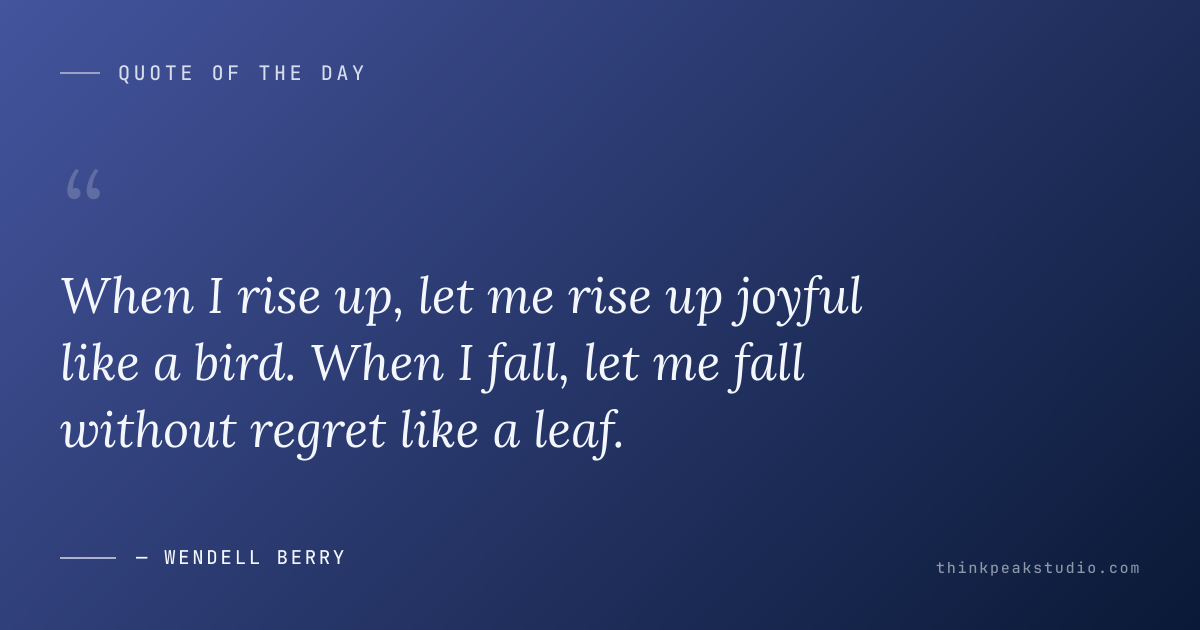
“When I rise up, let me rise up joyful like a bird. When I fall, let me fall without regret like a leaf.”
What this quote means
Wendell Berry wrote these lines inside Farming: A Hand Book, in the sequence that would later be gathered as The Mad Farmer Poems. They are written as a prayer — a small request addressed, without ceremony, to the world. The poem asks for only two things, and they are the two movements that every life is made of: the rising and the falling. Berry does not ask to rise high, or to fall late, or to escape the falling altogether. He asks only for the manner of each — that the rising be joyful, and that the falling be without regret.
The first half is the easier one to hear. To rise up joyful like a bird is to greet the day, the season, the work, with a gladness that is instinct rather than effort. Birds do not rise out of duty or ambition; they rise because it is morning, because the body answers the light. Berry, who woke each day on a Kentucky hillside above the river, knew that the best work is done in that spirit — the plowing, the writing, the mending of fences done not as a burden to be endured but as a life to be entered. But the second half is where the prayer becomes radical. To fall without regret like a leaf is to accept the end not as a defeat but as a completion. A leaf does not fall grudgingly; it lets go when its season is finished, and in letting go it feeds the ground it once grew from. Berry is asking for the courage to finish — to close a life, a book, a season, a relationship to a place, without clutching at it, without wishing it had been different.
It is easy to read the line and think Berry is only talking about death. But the mad farmer prays this every morning. Rising joyful and falling without regret is a discipline for the whole of a day, not just the end of one. You can rise joyful into a Tuesday and fall without regret at its close — having done the work you could do, loved the people you could love, and let go of the rest. The leaf that falls without regret is the leaf that was fully alive all summer. Berry spent a lifetime insisting that the good life is a life of attention, fidelity, and belonging to a place; this prayer is the distilled version of that creed. Live so fully attached that when you are released, you can let go cleanly. Love so completely that you are never sorry you did.
About Wendell Berry
Wendell Erdman Berry was born on August 5, 1934, in Louisville, Kentucky, to John Marshall Berry, a lawyer and tobacco farmer, and Virginia Erdman Perry. Both his parents’ families had farmed in Henry County for at least five generations, and the land along the Kentucky River would become the center of his life and work. He earned a B.A. in 1956 and an M.A. in 1957 in English at the University of Kentucky, married Tanya Amyx in 1957, and in 1958 studied creative writing at Stanford under Wallace Stegner alongside Larry McMurtry, Ernest Gaines, Robert Stone, and Ken Kesey. His first novel, Nathan Coulter, appeared in 1960.
He began teaching English at the University of Kentucky in 1964, but on July 4, 1965, he did the thing that would define him: he and Tanya and their two children moved to Lane’s Landing, a twelve-acre farm he had purchased near Port Royal, on the western bank of the Kentucky River. The farm grew to about 117 acres, and Berry farmed, resided, and wrote there for the rest of his life — growing corn and small grains, keeping Border Cheviot sheep, and turning his own daily rounds into a body of work unlike any other in American letters. He resigned from the university in 1977 and never looked back, choosing the interdependence of a working farm over the independence of an academic career, and spending the next half-century testing in practice what he argued in prose.
His arguments were made in landmark books: The Unsettling of America: Culture and Agriculture (1977), a sustained indictment of industrial agriculture that has never gone out of print; The Gift of Good Land (1981); and the great Port William novels and stories — A Place on Earth, The Memory of Old Jack, Jayber Crow, Hannah Coulter — chronicling a fictional Kentucky town and its “membership,” in which people hold one another in a kind of presence even across distance and death. He published more than fifty books of poetry, essays, and fiction, and became, in Jedediah Britton-Purdy’s phrase, a writer of praise for the quiet, mostly uncelebrated labor and affection that keep the world whole. In 2018, he became one of the very few living writers admitted to the Library of America, which began publishing his collected fiction and essays.
He was also one of the most principled activists of his generation. He spoke out against the Vietnam War in 1968, engaged in nonviolent civil disobedience against a nuclear power plant in 1979 and against mountaintop-removal coal mining in 2011, removed his papers from the University of Kentucky in 2009 over its embrace of the coal industry, and co-authored a 2009 New York Times op-ed calling for a 50-year farm bill. He received the National Humanities Medal in 2010, delivered the 41st Jefferson Lecture in 2012, and in 2015 became the first living writer inducted into the Kentucky Writers Hall of Fame. He died at home in Port Royal on August 31, 2026, at the age of 92. His Wikipedia page, which typically drew a few hundred views a day, surged past 82,000 on September 1 as the world opened his books one last time — and found, in lines like this one, exactly what he always promised: a way of being that accepts no permanent damage, and lets go without regret.
Create your own quote graphic with this quote
Few lines deserve a quiet, beautiful frame more than this one. A clean typographic layout, an earthy green-and-gold palette, and generous whitespace can turn these two sentences into a graphic people save and share — a reminder to rise joyful and fall without regret. If you want to make a quote card from this — or any quote — Quotes Creator gives you the fonts, gradients, backgrounds, and export sizes to do it in minutes, ready for Instagram, Stories, Pinterest, and everywhere else.
Editor’s note
Wendell Berry is one of the most-read people on the internet this week. His Wikipedia page, which normally drew only a few hundred views a day, surged past 82,000 views on September 1, 2026 — the morning after he died at his farm in Port Royal, Kentucky, at the age of 92. We are featuring this quote because it is the whole of his teaching in one breath: a prayer for rising joyful into the day and falling without regret when the season ends. For sixty years Berry argued that the good life is not a matter of accumulating more but of belonging more deeply — to a place, to a community, to the work of our hands — and that caring for the earth is the oldest and most worthy responsibility we have. His final gift to readers is this line, and it is also his permission slip: love fully, work faithfully, and when it is time to go, go cleanly. Before your next ordinary morning, ask yourself what a bird knows by instinct and a leaf obeys without complaint — can you rise joyful, and can you fall without regret?
— ThinkPeak Studio Editorial Team
Tips for designing this quote
- ✓ Use deep woodland greens and harvest gold to echo Berry’s Kentucky farmland and the turning season
- ✓ Keep the text centered and italic in a serif font so it reads like the small prayer it was written to be
- ✓ Break the quote so that “rising joyful” and “falling without regret” land on their own lines as twin movements
- ✓ Add a subtle gradient background rather than a flat color to suggest morning light on the river
- ✓ Export in square format for Instagram feed and portrait for Stories or Pinterest
Create your own quote graphic with this quote
Turn this line into a shareable graphic in seconds — free, no signup needed. For video quotes and 100+ templates, try the Android app.
Advertisement
Enjoyed this article? Get more like it in your inbox.


