Quote of the Day: W. B. Yeats on Passionate Intensity
The Nobel Prize-winning poet on conviction, chaos, and the centre that cannot hold.
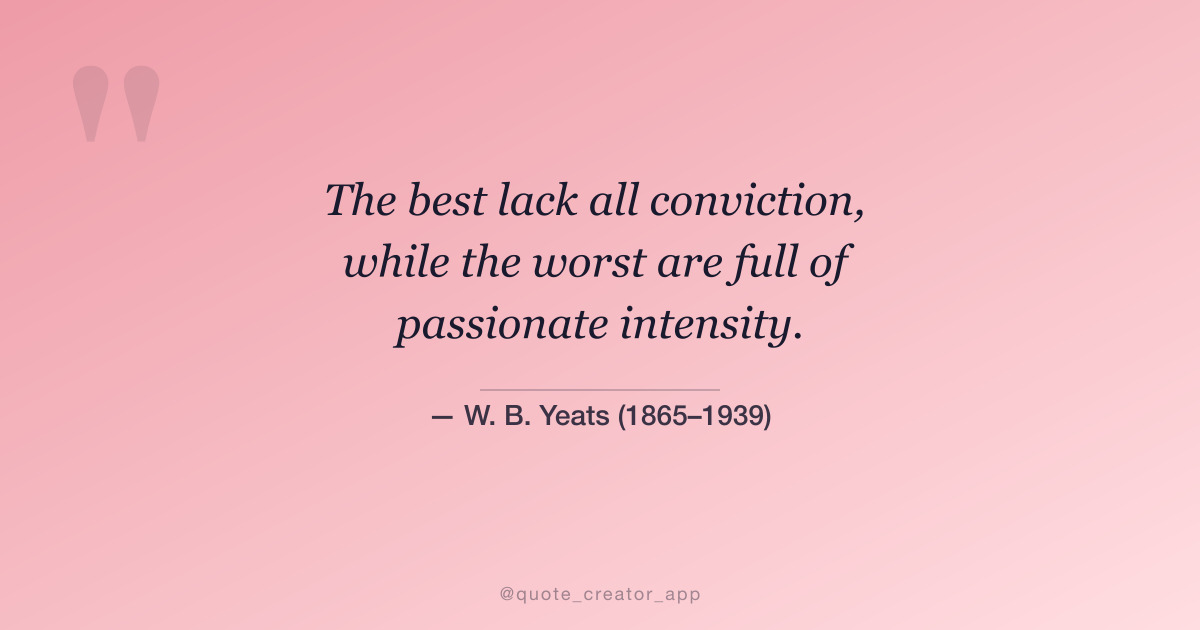
“The best lack all conviction, while the worst are full of passionate intensity.”
Editor’s note
Born on this day in 1865, W. B. Yeats wrote these lines in “The Second Coming” over a century ago, yet they ring as true today as they did in 1919. They capture the vertigo of an age unmoored — and challenge us to ask: in our own lives, where are we holding conviction, and where have we let it slip? If this resonates, take five minutes today to name one thing you believe in deeply and why.
— ThinkPeak Studio Editorial Team
What this quote means
On the surface, this couplet from Yeats’ 1919 poem “The Second Coming” draws a devastating contrast between two groups of people. The “best” — those of integrity, intelligence, and moral clarity — have lost their sense of certainty and purpose. They hesitate, question themselves, and retreat from action. Meanwhile, the “worst” — those driven by cruelty, ambition, or fanaticism — act with total, unshakable conviction. The poem’s stark binary exposes a terrifying paradox: that in times of crisis, the most dangerous people are often the most certain, and the most virtuous the most paralysed.
The deeper insight is that conviction itself is not a virtue — it depends entirely on what it serves. Yeats understood that passionate intensity without moral direction produces catastrophe. The line also speaks to a structural truth about social collapse: systems don’t fail because evil triumphs over good, but because good people abdicate their responsibility. When those who know better fall silent, the void is filled by those who shout loudest. The poem’s enduring power lies in its refusal to comfort — it simply holds up a mirror to a civilisation losing its centre.
Yeats wrote “The Second Coming” in January 1919, just months after the armistice that ended World War I — a conflict that had shattered faith in progress, reason, and the benevolent arc of history. The Russian Revolution had succeeded, civil war raged in Ireland, and the Spanish flu was killing millions worldwide. Yeats, deeply influenced by his occult studies and wife Georgie’s automatic writing, believed history moved in two-thousand-year cycles. He felt the Christian era was ending and something “rough beast” was slouching toward Bethlehem to be born. The poem is the most famous expression of millenarian anxiety in modern literature.
In the twenty-first century, these lines have become a kind of shorthand for political and cultural polarisation. They appear in op-eds, protest signs, and social media threads whenever the centre seems unable to hold — from the Brexit referendum to the Capitol riots, from corporate boardrooms to family dinner tables. The quote is a reminder that passionate intensity is not the same as truth, and that the absence of conviction in thoughtful people has real-world consequences. It challenges us to examine where we place our certainty and whether we have earned the right to it.
About W. B. Yeats
William Butler Yeats was born on June 13, 1865, in Sandymount, County Dublin, Ireland. His father, John Butler Yeats, was a respected painter; his mother, Susan Pollexfen, came from a wealthy Sligo family steeped in folklore and legend. The young Yeats divided his childhood between Dublin, London, and the County Sligo countryside — whose mythic landscape would haunt his imagination for the rest of his life. He studied at the Metropolitan School of Art in Dublin but soon abandoned painting for poetry, publishing his first works in the 1880s under the spell of the Romantics and the Pre-Raphaelites.
Yeats became the central figure of the Irish Literary Revival, a movement that sought to reclaim and reimagine Celtic heritage as the foundation of a national Irish culture. Alongside John Millington Synge and Lady Gregory, he co-founded the Abbey Theatre in 1904, serving as its chief playwright and director. His poetry evolved dramatically over five decades — from the languid, dreamy symbolism of his early work to the hard-edged, muscular modernism of his later masterpieces. He was awarded the Nobel Prize in Literature in 1923, and later served two terms as a Senator of the Irish Free State. His most famous poems — “The Second Coming,” “Sailing to Byzantium,” “Easter 1916,” “Among School Children” — are cornerstones of the English-language canon.
An intriguing and lesser-known side of Yeats was his lifelong fascination with the occult. He joined the Hermetic Order of the Golden Dawn in 1890 and remained a committed esotericist for decades. In 1917, he married Georgie Hyde-Lees, who surprised him by claiming to channel spirits through automatic writing. Yeats took this phenomenon with profound seriousness, systematising the communications into his philosophical treatise A Vision (1925), which shaped his later poetry. Far from the genteel, romantic image sometimes attached to him, Yeats was a man of deep contradictions — a mystic who loved politics, a moderniser rooted in ancient myth, a passionate soul simultaneously drawn to order and chaos. He died in the south of France on January 28, 1939, at the age of 73.
Create your own quote graphic with this quote
This is the kind of quote that resonates most when it is presented visually. A clean typographic layout, a fitting colour palette, and readable font sizing can transform these words into a graphic that people save and share. If you want to turn this quote into an Instagram post, WhatsApp status, Pinterest pin, or reel cover, Quotes Creator gives you all the tools to do it in minutes — custom fonts, gradients, backgrounds, and export sizes ready for every major platform.
Tips for designing this quote
- ✓ Use a serif font (Georgia, Playfair Display) to honour the literary feel of the quote
- ✓ Keep the quote on two or three lines — shorter display text reads better on mobile
- ✓ Pair the quote with a soft rose gradient that matches the tone of passion and urgency
- ✓ Add the author name in a smaller, lighter weight below the quote
- ✓ Export in square format for Instagram feed and portrait for Stories or Pinterest
Turn this quote into a stunning graphic
Download Quotes Creator and design a shareable image from this quote in under a minute. Choose from dozens of templates, custom fonts, and backgrounds.
Create your own quote graphic with this quote
Turn this line into a shareable graphic in seconds — free, no signup needed. For video quotes and 100+ templates, try the Android app.
Advertisement
Enjoyed this article? Get more like it in your inbox.