Quote of the Day: William Gibson on the Future’s Uneven Arrival
Trending as the upcoming Neuromancer television adaptation reignites interest in the godfather of cyberpunk, Gibson’s most-quoted line has never felt more relevant in an age where some commute in driverless cars while others still struggle for broadband access.
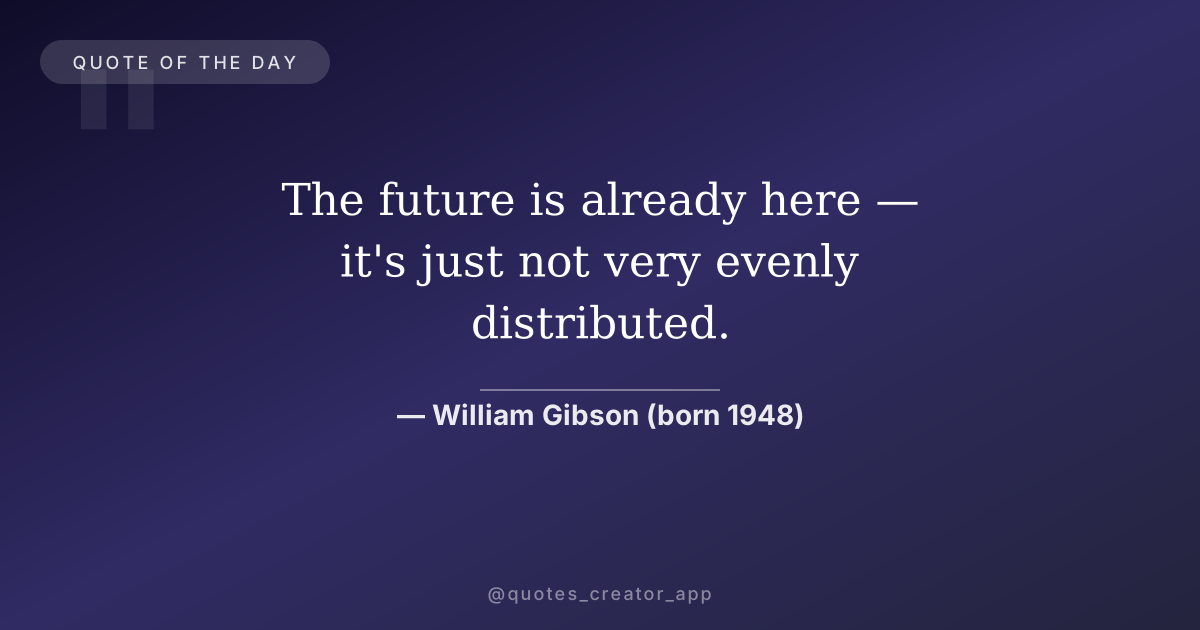
“The future is already here — it’s just not very evenly distributed.”
What this quote means
On its surface, Gibson’s observation is a wry commentary on technological adoption. The future does not arrive all at once, like a curtain rising on a new act. It trickles in through the uneven channels of wealth, geography, and infrastructure. The richest cities get hyperloop stations while rural towns lose their last bus route. One office has holographic conferencing; another still fights with Zoom audio lag. Gibson compresses this entire landscape of inequality into a single, almost throwaway line — but its weight has only grown heavier with time.
The deeper insight is about perception itself. We tend to imagine the future as a destination we all reach together, a bright tomorrow that arrives uniformly like dawn. Gibson rejects this. Instead, the future is already all around us, but it is fragmented — a patchwork of eras coexisting uneasily. Your smartphone is a science fiction device from the 1960s, but it sits in the same pocket as keys that have not changed their fundamental design in a century. The future, Gibson suggests, is not a time but a distribution problem. It is a question of who gets access, who gets left behind, and who gets to decide what “progress” even means.
This quote has taken on a second life in discussions of technology ethics, AI access, and the digital divide. When self-driving taxis roam San Francisco but parts of Appalachia lack reliable cell service, when a teenager in Seoul learns from an AI tutor while one in Kinshasa cannot find a textbook — these are not failures of innovation. They are failures of distribution. Gibson saw this coming long before the terms “digital divide” or “AI access gap” entered the lexicon. He understood that technology does not liberate evenly; it liberates along the contours of existing power and privilege.
There is also a quieter, more personal reading of the line. The future is already here, within you — your potential, your capacity to grow and change — but it is not evenly distributed across your own life either. Some days you are the future: sharp, present, unstoppable. Other days you are catching up with a version of yourself that arrived ahead of schedule. Gibson’s line, for all its technological overtones, is ultimately about the human condition: we are all living in multiple eras at once, and the only honest response is to acknowledge the unevenness.
About William Gibson
William Ford Gibson was born on March 17, 1948, in Conway, South Carolina, and grew up in the small Appalachian town of Wytheville, Virginia. His childhood was marked by the sudden death of his father when Gibson was six years old, a traumatic break that he later described as having “curious advantages for the artist.” Raised by his mother in a deeply conservative town that distrusted modernity, Gibson retreated into science fiction, Beat literature, and the music of punk rock — the raw materials that would later define his voice as a writer.
After his mother’s death when he was 18, Gibson dropped out of school and drifted through the counterculture of the late 1960s, eventually moving to Canada to avoid the Vietnam War draft. He settled in Vancouver, married Deborah Thompson, and after years of odd jobs and thrift-store dealing, enrolled at the University of British Columbia, where he earned a degree in English literature. It was there, in a science fiction course taught by Susan Wood, that he wrote his first short story, “Fragments of a Hologram Rose.”
Gibson’s debut novel, Neuromancer (1984), arrived like a thunderbolt. It was the first novel to win science fiction’s “triple crown” — the Hugo, Nebula, and Philip K. Dick Awards — and it single-handedly launched the cyberpunk movement. Gibson coined the term “cyberspace” in his 1982 short story “Burning Chrome,” and in Neuromancer he gave it a visual and emotional vocabulary that would shape the internet age: a “consensual hallucination” where data danced with human consciousness. The novel sold over 6.5 million copies and changed how the world imagined technology, influencing everything from The Matrix to the design of modern user interfaces.
Gibson followed with the Sprawl trilogy (Count Zero, Mona Lisa Overdrive), the steampunk collaboration The Difference Engine with Bruce Sterling, the Bridge trilogy, and later the Blue Ant novels, which brought him mainstream bestseller status. His more recent Jackpot trilogy, beginning with The Peripheral (2014), has been adapted into an Amazon television series. Throughout his career, Gibson has been described by The Guardian as “probably the most important novelist of the past two decades” and by The Sydney Morning Herald as the “noir prophet” of cyberpunk. Now 78, he continues to write and speak about the accelerating weirdness of a world he helped invent.
Create your own quote graphic with this quote
Gibson’s words deserve a visual treatment as clean and futuristic as the ideas they carry. A dark, cosmic palette with neon accents, a sharp sans-serif typeface, and minimal layout design can make this quote feel like a dispatch from tomorrow. If you want to turn this quote into an Instagram post, Twitter banner, or WhatsApp status, Quotes Creator gives you all the tools to do it in minutes — custom fonts, gradients, backgrounds, and export sizes ready for every major platform.
Editor’s note
With the Neuromancer TV series now in production and Gibson’s page on Wikipedia surging past 10,000 daily views, his work is enjoying a full cultural resurgence. It is a fitting moment for this particular quote, which has become something of a mantra for anyone trying to make sense of the gap between what technology promises and what it actually delivers. In 2026 — a year in which AI writes code, private companies race to Mars, and half the world still lacks reliable internet — the future has indeed arrived. It is just, as Gibson warned us, not very evenly distributed.
— ThinkPeak Studio Editorial Team
Tips for designing this quote
- ✓ Use a dark, cosmic background (deep purples, midnight blues) to evoke Gibson’s cyberpunk aesthetic
- ✓ Pair with a neon accent color (cyan, electric violet) for the quote text or decorative elements
- ✓ Keep typography minimal — the quote is philosophical, not punchy; let the words breathe
- ✓ Add a subtle grid pattern or pixelated border to nod at the digital themes Gibson pioneered
- ✓ Export in landscape for Twitter and LinkedIn, or square for Instagram and Pinterest
Create your own quote graphic with this quote
Turn this line into a shareable graphic in seconds — free, no signup needed. For video quotes and 100+ templates, try the Android app.
Advertisement
Enjoyed this article? Get more like it in your inbox.