Quote of the Day: William Styron on Despair and Hope
Born on this day in 1925, William Styron was one of America’s most celebrated novelists — and his unflinching memoir about depression gave language to a pain millions endure in silence.
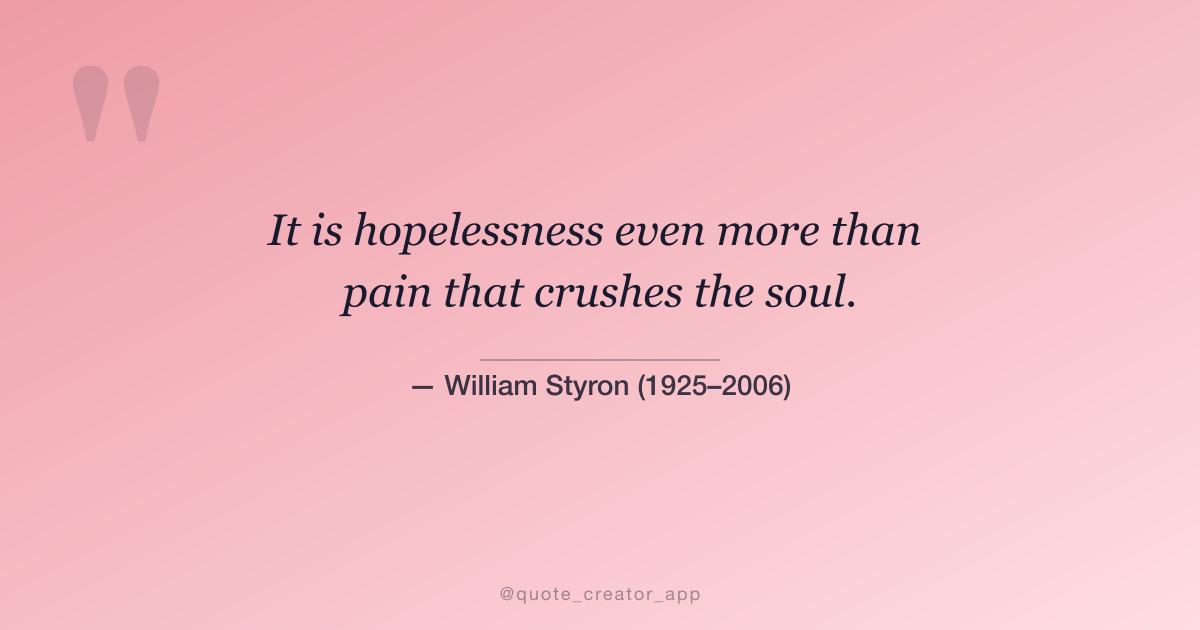
“It is hopelessness even more than pain that crushes the soul.”
What this quote means
On the surface, Styron is making a stark distinction between two kinds of suffering: physical pain and the loss of hope. Pain, however intense, can often be endured because we trust it will end. We have medications, treatments, and the body’s own capacity to heal. But hopelessness strips away that trust in the future — it removes the belief that relief will come, and with that belief goes the very will to keep going.
The deeper insight is that human beings are wired for hope. We can withstand extraordinary physical hardship as long as we believe there is a reason to endure — a light at the end of the tunnel, a promise of better days. Hopelessness attacks at precisely this level. It does not merely add to our pain; it cancels out the future itself, leaving only an endless, unchanging present of suffering. That is why, Styron argues, hopelessness is the more devastating force: it dismantles the psychological architecture that makes endurance possible.
Styron wrote these words from intimate experience. In 1985, at the height of his literary success, he was struck by a crippling depression that nearly drove him to suicide. Darkness Visible, published five years later, was his attempt to put words to an illness he felt was woefully misunderstood. He was frustrated by the word “depression” itself, calling it “a true wimp of a word for such a major illness” — too bland and ordinary to capture the ferocity of what he experienced. The memoir became a lifeline for countless readers who had suffered in silence, uncertain whether anyone else could understand what they were going through.
For anyone who has ever felt the weight of despair — whether from depression, grief, or life’s cruel reversals — this quote offers a kind of validation. It names the enemy. And in naming it, it takes the first step toward fighting it. Styron himself recovered, and he ended his memoir on a note of hard-won hope: “Depression is not the soul’s annihilation; it is conquerable.” The hopelessness he wrote about was real, but so was the possibility of emerging from it.
About William Styron
William Clark Styron Jr. was born on June 11, 1925, in Newport News, Virginia. He lost his father at age thirteen and was raised by his mother, who instilled in him a love of reading. After serving in the Marine Corps during World War II, he returned to complete his education at Duke University, where a creative writing teacher recognized his raw talent and encouraged him to pursue fiction. Styron moved to New York City, worked briefly as a manuscript reader, and then — fired from his job — committed himself entirely to writing his first novel.
That novel, Lie Down in Darkness (1951), was published when Styron was just twenty-six and won the Prix de Rome. He went on to write The Confessions of Nat Turner (1967), which won the Pulitzer Prize for Fiction, and Sophie’s Choice (1979), which was adapted into an Academy Award-winning film. But it was his slender, devastating memoir Darkness Visible (1990) that may have had the deepest cultural impact — a book that changed how the public talked about clinical depression and helped destigmatize one of the most misunderstood illnesses of our time.
A lesser-known fact about Styron is that he spent years quietly advocating for writers facing censorship and political persecution. He served as president of the American Academy of Arts and Letters and was a vocal opponent of the death penalty, a stance shaped partly by his friendship with the existentialist Albert Camus. Styron died in 2006 at the age of eighty-one, having left behind a body of work that wrestles unflinchingly with the darkest corners of human experience — and finds, in the end, a reason to go on.
Create your own quote graphic with this quote
This is the kind of quote that resonates most when it is presented visually. A clean typographic layout, a fitting color palette, and readable font sizing can transform these words into a graphic that people save and share. If you want to turn this quote into an Instagram post, WhatsApp status, Pinterest pin, or reel cover, Quotes Creator gives you all the tools to do it in minutes — custom fonts, gradients, backgrounds, and export sizes ready for every major platform.
Editor’s note
Born in 1925, William Styron’s line — “It is hopelessness even more than pain that crushes the soul” — resonates deeply on June 11, 2026. His reminder that hope is not a luxury but a psychological necessity feels especially urgent in times when despair feels easier than optimism. If these words speak to you, consider reaching out to someone you trust — Styron’s own recovery began when he shared his darkness with others.
— ThinkPeak Studio Editorial Team
Tips for designing this quote
- ✓ Use a serif font (Georgia, Playfair Display) to honour the literary feel of the quote
- ✓ Keep the quote on one or two lines — shorter display text reads better on mobile
- ✓ Pair the quote with a soft gradient that matches the emotional tone: soft rose for compassion and humanity
- ✓ Add the author name in a smaller, lighter weight below the quote
- ✓ Export in square format for Instagram feed and portrait for Stories or Pinterest
Create your own quote graphic with this quote
Turn this line into a shareable graphic in seconds — free, no signup needed. For video quotes and 100+ templates, try the Android app.
Advertisement
Enjoyed this article? Get more like it in your inbox.