Quote of the Day: Yayoi Kusama on Being One Dot Among a Million Stars
The artist who covered the world in polka dots died on August 14, 2026, at the age of 97. Days after her death sent millions back to her words, the sentence she wrote in her autobiography has never felt more alive — a reminder that the smallest mark in the cosmos is still part of the whole.
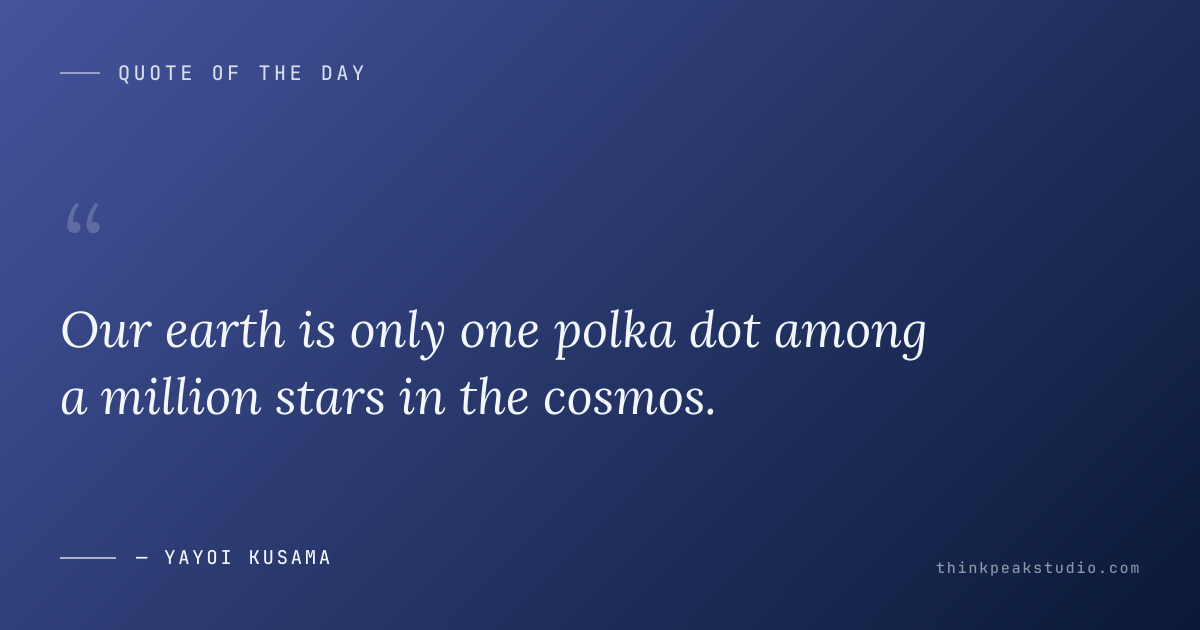
“Our earth is only one polka dot among a million stars in the cosmos.”
What this quote means
Read on its surface, the sentence is a small cosmic humbling. The Earth — the entire planet, with its seven continents, its oceans, its eight billion people — is, in Kusama’s telling, nothing more than one polka dot among a million stars. She takes the motif she is famous for and scales it up to the size of the universe. The dot is no longer decoration; it is the fundamental unit of existence. In a single image she collapses the vastness of astronomy into the friendly, round, repeatable shape of a child’s drawing.
But the deeper insight is that smallness, in Kusama’s philosophy, is not insignificance — it is connection. A polka dot, she said, “can’t stay alone”; dots only make sense in relation to other dots. The Earth is small because the cosmos is huge, and that is exactly why it belongs. She called her lifelong project “self-obliteration” — the dissolving of the separate self into the pattern of the whole. This quote is that idea in prose: to be a dot among dots is not to be nothing; it is to be part of everything. The sentence quietly frees us from the exhausting demand to be the center — and hands us, in exchange, a place in the pattern.
The words carry the weight of her biography. Kusama began, as a child, to see “flashes of light, auras, or dense fields of dots” — hallucinations in which flowers spoke and fabric patterns swelled and swallowed her. She transformed that terror into her signature style, and art became her survival. From 1977 she lived, by choice, in a psychiatric hospital in Tokyo, walking each day across the street to the studio where she kept working. “If it were not for art,” she often said, “I would have killed myself a long time ago.” Written in her autobiography Infinity Net, this sentence condenses a life spent turning fear into beauty — and turning the most ordinary shape in the world into a gateway to the infinite.
It applies to everyday life because it reframes how we measure our importance. When the pressure to be exceptional becomes crushing, Kusama offers a gentler scale: you do not have to be the whole sky — only one honest dot in it, holding your place among the others. In a culture obsessed with standing out, the sentence is a radical permission to be small and connected, to belong rather than to tower. Next time you feel invisible, remember that stars are also dots, and the night sky is made entirely of them.
About Yayoi Kusama
Yayoi Kusama was born on March 22, 1929, in Matsumoto, Nagano, into a wealthy family that ran a plant nursery and seed farm. Her childhood was unhappy: her mother was physically and emotionally abusive, her father spent much of his time with other women, and Kusama was sent to spy on his affairs — experiences she later said instilled in her a lifelong aversion to sex and the male body. At ten, she began having hallucinations of dots and talking flowers; at thirteen she was sewing parachutes in a military factory during World War II. Despite her mother’s opposition, she studied traditional nihonga painting in Kyoto, grew restless with it, and in 1958 moved to New York City, where she corresponded with Georgia O’Keeffe and became a fixture of the 1960s avant-garde — staging happenings in which naked participants were painted with bright polka dots, and influencing contemporaries including Andy Warhol and Claes Oldenburg.
She returned to Japan in 1973 and, in 1977, voluntarily checked into Seiwa Hospital, where she chose to live for the rest of her life, working daily in a studio across the street. Interest in her work revived in the 1980s, and her fame grew into something rare for a living artist: a solo presentation in Japan’s pavilion at the Venice Biennale in 1993, blockbuster Infinity Mirror Rooms that drew hours-long queues at museums worldwide, collaborations with Louis Vuitton in 2012 and 2023, her own museum in Shinjuku opening in 2017, and a ranking as one of the world’s best-selling female artists — #19 on Sotheby’s 2023 list of the top 50 artists. She died on August 14, 2026, in a Tokyo hospital, aged 97, having kept painting nearly to the end.
A lesser-known side of Kusama: she was as much a writer as a painter. Alongside her canvases and pumpkins she published novels, poetry, and the autobiography Infinity Net, from which this quote comes. Her appetite was famously undimmed — “I want to become more famous, even more famous,” she insisted — and she described the approach of death as the brightening of her life: “The older I become, and the closer death approaches, the brighter my life gets day by day.”
Create your own quote graphic with this quote
This is the kind of quote that resonates most when it is presented visually. A clean typographic layout, a fitting color palette, and readable font sizing can transform these words into a graphic that people save and share. If you want to turn this quote into an Instagram post, WhatsApp status, Pinterest pin, or reel cover, Quotes Creator gives you all the tools to do it in minutes — custom fonts, gradients, backgrounds, and export sizes ready for every major platform.
Editor’s note
Yayoi Kusama was one of the most-read people on the internet this week. Her Wikipedia page — which typically draws around 800 views a day — spiked to 232,885 views on August 27, 2026, as obituaries and tributes appeared across the world following her death on August 14. Among all the words written about her, the sentence readers keep sharing is the one she wrote herself about being a single polka dot among a million stars. It is the clearest statement of the philosophy she lived: that art could turn pain into connection, and that no one is too small to belong to the whole. Before you share it, ask yourself what your own dot looks like — and whether you are letting it take its place in the pattern.
— ThinkPeak Studio Editorial Team
Tips for designing this quote
- ✓ Use a fuchsia-to-coral gradient that echoes Kusama’s polka-dot palette and her Infinity Mirror Rooms
- ✓ Keep the text centered and italic in a serif font for a calm, cosmic feel that matches the message
- ✓ Let the words breathe on two short centered lines — the contrast between “polka dot” and “million stars” deserves the pause between them
- ✓ Add a subtle pattern of dots behind the text as a quiet nod to her signature motif
- ✓ Export in square format for Instagram feed and portrait for Stories or Pinterest
Create your own quote graphic with this quote
Turn this line into a shareable graphic in seconds — free, no signup needed. For video quotes and 100+ templates, try the Android app.
Advertisement
Enjoyed this article? Get more like it in your inbox.


