On this page
- 1. “Courage starts with showing up and letting ourselves be seen.”
- 2. “It’s not about being the best. It’s about being better than you were yesterday.”
- 3. “The impediment to action advances action. What stands in the way becomes the way.”
- 4. “Discipline equals freedom.”
- 5. “I don’t stop when I’m tired. I stop when I’m done.”
- 6. “You can choose courage, or you can choose comfort, but you cannot choose both.”
- 7. “The obstacle in the path becomes the path. Never forget, within every obstacle is an opportunity to improve our condition.”
- 8. “The more you sweat in peace, the less you bleed in war.”
- Designing quote graphics for “Courage & Fear”
8 Quotes About Courage From Four Voices Who Live It Daily
Courage has a branding problem. We picture it as a single heroic moment — a battlefield, a courtroom, a last stand — when in fact the people most qualified to talk about it describe something far more ordinary: a choice, repeated daily, to act while scared. The four voices in this collection are not poets of courage; they are practitioners. A former Navy SEAL who turned impossible standards into a philosophy of self-discipline. A researcher who spent two decades studying vulnerability and concluded that courage is the prerequisite for every other virtue. A modern Stoic who rebuilt an ancient tradition around the simple claim that the obstacle is the way. And a combat veteran who reduced leadership to a single equation: discipline equals freedom. This collection brings together eight of their most direct statements on what courage actually is — not the absence of fear, but the decision to move anyway.
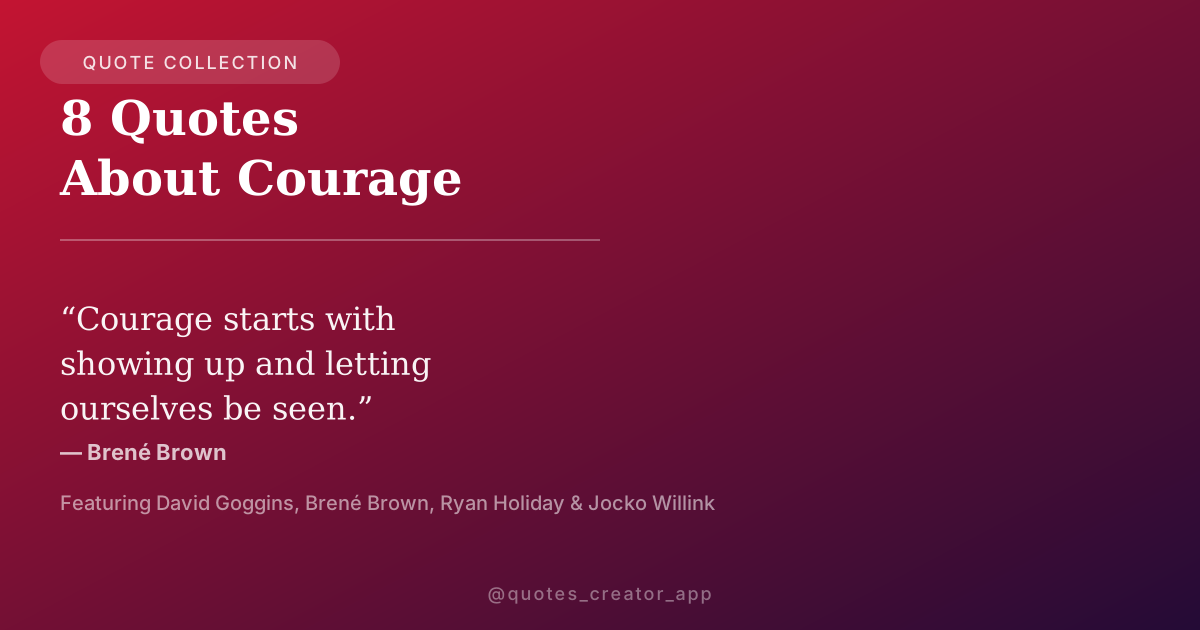
1. “Courage starts with showing up and letting ourselves be seen.”
Brené Brown opens Daring Greatly with this line, and it quietly reverses the entire order of operations most of us assume about bravery. We tend to think courage begins with certainty — that you must feel ready, sure, and armored before you step forward. Brown argues the opposite: courage begins with exposure. To show up and be seen is to risk judgment, rejection, and failure while still being present enough to be affected by the outcome. That is why her research keeps arriving at the same conclusion — vulnerability is not the opposite of courage, it is its birthplace. The person who hides, hedges, or waits until they feel invincible never actually gets to be brave, because courage is only possible where there is something real to lose. Showing up is the whole game; everything else is logistics.
— Brené Brown, Daring Greatly (2012)
2. “It’s not about being the best. It’s about being better than you were yesterday.”
David Goggins built a cult following on the back of sentences like this one, and its power is that it removes the only excuse that keeps most people from acting: the belief that you are not good enough. Goggins reframes courage as a private competition with your past self rather than a public contest against the world. You do not need to be the strongest person in the room to be brave; you need to be stronger than the version of yourself that gave up yesterday. That single reframe makes courage available to everyone, on every ordinary day, with no audience required. Goggins has spent his career proving the point — a man once told he had no future who went on to become a Navy SEAL, an ultramarathon runner, and a record-holding pull-up artist, not because he was talented but because he refused to let yesterday define today.
— David Goggins, Can’t Hurt Me (2018)
3. “The impediment to action advances action. What stands in the way becomes the way.”
Ryan Holiday’s translation of Marcus Aurelius is the most counterintuitive statement in this collection, because it treats obstacles not as things to overcome but as the raw material of the path itself. The Stoic tradition Holiday writes from insists that adversity is not a detour from your goal — it is the goal, repackaged as resistance. A setback reveals what you are made of. A closed door forces a better route. A crisis compels the focus that comfort never could. This is courage redefined as reframing: the brave person does not need less difficulty, only the right relationship to it. Where most of us spend our energy wishing the obstacle away, the Stoic spends it asking what the obstacle is trying to teach. The way forward, Holiday suggests, is almost never through an obstacle-free life. It is through the obstacles themselves.
— Ryan Holiday, The Obstacle Is the Way (2014)
4. “Discipline equals freedom.”
Jocko Willink’s three words are the shortest definition of courage in this collection, and the reason they land so hard is that they refuse the comfortable lie that freedom means doing whatever you feel like. Real freedom, Willink argues, is the ability to do what you know you should — to wake up early, train when you are tired, say no when it is tempting to say yes — and that ability is built entirely through discipline. The discipline is the hard part, the part that requires daily courage, and the freedom is the payoff. A man who commanded SEAL teams in the bloodiest urban battle of the Iraq War knows the trade better than most: the teams that trained hardest in peacetime suffered least in combat. Courage, in his formulation, is not a rare lightning strike. It is a habit, rehearsed so often that when the moment arrives, your training acts before your fear can.
— Jocko Willink, Extreme Ownership (2015)
5. “I don’t stop when I’m tired. I stop when I’m done.”
David Goggins’s most quoted line reads like a gym slogan, but it is actually a precise theory of courage under fatigue. Tiredness is not a reason to stop; it is simply information, and usually the first signal that the real work is beginning. Goggins built his entire public persona around this idea — finishing Navy SEAL Hell Week, running hundred-mile ultramarathons with broken feet, completing the MOAB’s 205-mile race — all by divorcing the decision to continue from the feeling of exhaustion. The sentence works because it relocates the finish line. When the goal is defined by completion rather than comfort, quitting stops being an option and becomes a definitional failure. Courage, in this telling, is not a burst of strength. It is the refusal to let a feeling you will not even remember in a year decide an outcome you will live with for the rest of your life.
— David Goggins, interview
6. “You can choose courage, or you can choose comfort, but you cannot choose both.”
Brené Brown’s most practical line turns courage into a cost-benefit decision you make every single day, usually without noticing. Comfort is seductive precisely because it feels like rest, when in fact it is often a tax on your future — the difficult conversation avoided, the hard truth unspoken, the risk declined. Brown’s research suggests that most of us quietly choose comfort dozens of times a day and call it prudence, never realizing we are opting out of courage one small decision at a time. The line is a mirror: it asks you to notice which one you are actually choosing, right now, in this moment. It also contains the most freeing implication of the whole collection — courage is a choice, which means it is always available. You do not have to be born brave. You just have to be willing to pay the price comfort demands for the courage you want.
— Brené Brown, Daring Greatly (2012)
7. “The obstacle in the path becomes the path. Never forget, within every obstacle is an opportunity to improve our condition.”
Ryan Holiday returns to the same idea from the opposite direction, and this version of the Stoic maxim is the most actionable sentence in the collection because it gives courage a concrete job: find the opportunity hiding inside the difficulty. Every obstacle — a failure, a rejection, a loss — is carrying within it a piece of training that the easy path could never provide. The fearful response to an obstacle is to see only the threat and retreat. The courageous response is to search the threat for the lesson, the edge, the improvement that only this specific difficulty can deliver. Holiday’s point is not that obstacles are secretly pleasant. It is that they are the only road to growth that exists, so treating them as the enemy is a category error. Courage, reframed, is simply the discipline of mining every setback for the upgrade it contains.
— Ryan Holiday, The Obstacle Is the Way (2014)
8. “The more you sweat in peace, the less you bleed in war.”
Jocko Willink’s closing line comes from his time as a Navy SEAL task unit commander, and it compresses the entire philosophy of preparation into a single exchange: you pay for courage in advance, through discipline, or you pay for its absence later, through consequence. The soldier who trains relentlessly in peacetime does not feel braver in the moment of contact — they simply have fewer decisions to make, because the right response has already been rehearsed into reflex. Willink’s message is that courage is not summoned at the moment of crisis; it is banked beforehand, one sweaty rep, one hard conversation, one early morning at a time. The most courageous thing you can do today is probably invisible — a task you do not want to do, done anyway, while there is no one watching and no emergency demanding it. That is the sweat. The war you are training for may never come. But the discipline will still have set you free.
— Jocko Willink, leadership talk
Create your own quote graphics
These quotes are meant to be shared. A well-designed quote graphic can stop a scroll, start a conversation, and inspire someone at the right moment. Whether you are posting on Instagram, creating Pinterest pins, or designing WhatsApp statuses, Quotes Creator gives you ready-made templates, beautiful fonts, and custom gradients to bring any of these quotes to life in minutes.
Designing quote graphics for “Courage & Fear”
- ✓ Use bold, dramatic reds and crimsons — they evoke fire, determination, and inner strength
- ✓ Strong serif fonts work best for courage quotes — they convey gravity and timelessness
- ✓ Pair quotes with imagery of mountains, storms, or wide horizons for a sense of scale
- ✓ Keep text to 2–3 lines maximum on mobile-sized graphics
- ✓ Export in landscape format for Twitter and square for Instagram
Why we curated this collection
We chose courage because it is the foundation of every other virtue — and then we asked four people who actually practice it, daily and under pressure, to define it in their own words. What is striking is how little their definitions resemble the heroic version we are sold. Nobody talks about feeling brave. Brené Brown talks about showing up and being seen, and warns that courage and comfort are rivals that cannot share the same life. David Goggins talks about competing only with yesterday and refusing to stop until the work is done. Ryan Holiday talks about obstacles as the path rather than the enemy. Jocko Willink reduces the whole thing to discipline, the quiet rehearsal of courage in peacetime so that the crisis never finds you unprepared. Four voices, one shared conclusion: courage is not a feeling you wait for. It is a decision you make, again and again, in the ordinary moments before anything is on the line — and it is the decision that makes every other virtue possible. We hope these words remind you that the brave act is not the loud one. It is the daily one.
— ThinkPeak Studio Editorial Team
Create your own quote graphic with this quote
Turn this line into a shareable graphic in seconds — free, no signup needed. For video quotes and 100+ templates, try the Android app.
Advertisement
Enjoyed this article? Get more like it in your inbox.