On this page
- 1. “I learned that courage was not the absence of fear, but the triumph over it. The brave man is not he who does not feel afraid, but he who conquers that fear.”
- 2. “Success is not final, failure is not fatal: it is the courage to continue that counts.”
- 3. “The most effective way to do it, is to do it.”
- 4. “I freed a thousand slaves. I could have freed a thousand more if only they knew they were slaves.”
- 5. “The ultimate measure of a man is not where he stands in moments of comfort and convenience, but where he stands at times of challenge and controversy.”
- 6. “Bravery is not the absence of fear but the action in the face of fear.”
- 7. “Courage is the most important of all the virtues, because without courage you can’t practice any other virtue consistently.”
- 8. “You may not always have a comfortable life, and you will not always be able to solve all of the world’s problems at once, but don’t ever underestimate the importance you can have, because history has shown us that courage can be contagious and hope can take on a life of its own.”
- Designing quote graphics for “Courage”
8 Quotes About Courage From People Who Faced the Impossible
Courage is the only virtue you cannot borrow. It cannot be handed down, inherited, or purchased — it has to be built, decision by decision, in the moments when running would be easier. The five voices in this collection come at that idea from very different lives: a South African president who spent twenty-seven years in prison and forgave the people who put him there, a wartime prime minister who rallied a nation during its darkest hour, a pioneering aviator who disappeared chasing the edge of the map, an escaped slave who risked everything to lead others to freedom, and a First Lady who turned composure into a form of bravery. Their definitions of courage disagree in almost every detail — except the one that matters. Courage is not the absence of fear. It is fear, outnumbered.
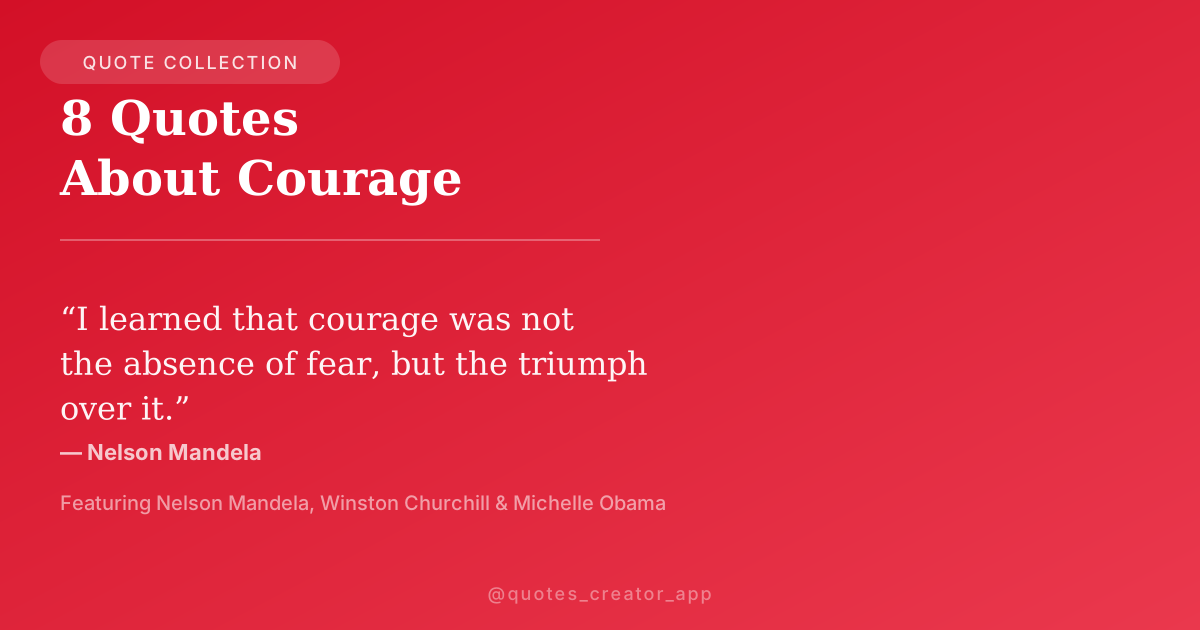
1. “I learned that courage was not the absence of fear, but the triumph over it. The brave man is not he who does not feel afraid, but he who conquers that fear.”
Nelson Mandela wrote this in his autobiography Long Walk to Freedom, and it remains the most quoted definition of courage in the modern world precisely because it refuses the fantasy version. Mandela had every reason to speak about fear from experience: he spent twenty-seven years imprisoned, most of it on Robben Island, and was offered release repeatedly in exchange for renouncing the armed struggle. He refused, knowing the offer might never come again. The sentence performs a quiet act of redefinition. If courage were the absence of fear, it would be a condition you were born with or without — something beyond your control. By insisting that the brave person simply feels the fear and acts anyway, Mandela returns courage to the realm of choice. It becomes something available to everyone, including the person whose hands are shaking.
— Nelson Mandela, Long Walk to Freedom (1994)
2. “Success is not final, failure is not fatal: it is the courage to continue that counts.”
Winston Churchill’s most quoted line is often mistaken for simple encouragement, but it is actually a sophisticated argument about where courage lives. Success is not final — because every victory contains the seeds of the next defeat if you stop. Failure is not fatal — because every defeat contains the material of the next attempt. Both statements point to the same conclusion: the only thing that actually matters is the willingness to keep going. Churchill delivered this message from the centre of a war that Britain was losing, when the bravest thing he could offer was not a promise of victory but a refusal to accept that the story had ended. Courage, in his telling, is not a burst of glory. It is a decision you renew every single morning.
— Winston Churchill, speech
3. “The most effective way to do it, is to do it.”
Amelia Earhart said this while describing how she learned to fly, and it cuts through every elaborate theory about how to start anything hard. The sentence is almost comically simple — which is exactly the point. Most of the time, the gap between wanting to do something and doing it is not filled by more preparation, more planning, or more permission. It is filled by the single, unglamorous act of beginning. Earhart knew about fear better than most: she was the first woman to fly solo across the Atlantic, and she disappeared over the Pacific chasing the first circumnavigation of the globe by a woman. For her, courage was not something you worked up to. It was something you discovered only after you had already started. The quote is a standing invitation to stop waiting for a moment when you feel brave enough — because that moment never arrives.
— Amelia Earhart, interview
4. “I freed a thousand slaves. I could have freed a thousand more if only they knew they were slaves.”
Harriet Tubman spoke these words late in her life, reflecting on the Underground Railroad that made her one of the most dangerous women in America. She returned to the South nineteen times — each return a death sentence if she had been caught — and personally led more than three hundred people to freedom, including her own parents. The quote’s power is in its second half, which reframes courage from a physical act into an act of awakening. The hardest chains, Tubman suggests, are the ones people do not know they are wearing. Courage is not just running for the border. It is first recognizing that the border exists, that you are not free, and that you deserve to be. That is why she was able to do what she did: she never had to convince herself that freedom was worth dying for, because she had already accepted that it was.
— Harriet Tubman, interview
5. “The ultimate measure of a man is not where he stands in moments of comfort and convenience, but where he stands at times of challenge and controversy.”
Martin Luther King Jr. wrote this in his 1963 book Strength to Love, and it locates courage precisely where it is hardest to detect. It is easy to be principled when it costs you nothing — when you are comfortable, when the crowd agrees, when no one is watching. The test comes when holding your ground carries a price. King spent his life being measured in exactly those moments: the bus boycott, the Birmingham campaign, the march on Washington, the final year of his life when the movement he led had turned against some of his positions. The quote is a warning against mistaking comfort for character. Courage is not a possession you carry. It is a position you take, under pressure, when taking it is inconvenient. And it is the only measure that survives contact with difficulty.
— Martin Luther King Jr., Strength to Love (1963)
6. “Bravery is not the absence of fear but the action in the face of fear.”
Mark Messier has been credited with this line across decades of hockey, and it arrives from a man who built a career out of acting while terrified. Messier led the New York Rangers to their first Stanley Cup in fifty-four years in 1994, delivering a guarantee before the deciding game that teammates later described as the most reckless and most inspiring thing they had ever heard. His definition of bravery matches the best psychological research: courage is not a feeling but a behaviour. It is what you do with the fear once you have it. The people we call brave are rarely the people who felt nothing. They are the people who walked forward anyway, counted the cost, and decided that the risk was worth the reason. Messier’s sentence hands that decision to anyone who reads it — which is to say, to everyone.
— Mark Messier, attributed quote
7. “Courage is the most important of all the virtues, because without courage you can’t practice any other virtue consistently.”
Maya Angelou’s statement is the intellectual backbone of this entire collection, and it explains why courage keeps showing up inside every other theme we cover — resilience, leadership, honesty, love. You cannot be consistently kind if you are too afraid of being taken advantage of. You cannot be consistently honest if you are afraid of the consequences. You cannot be consistently generous if you are afraid of running out. Every other virtue requires you to act in the face of possible loss, and acting in the face of possible loss is precisely what courage is. Angelou’s formulation does something profound: it makes courage not one virtue among many but the precondition for all of them. It is the engine without which every other value is just an intention, held in the head but never acted on in the world.
— Maya Angelou, interview
8. “You may not always have a comfortable life, and you will not always be able to solve all of the world’s problems at once, but don’t ever underestimate the importance you can have, because history has shown us that courage can be contagious and hope can take on a life of its own.”
Michelle Obama delivered this during the 2016 Democratic National Convention, and it closes the collection with the insight that courage is not a private possession. The sentence moves from the individual — the uncomfortable life, the unsolvable problems, the fear that your single effort is meaningless — to the collective. History has shown, she says, that courage is contagious. One person standing up makes the next person braver. One person speaking out gives the next person permission to speak. The reason the voices in this collection matter is not only what they did but what they released in others: Mandela’s prison cell became a movement, Tubman’s crossings became a network, Earhart’s flights became a generation of women aviators. Courage compounds. It is the only resource that grows the more you spend it.
— Michelle Obama, Democratic National Convention speech (July 25, 2016)
Create your own quote graphics
These quotes are meant to be shared. A well-designed quote graphic can stop a scroll, start a conversation, and inspire someone at the right moment. Whether you are posting on Instagram, creating Pinterest pins, or designing WhatsApp statuses, Quotes Creator gives you ready-made templates, beautiful fonts, and custom gradients to bring any of these quotes to life in minutes.
Designing quote graphics for “Courage”
- ✓ Use bold, dramatic reds and crimsons — they evoke fire, determination, and inner strength
- ✓ Strong serif fonts work best for courage quotes — they convey gravity and timelessness
- ✓ Pair quotes with imagery of mountains, storms, or wide horizons for a sense of scale
- ✓ Keep text to 2–3 lines maximum on mobile-sized graphics
- ✓ Export in landscape format for Twitter and square for Instagram
Why we curated this collection
Courage is the one theme every other theme depends on. You cannot be resilient without the courage to get back up. You cannot lead without the courage to be unpopular. You cannot love without the courage to be vulnerable. So we gathered five voices who tested the idea under the most extreme conditions human life offers — a prison cell, a war, an ocean, an escape from slavery, and the glare of a national stage — and every one of them arrived at the same conclusion: courage is not a feeling you wait for. It is a decision you make in the moment fear arrives, and it is the only decision that frees everything else. Their words do not pretend the fear is not there. They simply refuse to let the fear have the last word. We hope they remind you that you have already been brave more times than you remember — and that the next act of courage is closer than you think.
— ThinkPeak Studio Editorial Team
Create your own quote graphic with this quote
Turn this line into a shareable graphic in seconds — free, no signup needed. For video quotes and 100+ templates, try the Android app.
Advertisement
Enjoyed this article? Get more like it in your inbox.