On this page
- 1. “Creativity is not a rare ability. It is not difficult to access. It is a fundamental aspect of being human.”
- 2. “Ideas are like fish. If you want to catch little fish, you can stay in the shallow water. But if you want to catch the big fish, you’ve got to go deeper.”
- 3. “The most important thing about art is to work. Nothing else matters except sitting down every day and trying.”
- 4. “It’s very easy to be different, but very difficult to be better.”
- 5. “Resistance is the most toxic force on the planet. It is the fear that the work is too hard, too much, or too scary — and it must be defeated every single day.”
- 6. “The thing is, ideas come from somewhere deep, and your job is simply to be open enough to catch them.”
- 7. “Make the work you want to make. You don’t need permission, and you don’t need to wait.”
- 8. “The focus is not on what it costs to make, but on what it costs not to make.”
- Designing quote graphics for “Creativity & Originality”
8 Quotes About Creativity From People Who Built Careers Out of It
There is a story we keep telling ourselves about creativity: that it is a bolt of lightning, a sudden strike of genius that lands on the chosen few and leaves the rest of us permanently dry. Every serious person who has ever made things for a living rejects that story. The four voices in this collection have spent decades inside the creative process — a producer who has shaped the sound of modern music for three decades, a filmmaker whose dreams were strange enough to scare Hollywood, a novelist who wrote the defining book about writer’s block, and a designer who spent his career reducing complexity to a single clean line. None of them describe creativity as a gift you wait for. They describe it as a practice you show up for — a way of paying attention, of doing the work whether the muse arrives or not. This collection brings together eight of their most direct statements on what creativity actually is: not magic, but a way of operating.
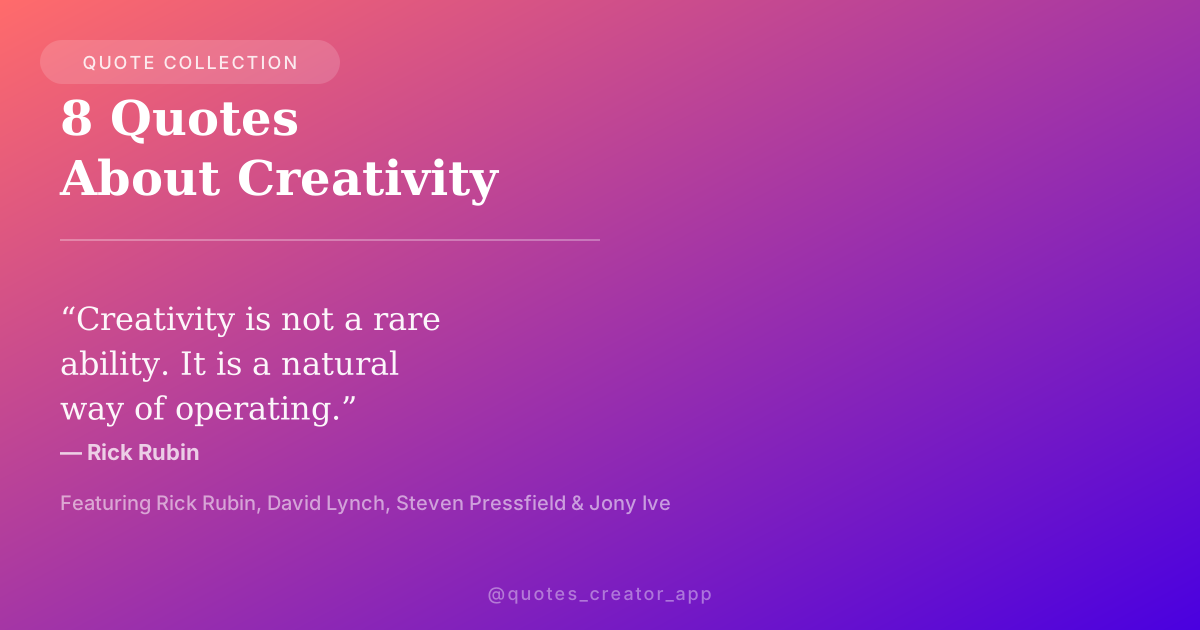
1. “Creativity is not a rare ability. It is not difficult to access. It is a fundamental aspect of being human.”
Rick Rubin opens The Creative Act by dismantling the most expensive myth in modern culture — the idea that creativity belongs to a special class of people. Rubin has spent three decades producing everyone from Johnny Cash to Adele to Kanye West, so his credentials for this claim are impeccable, and his argument is bracing: creativity is not a gift that some people have, but a capacity that everyone has, as basic to being human as breathing. The reason most of us think we lack it is that we have been taught to measure it by external standards — fame, sales, approval — when in fact the act of making something new is happening constantly, in every household, in every garden, in every notebook. By reframing creativity as a universal trait rather than a rare talent, Rubin removes the permission slip most people have been waiting for. You do not need to be exceptional to create. You just need to accept that you are already doing it.
— Rick Rubin, The Creative Act: A Way of Being (2023)
2. “Ideas are like fish. If you want to catch little fish, you can stay in the shallow water. But if you want to catch the big fish, you’ve got to go deeper.”
David Lynch wrote this in Catching the Big Fish, his book-length meditation on meditation, and it is the most useful image for the creative process ever written. The shallow water is the surface of the mind — the familiar thoughts, the obvious solutions, the ideas everyone has already had. The deep water is where the original material lives, and Lynch’s lifelong insistence is that the only way to reach it is to go down there, deliberately and regularly, through stillness and attention. He has spent fifty years making films that feel like dreams because he treats the unconscious as the primary source of material, not as a scary basement to be avoided. The metaphor quietly corrects our expectation of creativity: we assume good ideas come to us, but Lynch says we have to go to them. Depth is not a talent. It is a choice about where you are willing to fish.
— David Lynch, Catching the Big Fish (2006)
3. “The most important thing about art is to work. Nothing else matters except sitting down every day and trying.”
Steven Pressfield wrote The War of Art after years of struggling against what he calls Resistance — the force that keeps you from the work you know you should be doing — and this sentence is the entire book in miniature. Everything else about the creative life — talent, inspiration, timing, luck — is decoration. The core of it, the part that can never be faked or outsourced, is simply showing up and working. Pressfield is not romantic about this. He knows that most days will not produce anything worth keeping, and that the sitting down every day is the whole battle. His genius is in removing the drama: the amateur waits for the mood, while the professional understands that mood is irrelevant. The work is the teacher, the reward, and the identity. If you make sitting down to work non-negotiable, you have already won the war that most people lose before they start.
— Steven Pressfield, The War of Art (2002)
4. “It’s very easy to be different, but very difficult to be better.”
Jony Ive, the designer behind the products that defined Apple’s two most famous decades, is not interested in novelty for its own sake — and this quiet sentence is his entire design philosophy. Anyone can be different; difference is cheap, a matter of doing something odd for the sake of being noticed. Better is expensive. Better requires understanding the thing so completely that you can remove everything that is not it, until what remains is inevitable. Ive spent his career proving that the most radical act in a world drowning in noise is not to shout louder but to simplify with conviction — to spend the extra years, the extra prototypes, the extra sleepless nights making something that looks inevitable precisely because all the alternatives were discarded. The quote is a warning to the creative person: do not mistake shock for substance. Strangeness fades. The deeply considered thing endures.
— Jony Ive, design interview
5. “Resistance is the most toxic force on the planet. It is the fear that the work is too hard, too much, or too scary — and it must be defeated every single day.”
Pressfield’s central concept in The War of Art is Resistance, and this line names what it actually is: fear, wearing the costume of logic. Resistance does not look like fear. It looks like reasons — I’m too tired, I’m not ready, it’s not the right time, someone else is already doing it. It is the voice that offers a thousand legitimate-sounding excuses for not doing the one thing that matters, and Pressfield’s insight is that it gets stronger exactly in proportion to the importance of the work. The more a project matters to your deepest self, the louder the resistance will be. This reframes creative struggle from a personal failing into a universal law: the resistance you feel is not a sign that you lack talent, but a sign that you are doing the right thing. The battle is not creative. It is a daily, boring, absolutely essential act of simply starting anyway.
— Steven Pressfield, The War of Art (2002)
6. “The thing is, ideas come from somewhere deep, and your job is simply to be open enough to catch them.”
Lynch has said versions of this for decades, and it is the most counterintuitive statement in the collection because it inverts the direction of the creative act. We imagine the artist as a generator, producing ideas out of nothing, forcing the material into existence. Lynch describes the opposite: the artist is a receiver, and ideas arrive like fish that were already swimming in the deep. The implication is liberating and humbling at once. Liberating, because it means you do not have to manufacture brilliance — you only have to be receptive enough to notice it when it surfaces. Humbling, because it means the moment you decide you are blocked, you are the one who closed the water. Lynch’s lifelong practice of meditation is exactly this training in openness: sitting still until the noise drops and the deep becomes accessible. Catch the idea, and then spend the rest of your life learning how to translate it into form.
— David Lynch, Catching the Big Fish (2006)
7. “Make the work you want to make. You don’t need permission, and you don’t need to wait.”
Rick Rubin’s advice to the artists he produces sounds almost too simple, and that is precisely the point. Most creative people are waiting for something — for skill, for approval, for the right moment, for a sign. Rubin, who has spent his career getting out of the way of great work, insists that none of these are real conditions. Permission is not issued from above; it is taken. The work you make when no one is watching, when no one has asked, when you have no reason to expect reward — that is the work that reveals what you actually have to say. His perspective is that of someone who has watched thousands of artists freeze at the threshold, and the pattern is always the same: they treat the door as locked when it was never closed. Start before you are ready. The readiness arrives in the doing, not in the waiting.
— Rick Rubin, The Creative Act: A Way of Being (2023)
8. “The focus is not on what it costs to make, but on what it costs not to make.”
Jony Ive’s most radical statement inverts the standard accounting of creative work. Every artist and designer has felt the pressure to justify the effort — the hours, the iterations, the versions nobody ever saw — against some budget of time or money. Ive refuses that frame entirely. The real cost is never what you spend making something; it is what you forfeit by not making it well. A product that is merely adequate costs more in frustration, in returns, in a reputation slowly ground away, than the careful version ever could have cost in development. The same logic applies to any creative act: the half-finished book, the avoided conversation, the idea abandoned too early — each one carries a hidden tax that compounds. Ive is telling creative people to think in outcomes, not effort. Great work is not expensive. It is, by comparison, the only bargain available.
— Jony Ive, design interview
Create your own quote graphics
These quotes are meant to be shared. A well-designed quote graphic can stop a scroll, start a conversation, and inspire someone at the right moment. Whether you are posting on Instagram, creating Pinterest pins, or designing WhatsApp statuses, Quotes Creator gives you ready-made templates, beautiful fonts, and custom gradients to bring any of these quotes to life in minutes.
Designing quote graphics for “Creativity & Originality”
- ✓ Use bold, warm gradients — coral to deep indigo evokes both energy and depth of thought
- ✓ Serif fonts work best for creativity quotes — timeless and literary, like the ideas themselves
- ✓ Pair quotes with abstract or cosmic imagery to suggest the vastness of what can be imagined
- ✓ Keep text to 2–3 lines maximum on mobile-sized graphics
- ✓ Export in landscape format for Twitter and square for Instagram
Why we curated this collection
We chose creativity because it is the engine behind every other theme in this library — resilience is creative problem-solving, leadership is creative coordination, purpose is creative self-construction — and then we asked four people who have spent their entire professional lives inside it to describe it plainly. The pattern across all eight quotes is striking. Nobody treats creativity as a gift you wait for or a talent you are born with. Rick Rubin calls it a fundamental human ability and tells you to stop waiting for permission. David Lynch describes it as a discipline of depth — going down to where the big ideas swim and staying open enough to catch them. Steven Pressfield names the real enemy — Resistance, the fear wearing logic’s clothes — and reduces the whole craft to the daily act of sitting down and working. Jony Ive quietly adds that the point is never to be different but to be better, and that the true cost of anything is not making it well. Four different disciplines, one shared conclusion: creativity is not a lightning strike. It is a way of operating that anyone can choose — starting with the very next thing you make.
— ThinkPeak Studio Editorial Team
Create your own quote graphic with this quote
Turn this line into a shareable graphic in seconds — free, no signup needed. For video quotes and 100+ templates, try the Android app.
Advertisement
Enjoyed this article? Get more like it in your inbox.