On this page
- 1. “You can’t use up creativity. The more you use, the more you have.”
- 2. “The universe buries strange jewels deep within us all, and then stands back to see if we can find them.”
- 3. “Creativity is sacred, and it is not sacred. What we make matters enormously, and it is never going to matter at all.”
- 4. “Nothing is original. Steal from anywhere that resonates with inspiration or fuels your imagination.”
- 5. “Start copying what you love. Copy copy copy copy. At the end of the copy you will find yourself.”
- 6. “Creative work is not a selfish act or a bid for attention on the part of the actor. It’s a gift to the world and everyone in it.”
- 7. “Creativity is not a talent. It is a way of operating.”
- 8. “If you want creative workers, give them enough time to play.”
- Designing quote graphics for “Creativity”
8 Quotes About Creativity From People Who Make Things
Creativity is one of the most mythologized words in the modern vocabulary. We treat it as a bolt of lightning that strikes a lucky few, when the people who actually make things for a living describe it as something far more ordinary: a practice, a habit, a way of showing up. The five voices in this collection come at it from wildly different places — a poet who never ran dry, a novelist who demystified the muse, an artist who told us to steal everything, a marketer who reframed creative work as a gift, and a comedian who insisted creativity is a way of operating, not a talent. None of them treat it as a mystery. They treat it as work — and that is the most freeing idea of all.
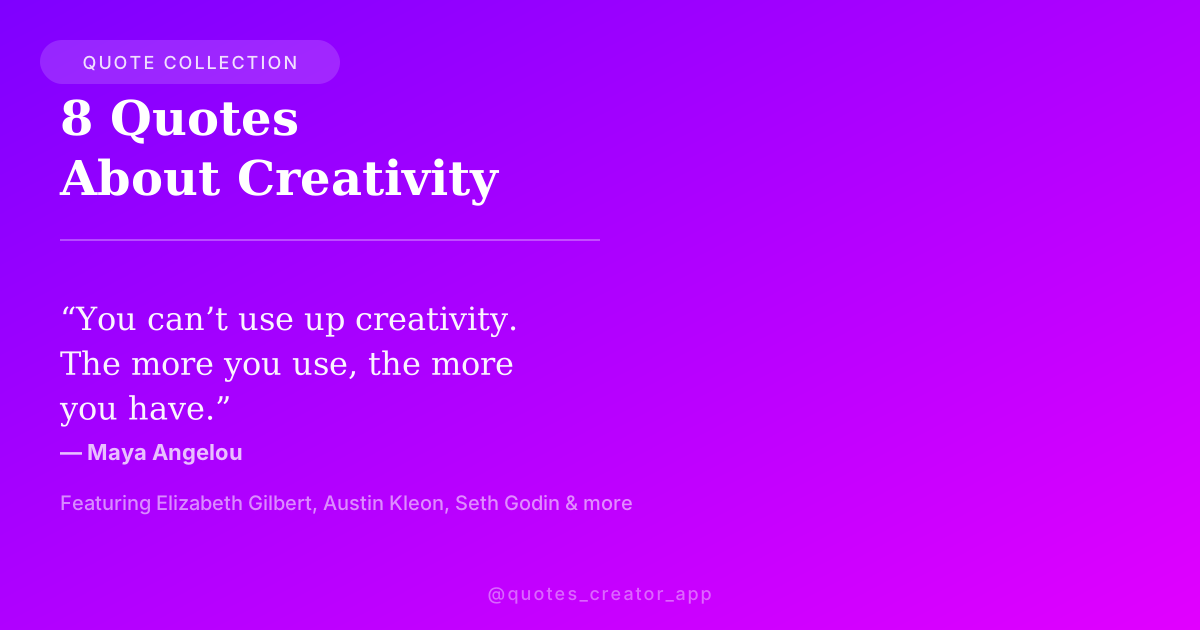
1. “You can’t use up creativity. The more you use, the more you have.”
Maya Angelou’s most repeated line about creativity quietly dismantles the single greatest fear that stops people from starting: the fear of running dry. If creativity were a finite resource, you would have to ration it — save it for the big moments, guard it from waste. Angelou, who published seven autobiographies and countless poems and essays, offers the opposite model: creativity is not a tank you drain but a muscle you grow. The more you draw on it, the more it replenishes. This is why the people who make the most tend to make even more, and why the people who wait for the perfect moment to be creative tend to wait forever. The act of creating feeds the capacity to create. If you are stuck, the answer is rarely to rest more. It is to make anything at all.
— Maya Angelou, interview
2. “The universe buries strange jewels deep within us all, and then stands back to see if we can find them.”
Elizabeth Gilbert wrote this in Big Magic, her manifesto on creative living, and it captures the whole argument of the book in one image. Creativity, in Gilbert’s telling, is not something you manufacture from nothing. It is something you discover — buried inside you like a jewel that was placed there before you were born. The line reframes the creative life from a question of production (“can I make something?”) to a question of excavation (“can I find what is already there?”). That shift matters because it changes the stakes. If creativity is buried inside you, then the only way to fail is to never dig. The universe, she suggests, is not judging your output. It is watching to see whether you will even try.
— Elizabeth Gilbert, Big Magic (2015)
3. “Creativity is sacred, and it is not sacred. What we make matters enormously, and it is never going to matter at all.”
This second line from Big Magic is the paradox that keeps creative people sane. Gilbert is holding two truths at once: the work matters enormously — it deserves your full seriousness, your craft, your devotion — and it does not matter at all — it is not going to save the world, and the world will not stop if you fail. Most creative people tilt too far in one direction. Take the work too seriously and you freeze under the weight of it. Take it too lightly and you never commit. Gilbert’s genius is refusing to choose. The serious side gives you the discipline to show up. The unserious side gives you the freedom to take risks, to make bad things, and to keep going. You need both, held in tension, forever.
— Elizabeth Gilbert, Big Magic (2015)
4. “Nothing is original. Steal from anywhere that resonates with inspiration or fuels your imagination.”
Austin Kleon’s opening salvo in Steal Like an Artist is the most liberating permission slip ever written for creative people. The myth of originality — that a truly creative person invents from nothing, out of a vacuum, with no influences — is not only false, it is paralyzing. Kleon argues the opposite: everything is a remix, and the great artists have always been great thieves. What matters is not whether you borrow, but what you borrow and how you transform it. The distinction he draws is between stealing from and stealing like. Stealing from someone means copying them outright. Stealing like them means absorbing their way of seeing, their instincts, their questions — and then making something that could only come from you. The act of being inspired is the act of collecting.
— Austin Kleon, Steal Like an Artist (2012)
5. “Start copying what you love. Copy copy copy copy. At the end of the copy you will find yourself.”
This is the practical instruction behind Kleon’s philosophy, and it is far more radical than it sounds. To become a writer, copy the writers you love until their sentences feel natural in your hands. To become a designer, copy the designers you admire until you understand why every line is where it is. The point is not to remain a copy — it is that copying is how taste becomes craft. Nobody skips this stage. The people we call original are the ones who copied so thoroughly, and so many different things, that the mixture of their influences became indistinguishable from themselves. Kleon’s deeper insight is that the search for your own voice does not begin with introspection. It begins with imitation. You find yourself only by first becoming other people, one after another, until you cannot help but be you.
— Austin Kleon, Steal Like an Artist (2012)
6. “Creative work is not a selfish act or a bid for attention on the part of the actor. It’s a gift to the world and everyone in it.”
Seth Godin wrote this in Linchpin, and it answers the most common accusation leveled at creative people: that making things is self-indulgent. Godin inverts the charge. The artist who publishes, who ships, who puts work into the world is not asking for applause — they are offering something to people who need it. A poem, a song, a product, a piece of software: these are gifts that did not exist before someone made them. Godin is famous for the argument that creative work is an act of generosity because it involves risk — the risk of being judged, ignored, or rejected — and you take that risk on behalf of an audience you may never meet. The moment you understand your creative work as a gift rather than a demand for approval, the fear of criticism loses most of its power.
— Seth Godin, Linchpin (2010)
7. “Creativity is not a talent. It is a way of operating.”
John Cleese’s one-sentence reframing from Creativity: A Short and Cheerful Guide is the closest thing this collection has to a thesis statement. The talent view of creativity is the reason most people believe they are not creative: they think it is a gift you are either born with or not. Cleese, who spent a lifetime being spontaneously funny in public, insists it is something else entirely — a mode, a process, a set of conditions you can create for yourself. His famous recipe involves the two things organizations almost never provide: space and time. You cannot be creative on demand and you cannot be creative while distracted. You can, however, deliberately build the quiet, unhurried, playful frame of mind in which ideas surface. That frame is available to everyone. The talent was never the barrier.
— John Cleese, Creativity: A Short and Cheerful Guide (2020)
8. “If you want creative workers, give them enough time to play.”
Cleese has said some version of this for decades, and it remains the most countercultural thing in this entire collection. Our default model of productivity assumes the opposite: that play is the enemy of work, that time must be tightly scheduled, and that deadlines squeeze out the best output. Cleese argues the reverse. The most original solutions, he observed across his career in comedy, almost never arrive when you are staring at the problem. They arrive in the relaxed, exploratory mode — when you are playing with the pieces, trying things, making connections without fear of judgment. Play is not a break from creative work. It is the condition under which creative work happens. The lesson applies to a team, a classroom, or a single person at a desk: protect unstructured time, resist the urge to fill every moment, and the ideas will come to you the way they always have — sideways.
— John Cleese, lecture
Create your own quote graphics
These quotes are meant to be shared. A well-designed quote graphic can stop a scroll, start a conversation, and inspire someone at the right moment. Whether you are posting on Instagram, creating Pinterest pins, or designing WhatsApp statuses, Quotes Creator gives you ready-made templates, beautiful fonts, and custom gradients to bring any of these quotes to life in minutes.
Designing quote graphics for “Creativity”
- ✓ Use bold purple and magenta gradients — they evoke imagination, energy, and original thinking
- ✓ Serif fonts work best for creativity quotes — classical and timeless, like the ideas themselves
- ✓ Pair quotes with abstract or cosmic backgrounds to suggest the vastness of what can be imagined
- ✓ Keep text to 2–3 lines maximum on mobile-sized graphics
- ✓ Export in landscape format for Twitter and square for Instagram
Why we curated this collection
We chose creativity because it is the theme every other theme eventually leads back to. Resilience is creative problem-solving under pressure. Leadership is creative coordination of people. Purpose is the creative act of building a life. And yet we tend to treat it as a mysterious gift rather than a practice. So we gathered five people who make things for a living — a poet, two novelists, a designer, a marketer, and a comedian — and every one of them described creativity in almost exactly the same way: it is not a talent you wait for, it is a habit you build. Make something, even badly. Copy what you love until it becomes yours. Protect the time and space to play. Treat the work as a gift and let it go. The mystique evaporates the moment you start — and what is left is simply the joy of making. We hope these eight quotes remind you that you were never waiting for permission.
— ThinkPeak Studio Editorial Team
Create your own quote graphic with this quote
Turn this line into a shareable graphic in seconds — free, no signup needed. For video quotes and 100+ templates, try the Android app.
Advertisement
Enjoyed this article? Get more like it in your inbox.