On this page
- 1. “You can’t use up creativity. The more you use, the more you have.” — Maya Angelou
- 2. “Creativity is just connecting things. When you ask creative people how they did something, they feel a little guilty because they didn’t really do it, they just saw something. It seemed obvious to them after a while.” — Steve Jobs
- 3. “Ideas are like fish. If you want to catch little fish, you can stay in the shallow water. But if you want to catch the big fish, you’ve got to go deeper.” — David Lynch
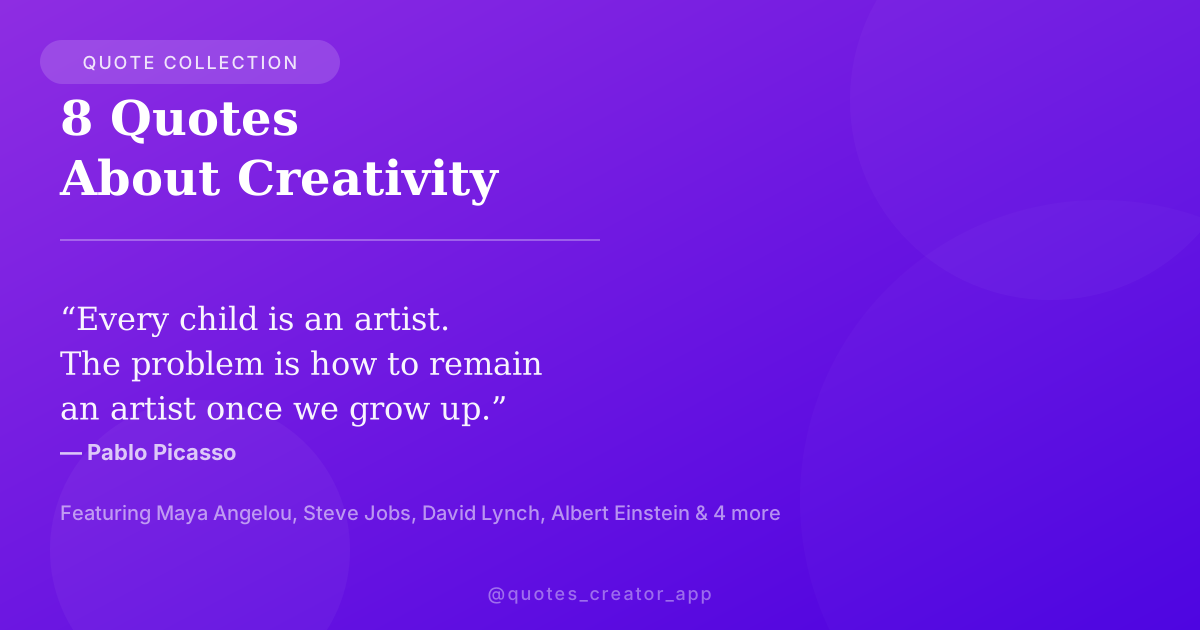
- 4. “Every child is an artist. The problem is how to remain an artist once we grow up.” — Pablo Picasso
- 5. “Imagination is more important than knowledge. For knowledge is limited, whereas imagination embraces the entire world, stimulating progress, giving birth to evolution.” — Albert Einstein
- 6. “Think left and think right and think low and think high. Oh, the thinks you can think up if only you try!” — Dr. Seuss
- 7. “The act of creation is an act of destruction. You must be willing to break what came before.” — Hayao Miyazaki
- 8. “There is no innovation and creativity without failure. Period.” — Brené Brown
- Honorable Mentions
- Designing quote graphics for “Creativity & Imagination”
8 Quotes About Creativity & Imagination to Spark Your Next Idea
Creativity is the force that turns the ordinary into the extraordinary. From poets who found endless wells of inspiration to inventors who saw connections no one else could, these eight voices reveal that the creative impulse is not a rare gift — it is a muscle we can all strengthen, a habit we can all cultivate, and a way of seeing the world that transforms everything it touches.
1. “You can’t use up creativity. The more you use, the more you have.” — Maya Angelou
Maya Angelou, one of the most celebrated poets and memoirists of the twentieth century, understood creativity as an inexhaustible resource. Where others might worry about running dry or repeating themselves, Angelou saw creation as a self-replenishing cycle. The more you pour out, the more flows in. This is a fundamentally different model from the “limited well” metaphor that so many creatives fear. Angelou’s own career — seven autobiographies, multiple poetry collections, essays, screenplays, and decades of public performance — is the living proof of her thesis. She never stopped creating, and she never ran out of things to say, because creativity, for her, was not a finite resource but a relationship with life itself.
2. “Creativity is just connecting things. When you ask creative people how they did something, they feel a little guilty because they didn’t really do it, they just saw something. It seemed obvious to them after a while.” — Steve Jobs
Steve Jobs offered this definition in a 1996 Wired interview, and it remains one of the most useful descriptions of the creative process ever articulated. Jobs demystifies creativity by reducing it to pattern recognition. Creative people are not inventing from nothing. They are seeing relationships between existing experiences that others have overlooked. The “guilt” he mentions is telling — truly creative people often feel like they are cheating because the connections seem so obvious to them. But the simplicity of the insight belies the difficulty of the practice. Seeing connections requires a mind stocked with diverse experiences, the curiosity to explore fields outside your own, and the humility to let seemingly unrelated ideas collide.
— Steve Jobs, Wired interview (February 1996)
3. “Ideas are like fish. If you want to catch little fish, you can stay in the shallow water. But if you want to catch the big fish, you’ve got to go deeper.” — David Lynch
David Lynch, the visionary filmmaker behind Twin Peaks, Blue Velvet, and Mulholland Drive, built his entire creative practice around this metaphor. In his book Catching the Big Fish, Lynch describes meditation as the deep diving apparatus that allows him to access the richest ideas. The shallow water represents conventional thinking — the surface-level ideas that anyone can pluck. The deep water is where the strange, powerful, transformative ideas live. Most people never venture there because it requires discipline, solitude, and a tolerance for not knowing what you will find. Lynch’s career is a testament to the rewards of going deeper: his most celebrated work is also his most uncategorizable, born from a willingness to descend into the dark waters of his own consciousness and bring back whatever he found there.
— David Lynch, Catching the Big Fish (2006)
4. “Every child is an artist. The problem is how to remain an artist once we grow up.” — Pablo Picasso
Picasso’s most famous quote about creativity is also his most heartbreaking — because it identifies a loss that almost everyone has experienced. Children draw without self-judgment. They mix colors without worrying about rules. They invent worlds without asking for permission. At some point in adulthood, that freedom is replaced by self-criticism, fear of failure, and the pressure to be productive rather than playful. Picasso, who spent his entire career breaking artistic conventions, was himself a model of the adult who never lost the child’s capacity for wonder. His constantly shifting styles — Blue Period, Rose Period, Cubism, Surrealism — were not calculated career moves but expressions of a restless creative spirit that refused to settle into a comfortable formula. The question he poses is not rhetorical. It is a challenge: how will you protect the artist you were born as?
5. “Imagination is more important than knowledge. For knowledge is limited, whereas imagination embraces the entire world, stimulating progress, giving birth to evolution.” — Albert Einstein
Einstein, the physicist who rewrote our understanding of the universe, made this statement in a 1929 interview with The Saturday Evening Post. It is a remarkable admission from someone whose work was grounded in rigorous mathematics and empirical observation. Einstein is arguing that knowledge — the accumulated facts and formulas of the past — can only take us so far. It describes what already is. Imagination, by contrast, reaches toward what could be. It is the engine of every breakthrough in science, art, and human progress. Einstein’s own greatest insights — the theory of relativity, the photoelectric effect, the nature of spacetime — began not with equations but with thought experiments: imagining himself riding a beam of light, picturing a falling man in an elevator. Knowledge provided the scaffolding, but imagination built the structure.
— Albert Einstein, The Saturday Evening Post (October 26, 1929)
6. “Think left and think right and think low and think high. Oh, the thinks you can think up if only you try!” — Dr. Seuss
Theodor Geisel, better known as Dr. Seuss, wrote these lines in his 1975 book Oh, the Thinks You Can Think!, and they capture his entire creative philosophy in a single joyful couplet. Geisel understood that creativity is not a single direction of thought but a willingness to explore every angle — left, right, low, high. His own process was a masterclass in this principle: constrained by a list of only 220 words in The Cat in the Hat, he produced one of the most beloved children’s books of all time. Told he could not write a book using only fifty different words, he wrote Green Eggs and Ham. The most creative work often emerges not from unlimited freedom but from embracing playful constraints. The “thinks” you can think up are infinite, but they require the first step: trying.
7. “The act of creation is an act of destruction. You must be willing to break what came before.” — Hayao Miyazaki
Hayao Miyazaki, the co-founder of Studio Ghibli and one of the most influential animators in film history, understands creativity as a fundamentally destructive act. Every new film he makes begins with rejecting the formulas that made his previous films successful. My Neighbor Totoro has no antagonist. Princess Mononoke refuses to draw a clear line between good and evil. Spirited Away builds its story around a bathhouse for spirits rather than a conventional hero’s journey. Each film dismantles an assumption about what animation can be and rebuilds it from scratch. Miyazaki’s insight is that true originality does not come from adding to what already exists but from clearing away the old to make space for something that has never been seen before. It is a difficult philosophy because it demands constant reinvention, but it is also the reason his work feels timeless rather than dated.
— Hayao Miyazaki, Starting Point: 1979–1996
8. “There is no innovation and creativity without failure. Period.” — Brené Brown
Brené Brown, the research professor whose work on vulnerability, courage, and shame has reshaped how millions think about leadership and creativity, delivers this line with the authority of someone who has spent decades studying the relationship between emotional risk and creative output. Her research shows that the single biggest barrier to creativity is not a lack of talent or ideas but the fear of being judged. Organizations and individuals who punish failure kill creativity at the root. Those who create conditions where failure is safe unleash the full creative potential of their people. Brown’s message is both liberating and demanding: you cannot selectively numb the fear of failure without also numbing the capacity for creativity. To have one, you must accept the possibility of the other.
— Brené Brown, Dare to Lead (2018)
Honorable Mentions
- “Do not go where the path may lead, go instead where there is no path and leave a trail.” — Ralph Waldo Emerson
- “The creation of something new is not accomplished by the intellect but by the play instinct.” — Carl Jung
- “You can’t wait for inspiration. You have to go after it with a club.” — Jack London
- “Creativity is intelligence having fun.” — Albert Einstein
Create your own quote graphics
These quotes are meant to be shared. A well-designed quote graphic can stop a scroll, start a conversation, and inspire someone at the right moment. Use our free online quote maker to turn any of these quotes into a beautiful image in seconds. For the full toolkit — video quotes, 100+ templates, custom backgrounds — download the Quotes Creator Android app.
Designing quote graphics for “Creativity & Imagination”
- ✓ Use bold purple and deep blue gradients to evoke the depth of creative thinking
- ✓ Serif fonts like Georgia lend a timeless quality to wisdom about the creative process
- ✓ Pair quotes with abstract or cosmic backgrounds to suggest the vastness of imagination
- ✓ Keep text to 2–3 lines maximum on mobile-sized graphics
- ✓ Export in square format for Instagram and portrait for Pinterest
Why we curated this collection
We chose creativity because it is the engine of every meaningful human achievement. In a world that often prizes efficiency over exploration, these eight voices remind us that the creative impulse is not a luxury reserved for artists and inventors. It is a fundamental human capacity — one that helps us solve problems, connect with each other, and make sense of our lives. Whether you are a painter, an engineer, a teacher, or a parent trying to get dinner on the table, creativity is the tool that lets you turn what is into what could be. We hope this collection inspires you to protect your own creative spirit, dive deeper for the big ideas, and never stop making.
— ThinkPeak Studio Editorial Team
Create your own quote graphic
Turn this line into a shareable graphic in seconds — free, no signup needed. For video quotes and 100+ templates, try the Android app.
Advertisement
Enjoyed this article? Get more like it in your inbox.