On this page
- 1. “For to be free is not merely to cast off one’s chains, but to live in a way that respects and enhances the freedom of others.”
- 2. “If there is no struggle, there is no progress.”
- 3. “I don’t want you to be hopeful. I want you to panic. I want you to feel the fear I feel every day. And then I want you to act.”
- 4. “It is time that we all see gender as a spectrum instead of two sets of opposing ideals.”
- 5. “I would like to be remembered as a person who wanted to be free... so other people would be also free.”
- 6. “I need ammunition, not a ride.”
- 7. “To deny people their human rights is to challenge their very humanity.”
- 8. “Those who profess to favor freedom, and yet deprecate agitation, are men who want crops without plowing up the ground.”
- Designing quote graphics for “Freedom & Voice”
8 Quotes About Freedom & Voice From People Who Paid for Their Words
Freedom has a habit of sounding easy until you look at who actually gets to speak. Every voice in this collection paid a real price for the right to be heard — in prison, in exile, in fear of a bombing campaign, or in the quiet daily refusal to sit down and shut up. A prisoner who spent twenty-seven years in a cell and emerged to lead a nation. A fugitive who learned to read against the law and spent his life arguing that liberty is never free. A teenager who stood in front of global leaders and demanded they act. An actress who redefined equality on the world’s biggest stage. A seamstress whose refusal to give up her seat changed a country. A president who chose ammunition over an evacuation. This collection brings together eight of their most direct statements on what freedom really is — not a gift handed down, but something claimed, spoken, and defended, often at great cost.
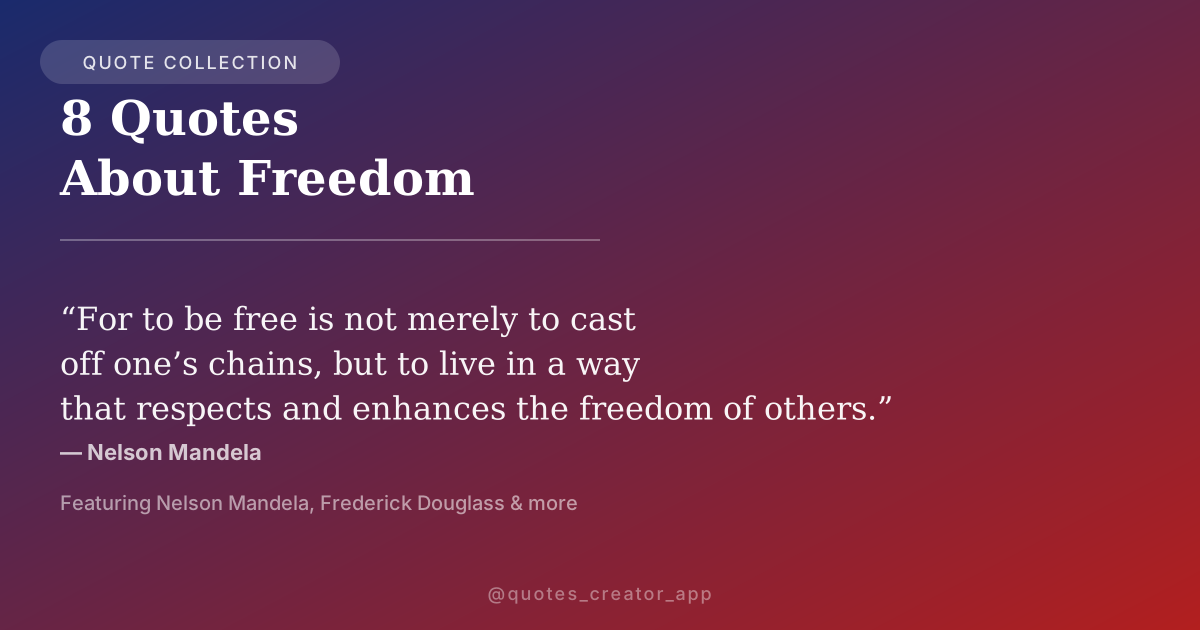
1. “For to be free is not merely to cast off one’s chains, but to live in a way that respects and enhances the freedom of others.”
Nelson Mandela wrote this in Long Walk to Freedom, and it is the most complete definition of liberty ever written by someone who earned the right to define it. He is not describing freedom as the absence of chains — that is only the beginning, the part anyone can understand. The deeper claim is that freedom is a way of living, a practice of attending to the freedom of everyone around you. Mandela spent twenty-seven years in prison, and when he walked out, he did not walk out for himself. He walked out to dismantle apartheid, to reconcile with the people who had jailed him, and to build a country where freedom was shared rather than hoarded. The sentence quietly indicts every version of liberty that stops at “my freedom.” Real freedom, in Mandela’s telling, is the kind that recognizes other people as equally free — and that recognition is what turns a personal release into a national one.
— Nelson Mandela, Long Walk to Freedom (1994)
2. “If there is no struggle, there is no progress.”
Frederick Douglass delivered this line in an 1857 speech on West India Emancipation, and it is the shortest possible answer to the question of why freedom is expensive. Douglass was a man who had escaped slavery, taught himself to read and write against the law, and then spent his life arguing that the two great words of the American founding — liberty and equality — had to be made true. The sentence is a warning to everyone who wants change without paying for it. Progress, he insists, never arrives politely. It is fought for, demanded, agitated into existence. Douglass’s point is not that struggle is noble for its own sake; it is that struggle is the mechanism by which freedom actually gets extended to people who have been denied it. You can want the crops without plowing, he argued elsewhere — but you will not get them. Freedom, like everything worth having, comes with a price attached.
— Frederick Douglass, speech on West India Emancipation (August 3, 1857)
3. “I don’t want you to be hopeful. I want you to panic. I want you to feel the fear I feel every day. And then I want you to act.”
Greta Thunberg said this to world leaders at the World Economic Forum in Davos in 2019, and it is a radical redefinition of what a young voice can demand. She was sixteen years old, and instead of asking for hope, she asked for fear — because hope, in her argument, had become an excuse for inaction. The adults in the room kept saying the future would be fine, and she kept pointing out that they were the ones who had to live with the results. The sentence is about voice in its most uncompromising form: not asking permission to speak, but telling the people in power exactly what they do not want to hear. Thunberg’s freedom was the freedom to be inconvenient, to refuse the polite script offered to children, and to convert anxiety into a global movement of school strikes. Her point is that freedom of speech means nothing if you only use it to say what is comfortable.
— Greta Thunberg, World Economic Forum, Davos (January 22, 2019)
4. “It is time that we all see gender as a spectrum instead of two sets of opposing ideals.”
Emma Watson said this at the United Nations in 2014, launching the HeForShe campaign, and it is a declaration of freedom in a domain where freedom is rarely discussed: the right to be yourself rather than the version society assigns to your gender. Watson stood on the world’s most powerful platform and argued that both men and women are trapped by the ideals they are handed — men expected to be strong and unfeeling, women expected to be soft and accommodating — and that this trap is a kind of imprisonment too. The phrase “gender as a spectrum” was her way of insisting that human beings are more various than the boxes built for them. The speech made her one of the most visible voices on equality of her generation, and the sentence endures because it locates freedom where people least expect it: in the permission to simply be who you are.
— Emma Watson, HeForShe address, United Nations (September 20, 2014)
5. “I would like to be remembered as a person who wanted to be free… so other people would be also free.”
Rosa Parks said this late in her life, and it is the quietest sentence in this collection and one of the most radical. On December 1, 1955, she refused to give up her seat on a Montgomery bus, and in doing so she became the catalyst for a year-long bus boycott that crippled segregation in a major American city. But Parks never described herself as a symbol or a hero. She described herself as someone who was tired, and who had decided, after years of injustice, that her freedom mattered. The remarkable part of this quote is the second half — “so other people would be also free.” Parks understood that her own freedom was bound up with everyone else’s, that the seamstress who refused a seat was making a claim not just for herself but for every person who would come after. It is freedom without ego: not freedom from something, but freedom that opens the door for others.
— Rosa Parks, My Story (1992)
6. “I need ammunition, not a ride.”
Volodymyr Zelensky said this on the first day of Russia’s full-scale invasion of Ukraine in February 2022, after the United States offered to evacuate him from Kyiv. It is the shortest and most devastating statement of what freedom means under fire. Zelensky was offered the easy option — escape, safety, a life in exile — and he refused it, because leaving would have meant surrendering not just his country but the very idea that a nation can choose its own future. The sentence turned a wartime president into a symbol of resistance worldwide, and it captured something universal: freedom is not a principle you hold when it costs nothing. It is a principle you hold when it costs everything. He needed ammunition, not a ride, because ammunition was what his people needed to defend the freedom they had chosen. In six words, Zelensky said more about liberty than most political speeches say in an hour.
— Volodymyr Zelensky, on refusing evacuation from Kyiv (February 25, 2022)
7. “To deny people their human rights is to challenge their very humanity.”
Nelson Mandela delivered this line to the United States Congress in 1990, months after his release from prison, and it is his most precise statement on why freedom is not negotiable. Human rights, in his argument, are not a legal convenience or a political preference. They are the expression of what it means to be human — and to deny them is not merely to make a mistake, but to deny the humanity of the people you oppress. The sentence cuts both ways. For the oppressed, it is a reminder that their dignity is not on loan from anyone. For the oppressor, it is a warning that injustice is a form of self-harm, because it requires you to stop seeing other people as fully human. Mandela spent decades being treated as less than human and emerged arguing that the people who had treated him that way had diminished themselves, not him. Freedom, in this telling, is not a reward for good behavior. It is the recognition of what is already true.
— Nelson Mandela, address to the U.S. Congress (June 26, 1990)
8. “Those who profess to favor freedom, and yet deprecate agitation, are men who want crops without plowing up the ground.”
Frederick Douglass wrote this in the same 1857 speech, and it is the sharpest sentence in the entire history of American oratory about the cost of change. He was addressing the comfortable people — the ones who said they supported abolition in principle but objected to the noise, the protests, the disruption that abolition actually required. Douglass’s metaphor is devastating: freedom is a crop, and crops require plowing. You cannot want the harvest while objecting to the work. The sentence remains relevant to every generation because it names the most common form of cowardice there is — wanting a better world without wanting to be disturbed. Douglass’s argument is that agitation is not a threat to freedom but a sign that freedom is being taken seriously. The people who complain about the protesters are usually the people who benefited from the status quo. And the people who want change without struggle are, in his immortal phrase, asking for something that does not exist.
— Frederick Douglass, speech on West India Emancipation (August 3, 1857)
Create your own quote graphics
These quotes are meant to be shared. A well-designed quote graphic can stop a scroll, start a conversation, and inspire someone at the right moment. Whether you are posting on Instagram, creating Pinterest pins, or designing WhatsApp statuses, Quotes Creator gives you ready-made templates, beautiful fonts, and custom gradients to bring any of these quotes to life in minutes.
Designing quote graphics for “Freedom & Voice”
- ✓ Use deep navy melting into crimson — they evoke resolve, sacrifice, and the cost of liberty
- ✓ Serif italics lend these quotes a dignified, timeless voice that suits matters of principle
- ✓ Lead with one strong line in bold text, then let the full quote breathe below
- ✓ Keep text to 2–3 lines maximum on mobile-sized graphics
- ✓ Export in square format for Instagram and portrait for Pinterest
Why we curated this collection
We chose freedom because it is the word everyone claims and almost no one has paid for — and then we gathered six voices who paid more than most. The pattern across all eight quotes is unmistakable. Nelson Mandela defines freedom as respect for the freedom of others, and warns that denying human rights is denying humanity itself. Frederick Douglass insists that progress requires struggle, and that you cannot want the crop without doing the plowing. Greta Thunberg refuses to trade fear for false hope and demands action instead. Emma Watson locates freedom in the right to be yourself beyond the boxes of gender. Rosa Parks claims her freedom quietly, so that others could be free too. And Volodymyr Zelensky proves that freedom sometimes means choosing ammunition over an escape. Six lives, one shared conclusion — freedom is not a status you inherit. It is a voice you use, a price you pay, and a door you hold open for the next person. We hope these words remind you that your freedom is alive only as long as you speak.
— ThinkPeak Studio Editorial Team
Create your own quote graphic with this quote
Turn this line into a shareable graphic in seconds — free, no signup needed. For video quotes and 100+ templates, try the Android app.
Advertisement
Enjoyed this article? Get more like it in your inbox.