On this page
- 1. “We hold these truths to be self-evident, that all men are created equal, that they are endowed by their Creator with certain unalienable Rights, that among these are Life, Liberty and the pursuit of Happiness.”
- 2. “The God who gave us life, gave us liberty at the same time; the hand of force may destroy, but cannot disjoin them.”
- 3. “Liberty, when it begins to take root, is a plant of rapid growth.”
- 4. “The preservation of the sacred fire of liberty, and the destiny of the republican model of government, are justly considered as deeply, perhaps as finally staked, on the experiment entrusted to the hands of the American people.”
- 5. “For to be free is not merely to cast off one’s chains, but to live in a way that respects and enhances the freedom of others.”
- 6. “I have cherished the ideal of a democratic and free society in which all persons will live together in harmony and with equal opportunities. It is an ideal which I hope to live for. But, my lord, if needs be, it is an ideal for which I am prepared to die.”
- 7. “Freedom is never voluntarily given by the oppressor; it must be demanded by the oppressed.”
- 8. “The absence of freedom is the presence of death.”
- Designing quote graphics for "Freedom & Independence"
8 Quotes About Freedom & Independence to Inspire Your Pursuit of Liberty
Freedom is the thread that runs through the American experiment and the universal human story. From founding fathers to freedom fighters, these eight voices remind us that liberty is not given — it is claimed, protected, and passed forward.
1. “We hold these truths to be self-evident, that all men are created equal, that they are endowed by their Creator with certain unalienable Rights, that among these are Life, Liberty and the pursuit of Happiness.”
No sentence in the English language has shaped the modern world more than this one. Thomas Jefferson wrote these words in the summer of 1776 as the foundational claim of the American Declaration of Independence. The radical idea was not that governments grant rights, but that rights precede governments — they are endowed by a Creator and are therefore unalienable. Governments exist only to secure them, and when a government becomes destructive of that purpose, the people have the right to alter or abolish it. This single paragraph launched a global movement that continues to unfold in every corner of the world where people demand to be free.
— Thomas Jefferson, United States Declaration of Independence (1776)
2. “The God who gave us life, gave us liberty at the same time; the hand of force may destroy, but cannot disjoin them.”
Jefferson wrote this in his 1774 pamphlet “A Summary View of the Rights of British America,” two years before the Declaration. It is an earlier, sharper version of the same argument: liberty is not a political concession but a natural endowment. The phrase “the hand of force may destroy, but cannot disjoin them” is particularly striking. Jefferson acknowledges that tyrants can kill you, but they cannot sever the link between your humanity and your right to be free. That bond exists independent of any ruler’s permission. It is a powerful reminder that freedom is not something we earn from those in power — it is something we are born with.
— Thomas Jefferson, A Summary View of the Rights of British America (1774)
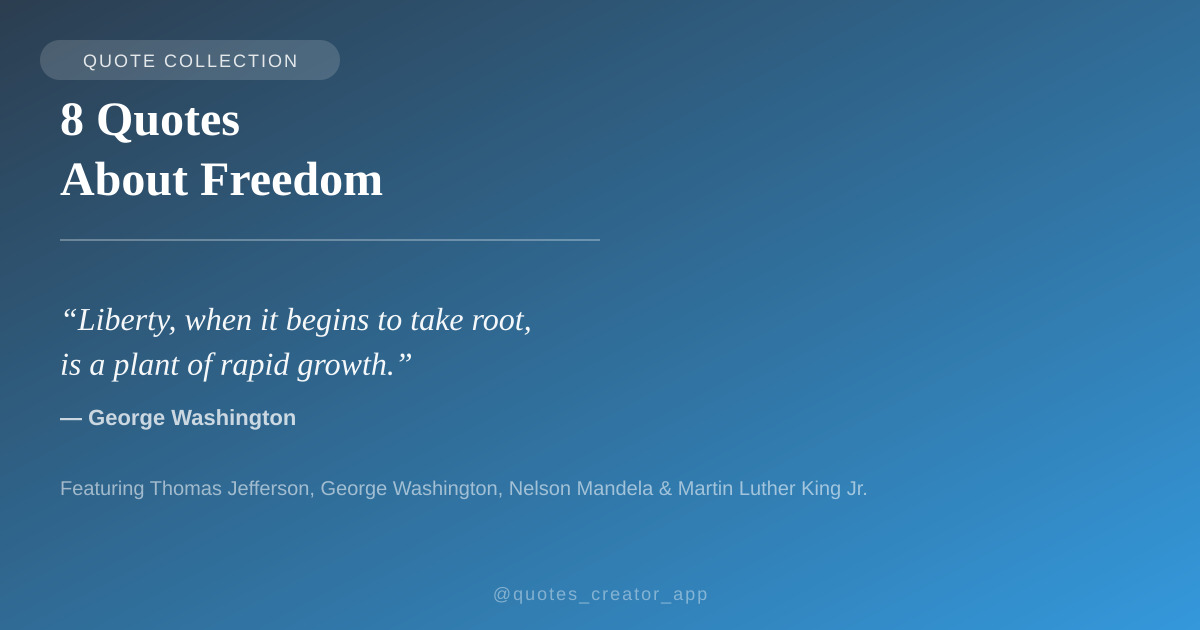
3. “Liberty, when it begins to take root, is a plant of rapid growth.”
George Washington wrote this to James Madison in 1788, just after the Constitution had been drafted and ratified. The new republic was a fragile experiment, and many doubted it would survive. Washington’s image of liberty as a plant is deceptively optimistic — once the seed is planted in fertile soil, growth is not slow or uncertain but rapid and inevitable. It reflects the confidence of someone who had spent a decade fighting for independence and was now watching the institutional framework for liberty take shape. Two centuries later, the metaphor holds: democratic freedoms, once experienced, are almost impossible to suppress permanently.
— George Washington, Letter to James Madison (March 2, 1788)
4. “The preservation of the sacred fire of liberty, and the destiny of the republican model of government, are justly considered as deeply, perhaps as finally staked, on the experiment entrusted to the hands of the American people.”
Washington spoke these words in his First Inaugural Address on April 30, 1789. The new president understood that the United States was not just another country changing leaders — it was a test case for self-government itself. If the American experiment failed, he believed, the cause of liberty everywhere would be set back for generations. The phrase “sacred fire of liberty” captures the almost religious reverence with which the founders approached their task. They were not merely governing a nation; they were stewarding a flame that could light the world or be extinguished by failure. That sense of responsibility still echoes every Fourth of July.
— George Washington, First Inaugural Address (April 30, 1789)
5. “For to be free is not merely to cast off one’s chains, but to live in a way that respects and enhances the freedom of others.”
Nelson Mandela wrote this in his 1995 autobiography “Long Walk to Freedom,” and it may be the most complete definition of freedom ever put in one sentence. After 27 years in prison, Mandela had every right to define freedom as personal liberation. Instead, he insisted that true freedom is relational. You are not truly free if your freedom diminishes someone else’s. The opposite is also true: your freedom is made more real when it contributes to the freedom of others. This insight transformed Mandela from a prisoner into a peacemaker and turned South Africa away from the brink of civil war. It is a definition of liberty that costs more than the selfish version, but it is the only one that lasts.
— Nelson Mandela, Long Walk to Freedom (1995)
6. “I have cherished the ideal of a democratic and free society in which all persons will live together in harmony and with equal opportunities. It is an ideal which I hope to live for. But, my lord, if needs be, it is an ideal for which I am prepared to die.”
Mandela spoke these words from the dock during the Rivonia Trial on April 20, 1964, knowing they could send him to the gallows. The speech lasted four hours, but this closing passage is what the world remembers. It demonstrates something rare: a man who had so fully integrated his values that he could face execution without changing his position. Mandela did not romanticize death. He simply made clear that a life without freedom was not worth living, and that the cause of a free South Africa was worth dying for. He was sentenced to life in prison and served 27 years. When he walked out, he proved that the ideal had outlasted the prison.
— Nelson Mandela, Speech from the dock, Rivonia Trial (April 20, 1964)
7. “Freedom is never voluntarily given by the oppressor; it must be demanded by the oppressed.”
Martin Luther King Jr. wrote this in his 1963 “Letter from a Birmingham Jail,” which is perhaps the most important document of the American civil rights movement. King was responding to white clergymen who urged patience and moderation, arguing that change should come through the courts, not through protests. His reply was devastating: no dominant group in history has ever surrendered its position without pressure. Freedom is not a gift the powerful bestow on the powerless. It is a demand that the oppressed must organize, march, and sacrifice to make real. It is a hard truth, but King argued that accepting it was the first step toward actually achieving freedom rather than waiting for it.
— Martin Luther King Jr., Letter from a Birmingham Jail (April 16, 1963)
8. “The absence of freedom is the presence of death.”
King delivered this line in a 1959 address to the NAACP, and it cuts with surgical precision. He was not speaking of physical death, though he knew that risk intimately. He meant that a person deprived of freedom is, in a moral and spiritual sense, already dead. The ability to choose, to speak, to assemble, to pursue one’s own path — these are not luxuries. They are what separate a life from mere existence. King’s formulation is absolute: if freedom is absent, the result is not merely discomfort or disadvantage but a kind of death. It is a reminder that the stakes of liberty could not be higher, and that complacency in the face of oppression is a form of consent to spiritual annihilation.
— Martin Luther King Jr., Address at the Fiftieth Annual NAACP Convention (July 17, 1959)
Create your own quote graphics
These quotes are meant to be shared. A well-designed quote graphic can stop a scroll, start a conversation, and inspire someone at the right moment. Whether you are posting on Instagram, creating Pinterest pins, or designing WhatsApp statuses, Quotes Creator gives you ready-made templates, beautiful fonts, and custom gradients to bring any of these quotes to life in minutes.
Designing quote graphics for “Freedom & Independence”
- ✓ Use dark blue and slate tones to match the authoritative, grounded mood of this collection
- ✓ Serif fonts work best for freedom and independence quotes — timeless, weighty, historic
- ✓ Pair quotes with patriotic gradient backgrounds for maximum impact
- ✓ Keep text to 2–3 lines maximum on mobile-sized graphics
- ✓ Export in square format for Instagram and portrait for Pinterest
Why we curated this collection
On July 4, the United States celebrates its independence — a moment in history when a group of ordinary people decided that freedom was worth fighting for. But freedom is not a finished project. It is a continuous act of maintenance, protection, and expansion. These eight quotes span nearly two centuries and two continents, from the drafting of the Declaration to the dismantling of apartheid. They come from founders and prisoners, presidents and activists. What unites them is the conviction that liberty is not a slogan but a practice — something you choose every day in how you treat others and what you are willing to risk. We hope they inspire you to keep choosing it.
— ThinkPeak Studio Editorial Team
Create your own quote graphic
Turn this line into a shareable graphic in seconds — free, no signup needed. For video quotes and 100+ templates, try the Android app.
Advertisement
Enjoyed this article? Get more like it in your inbox.