On this page
- 1. “Happiness is not something ready-made. It comes from your own actions.”
- 2. “There is no way to happiness. Happiness is the way.”
- 3. “My mission in life is not merely to survive, but to thrive; and to do so with some passion, some compassion, some humor, and some style.”
- 4. “Happiness depends upon ourselves.”
- 5. “The best way to cheer yourself up is to try to cheer somebody else up.”
- 6. “Whoever is happy will make others happy too.”
- 7. “If you want others to be happy, practice compassion. If you want to be happy, practice compassion.”
- 8. “Try to be a rainbow in someone’s cloud.”
- Designing quote graphics for “Happiness & Inner Peace”
8 Quotes About Happiness & Inner Peace From People Who Made It a Practice
We tend to treat happiness the way we treat the weather — something that happens to us, out of our control. The six voices in this collection spent their lives arguing the opposite: that contentment is a practice, built from attention, compassion, and the small choices of an ordinary day. A Tibetan spiritual leader who calls happiness an action, not a gift. A Zen monk who insists the path itself is the destination. A poet who turned surviving into thriving. A philosopher who located happiness inside our own choices. A humorist who found joy in giving it away. And a teenage diarist who discovered it in the smallest rooms of the darkest place on Earth. This collection brings together eight of their most direct statements on what happiness actually is — not the feeling you chase, but the peace you build.
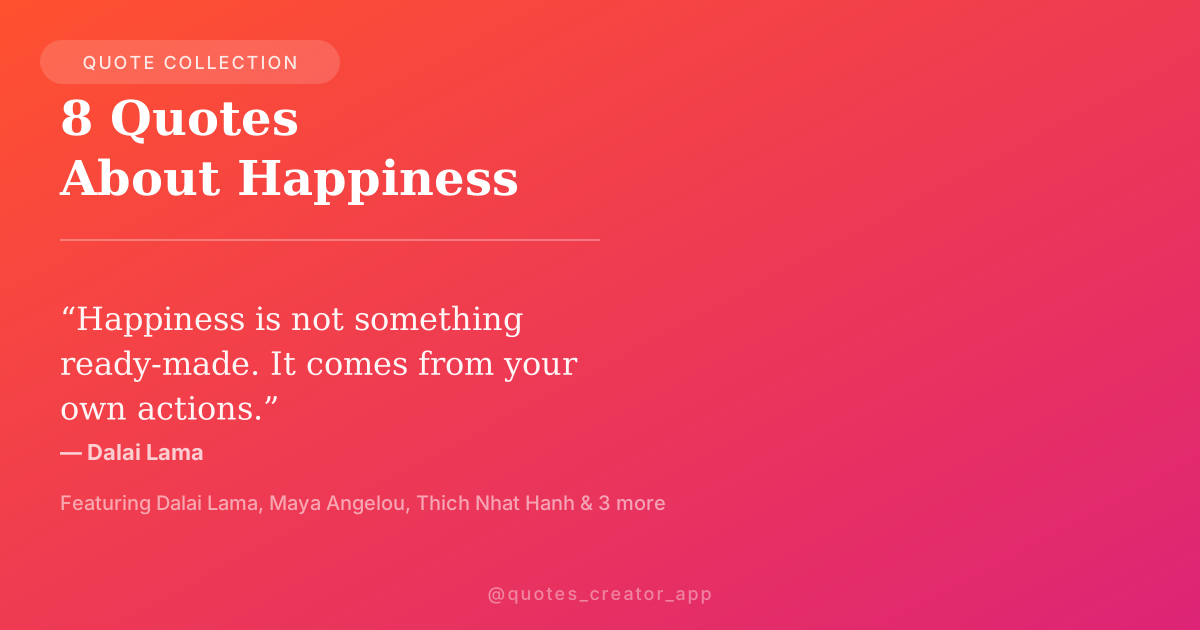
1. “Happiness is not something ready-made. It comes from your own actions.”
The Dalai Lama has repeated this sentence for decades, and it quietly dismantles the most popular theory of happiness there is. Most of us wait for happiness as if it were a delivery — once the promotion comes, once the relationship lands, once the numbers improve, then we will be content. The Dalai Lama inverts the whole sequence. Happiness is not a reward that follows good conditions; it is a behavior you choose regardless of them. His word choice matters: happiness comes from your actions, which means it is something you produce, not something you find. This is the deepest claim in his philosophy — that the mind is trainable, and contentment is the trained response to an unpredictable world.
— Dalai Lama, on the nature of happiness
2. “There is no way to happiness. Happiness is the way.”
Thich Nhat Hanh spent a life teaching this paradox, and it is the most radical redefinition of happiness in this collection. The ordinary version treats happiness as a destination — a place you arrive at after enough struggle, sacrifice, and waiting. Nhat Hanh says the journey and the goal are the same thing. If you are not at peace in this moment, no future moment will fix it, because you will carry the same restless mind into the future. The only way to be happy later is to be happy now — to notice the breath, the tea, the person in front of you. It sounds simple. It is actually the hardest discipline there is, which is why he called it a practice rather than an insight.
— Thich Nhat Hanh, on the path to happiness
3. “My mission in life is not merely to survive, but to thrive; and to do so with some passion, some compassion, some humor, and some style.”
Maya Angelou wrote these words late in her life, and they are her answer to a question most people never think to ask: what is the minimum you owe yourself? She refuses the lowest acceptable goal. Survival — getting through, getting by — is the baseline, not the finish line. Thriving is the mission, and she is precise about its ingredients: passion (energy for what you do), compassion (kindness toward others and yourself), humor (the ability to stay light), and style (the personal stamp you put on all of it). Angelou, who survived profound hardship, is the rare voice who can say this without sounding naive. She earned the right to insist that joy is a form of defiance.
— Maya Angelou, on her life’s mission
4. “Happiness depends upon ourselves.”
Aristotle wrote this in the Nicomachean Ethics, and it is the oldest sentence in this collection — and the one the modern world most often forgets. We have outsourced happiness to external results: wealth, status, outcomes, the approval of other people. Aristotle’s point is that anything that depends on luck can be taken away, and anything that can be taken away is not really yours. What is yours is your character, your choices, your response to circumstances — and happiness built on those cannot be lost. The sentence is not a naive optimism that everything will go well. It is the sturdier claim that your contentment is never fully hostage to your conditions. Two millennia later, that remains the most empowering definition of happiness ever written.
— Aristotle, Nicomachean Ethics (c. 340 BC)
5. “The best way to cheer yourself up is to try to cheer somebody else up.”
Mark Twain wrote this in a letter to Clara Spaulding in 1872, and it contains more psychology than most self-help books published since. The insight is that happiness is not a private resource you must conserve — it is a circuit that only lights up when it is shared. Focus on your own misery and it grows, because attention is its fuel. Focus on someone else’s and your own mood rises as a by-product, almost without your noticing. Twain, the great skeptic, is not being sentimental here. He is reporting a mechanism. Cheering someone up is one of the few activities where the act of giving is the act of receiving, and he built an entire comic career on the discovery.
— Mark Twain, letter to Clara Spaulding (1872)
6. “Whoever is happy will make others happy too.”
Anne Frank wrote this in her diary in 1944, while hiding in the annex in Amsterdam — and the context is what gives the sentence its force. If anyone had a right to claim that happiness was impossible, it was a thirteen-year-old in hiding, surrounded by the machinery of genocide. Instead, she recorded the opposite: that joy is contagious, and that the person who finds it becomes a source of it for everyone around them. The line is not an argument that happiness is easy. It is an argument that happiness is useful — that even under the worst conditions, it is something you can give to others, and that giving is itself a form of resistance.
— Anne Frank, The Diary of a Young Girl (1944)
7. “If you want others to be happy, practice compassion. If you want to be happy, practice compassion.”
The Dalai Lama’s most famous formulation makes a startling claim: that the same practice serves both goals. Most of us imagine that our happiness and other people’s happiness are in competition — that every kindness we extend costs us something, and every indulgence we take pays us something. The Dalai Lama says the two aims are actually the same action. Compassion is not a sacrifice of your own interests; it is the most reliable route to your own peace, because it moves your attention away from the small, hungry self that is never satisfied. The sentence is deliberately symmetrical — two desires, one answer — and that symmetry is the whole point. There is no you-versus-them. There is only practice.
— Dalai Lama, on compassion
8. “Try to be a rainbow in someone’s cloud.”
Maya Angelou offered this as her simple prescription for living well, and its gentleness hides a serious instruction. A rainbow does not eliminate the cloud; it appears against it, changing how the sky is read without pretending the weather is different. Angelou is saying you do not need to fix someone’s life, solve their problems, or take away their grief to bring them joy — you only need to show up as a point of color in an otherwise grey day. It lowers the bar for kindness to something almost anyone can clear, which is exactly why it is so useful. Happiness, in her telling, is not a grand achievement. It is a series of small appearances, made on purpose, in the middle of other people’s ordinary storms.
— Maya Angelou, on kindness
Create your own quote graphics
These quotes are meant to be shared. A well-designed quote graphic can stop a scroll, start a conversation, and inspire someone at the right moment. Whether you are posting on Instagram, creating Pinterest pins, or designing WhatsApp statuses, Quotes Creator gives you ready-made templates, beautiful fonts, and custom gradients to bring any of these quotes to life in minutes.
Designing quote graphics for “Happiness & Inner Peace”
- ✓ Use soft rose, coral, and golden gradients to evoke warmth, calm, and joy
- ✓ Serif fonts work beautifully for happiness quotes — gentle, timeless, and grounded
- ✓ Pair quotes with sunlit, serene imagery like golden-hour skies or still water
- ✓ Keep text to 2–3 lines maximum on mobile-sized graphics
- ✓ Export in landscape format for Twitter and square for Instagram
Why we curated this collection
Happiness is the most sought and least understood word in the language, so instead of adding our own definition, we gathered six people who have lived it from radically different directions — a spiritual leader, a Zen master, a poet, a philosopher, a humorist, and a teenage diarist. Notice what their quotes share: nobody describes happiness as luck, wealth, or the absence of problems. The Dalai Lama describes it as an action. Thich Nhat Hanh describes it as the path itself. Angelou describes it as thriving. Aristotle describes it as the one thing that depends on us. Twain and Anne Frank describe it as something you give away. They all arrive at the same quiet conclusion — happiness is not the feeling you wait for; it is the practice you choose, and the peace you build one ordinary moment at a time.
— ThinkPeak Studio Editorial Team
Create your own quote graphic with this quote
Turn this line into a shareable graphic in seconds — free, no signup needed. For video quotes and 100+ templates, try the Android app.
Advertisement
Enjoyed this article? Get more like it in your inbox.