On this page
- 1. “If you laugh with somebody, then you know you share something.”
- 2. “I always believe that funny is serious and serious is funny. You don’t really need a distinction between them.”
- 3. “You can’t just be crass without being witty. Angry crass is horrible.”
- 4. “Comedy has so much to do with honesty, and women can be more open about their emotions.”
- 5. “Things have to be funny first, and if they want to have a point, that’s awesome.”
- 6. “I like making fun of myself a lot. I like being made fun of, too. I’ve always enjoyed it. There’s just something really, really funny about someone tearing into me.”
- 7. “I’m not good at anything except writing jokes.”
- 8. “Catharsis isn’t art. You can’t rely on catharsis to get a laugh.”
- Designing quote graphics for “Humor & Laughter”
8 Quotes About Humor From the Funniest People Working Today
Humor is often dismissed as the lightest thing a person can do — a diversion, a garnish, a way to fill air between more serious sentences. The four voices in this collection would disagree. A comedian who grew up under apartheid and turned laughter into a shared language. A stand-up who rebuilt the boundaries of what a woman can say on stage. A storyteller whose carefully constructed bits made him one of the most beloved specials in modern comedy. And a writer who describes herself, without apology, as good at nothing except jokes. Between them they have sold out theaters, run late-night franchises, written bestsellers, and hosted the most watched political comedy show in the world. None of them treats humor as trivial. They treat it as the most honest thing a person can do — the place where truth hides in plain sight. This collection brings together eight of their most direct statements on what humor actually is: a survival instinct, a social contract, and a craft you sharpen for a lifetime.
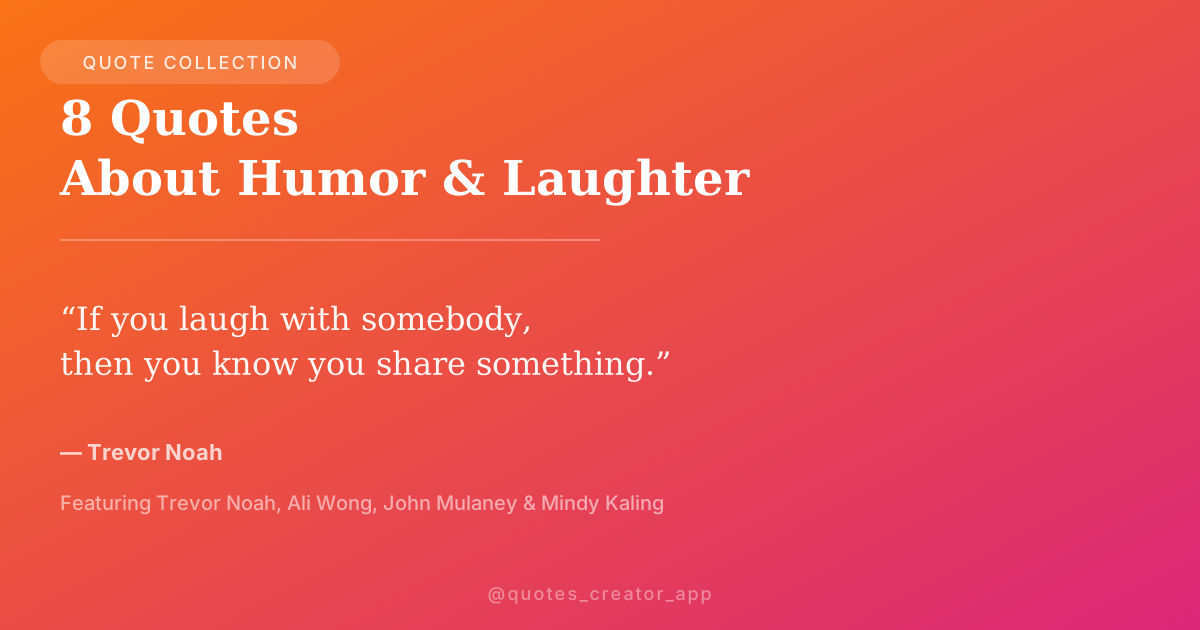
1. “If you laugh with somebody, then you know you share something.”
Trevor Noah is one of the great translators of humor’s social power, and this sentence is his simplest proof of it. He grew up in South Africa under apartheid, in a mixed-race family whose very existence was illegal, in a country designed to keep people from seeing one another as alike. Laughter, he discovered, collapsed the distance the law insisted on. When you laugh with someone, you are not merely entertaining them — you are agreeing, in that moment, about what the world is like. You are admitting that you both notice the same absurdity, feel the same way about it, and can stand on the same side of it. That is why humor is such a powerful connector across every division you can name: nationality, race, age, politics. Noah’s entire career has been an argument that comedy is the shortest route between two strangers, because shared laughter is the fastest evidence that neither of you is alone.
— Trevor Noah, interview
2. “I always believe that funny is serious and serious is funny. You don’t really need a distinction between them.”
This is the deepest sentence in the collection, and it comes from the host of The Daily Show — a man who has spent a decade making jokes about politics, race, and global crisis. Noah’s point is that the line between funny and serious is a fiction we maintain for comfort. The most serious things in the world — war, injustice, mortality — are also the most absurd, and the most reliably funny material is almost always dead serious underneath. Think of any great joke you have heard: it was about something that mattered. Noah refuses to let comedy be segregated into the “not serious” category, and equally refuses to let seriousness be treated as a place where laughter cannot go. His observation dissolves a false binary. The funniest people are often the most serious about what they care about, and the most serious conversations are frequently the ones most in need of a laugh to keep them human.
— Trevor Noah, on comedy and seriousness
3. “You can’t just be crass without being witty. Angry crass is horrible.”
Ali Wong’s stand-up specials built a reputation on being shocking — pregnant on stage, swearing with abandon, telling jokes about her body and her marriage that would have been unthinkable for a mainstream female comic a decade earlier. So it matters enormously that her definition of good comedy is not shock but wit. Crassness without wit, she says, is just noise — it reads as anger, and anger is the thing audiences smell and distrust. The craft is the difference. Anyone can say something transgressive; almost no one can say something transgressive and something sharp. Wong’s rule separates provocation from comedy: the provocation is only the doorway, and wit is what has to be waiting inside. It is a reminder that the most memorable humor is never merely bold — it is bold and precise, surprising and true, all at once.
— Ali Wong, on comedy
4. “Comedy has so much to do with honesty, and women can be more open about their emotions.”
Wong’s observation about the relationship between comedy and honesty is quietly radical, because it flips the stereotype. The popular image of the comic is the deflector — the person who uses jokes to avoid sincerity. Wong argues the opposite: the best comedy is a form of radical honesty, and it is precisely the willingness to say the true thing — the embarrassing thing, the unflattering thing — that makes an audience laugh from the gut. When she performs while hugely pregnant and jokes about motherhood’s unglamorous realities, the laughter comes from recognition, not shock. And her point about women being more open with their emotions is a direct challenge to the industry she entered, where women were long told that emotion on stage was weakness. Wong’s comedy argues that openness is not the enemy of funny; it is the source of it.
— Ali Wong, on comedy and honesty
5. “Things have to be funny first, and if they want to have a point, that’s awesome.”
John Mulaney is famous for jokes that somehow manage to be both deeply silly and unexpectedly thoughtful, and this sentence explains the order of operations behind them. The comedy comes first; the meaning is a bonus, never a substitute. Mulaney is describing a discipline that protects the joke from becoming a lecture. The moment an audience feels that the humor is a delivery vehicle for a message — that the joke exists to serve the point rather than the other way around — the joke dies. His rule keeps the craft honest: if it isn’t funny, no amount of insight will save it. But the phrase “that’s awesome” is doing generous work too. He is not saying meaning is forbidden — he is saying it is welcome, as long as it never gets promoted above the laughter. It is the working philosophy of a comedian who trusts his audience to find the point if he has done his job of making them laugh.
— John Mulaney, on writing comedy
6. “I like making fun of myself a lot. I like being made fun of, too. I’ve always enjoyed it. There’s just something really, really funny about someone tearing into me.”
Self-deprecation is the most reliable engine in all of comedy, and Mulaney’s statement is the confession of a master. His specials are built on a persona of cheerful, well-dressed ineptitude — the man who doesn’t understand finances, can’t handle confrontation, and once got into a fight with a stray cat over a bag of popcorn. The comedy works because he is genuinely delighted by his own absurdity rather than bitter about it. There is no self-pity in Mulaney’s self-mockery, only joy, and that joy is what makes it safe. An audience laughs hardest at the person who has already volunteered to be the joke, because it costs nothing to laugh with someone who is laughing at themselves first. It is also quietly strategic: the comic who makes fun of himself first disarms the room, takes away the sharpest weapon anyone could use against him, and earns the right to then aim outward.
— John Mulaney, on self-deprecation
7. “I’m not good at anything except writing jokes.”
Mindy Kaling’s most famous self-assessment is funny precisely because it is so unguarded. On the surface it reads as a joke about being useless — but it is actually a precise description of a woman who found her superpower early and built an entire career on it. Kaling has written for The Office, created and starred in her own shows, published bestselling books, and written major films. “Nothing except writing jokes” is the statement of someone who knows exactly where her talent lives and has optimized her life around it. The line also contains the real secret of the comedy writer’s craft: jokes are not a small skill. To write a joke well you must observe closely, understand people, edit ruthlessly, and find the precise word — which is a broader set of abilities than most people ever develop in any one field. Calling it “the only thing I’m good at” is the joke; the serious truth underneath is that it was enough.
— Mindy Kaling, Is Everyone Hanging Out Without Me? (2011)
8. “Catharsis isn’t art. You can’t rely on catharsis to get a laugh.”
Kaling’s most sophisticated statement about comedy is a warning against the easiest shortcut of all: the emotional release. When a comedian is angry or wounded, it is tempting to mistake the raw emotion for the humor — to believe that because an audience feels the shock or the venting, the moment has worked. Kaling says no. Catharsis is the audience’s feeling, not the joke’s achievement. You cannot build a career, a show, or even a five-minute set on the relief of expressing something; you need an actual joke, structured and timed and written. It is the difference between a rant and a routine. The insight is especially sharp coming from her, because she writes on shows where emotion is everywhere — the trick is never to let the emotion do the joke’s job. Feeling is the raw material. Craft is the art.
— Mindy Kaling, on comedy writing
Create your own quote graphics
These quotes are meant to be shared. A well-designed quote graphic can stop a scroll, start a conversation, and inspire someone at the right moment. Whether you are posting on Instagram, creating Pinterest pins, or designing WhatsApp statuses, Quotes Creator gives you ready-made templates, beautiful fonts, and custom gradients to bring any of these quotes to life in minutes.
Designing quote graphics for “Humor & Laughter”
- ✓ Use bright, warm gradients — orange to pink evokes energy, playfulness, and a smile
- ✓ Rounded, friendly fonts work best for humor quotes — they feel approachable and light
- ✓ Pair quotes with clean, minimal backgrounds so the punchline is never crowded
- ✓ Keep text to 2–3 lines maximum on mobile-sized graphics
- ✓ Export in square format for Instagram and portrait for Pinterest
Why we curated this collection
We chose humor because it is the most underrated serious subject there is — and then we asked four people who have built world-class careers on it to explain what they are actually doing. The pattern across all eight quotes is striking. Nobody treats humor as trivial or accidental. Trevor Noah describes laughter as the fastest proof of common ground, and insists that funny and serious are never really opposites. Ali Wong argues that the best comedy is a form of honesty, and that shock is worthless without wit to back it up. John Mulaney keeps the order of operations straight — funny first, point second — and turns self-mockery into a superpower. Mindy Kaling names the joke as the whole of her craft, and warns that emotion alone will never get a laugh. Four different disciplines, one shared conclusion: humor is not the opposite of the truth. It is the most efficient delivery system for the truth we have. We hope these words make you laugh — and make you notice how much serious work went into earning that laugh.
— ThinkPeak Studio Editorial Team
Create your own quote graphic with this quote
Turn this line into a shareable graphic in seconds — free, no signup needed. For video quotes and 100+ templates, try the Android app.
Advertisement
Enjoyed this article? Get more like it in your inbox.