On this page
- 1. “A leader is one who knows the way, goes the way, and shows the way.”
- 2. “Leadership is solving problems. The day soldiers stop bringing you their problems is the day you have stopped leading them.”
- 3. “Leadership is about making others better as a result of your presence and making sure that impact lasts in your absence.”
- 4. “Leadership is hard to define and good leadership even harder. But if you can get people to follow you to the ends of the earth, you are a great leader.”
- 5. “Leadership is not about titles, positions, or flowcharts. It is about one life influencing another.”
- 6. “Perpetual optimism is a force multiplier.”
- 7. “In the future, there will not be female leaders. There will just be leaders.”
- 8. “Just because you are CEO, don’t think you have landed. You must continually increase your learning, your skill level, and your contribution to the firm.”
- Designing quote graphics for “Leadership & Influence”
8 Quotes About Leadership & Influence From People Who Earned It
Leadership has been oversold as a title and undersold as a practice — until you listen to the people who actually did it. A minister turned author who spent decades teaching leaders in a hundred countries. A four-star general who led armies and then rebuilt the State Department around a single memo. A Silicon Valley executive who redefined what ambition looks like in the boardroom. A CEO who rose from a village in southern India to run two of the world’s largest companies. None of them led from behind a desk. They led in war rooms, on factory floors, in cabinet meetings, and across thousands of speeches. This collection brings together eight of their most direct statements on what leadership really is — not the title you are given, but the influence you earn by knowing the way, showing the way, and taking care of the people who follow.
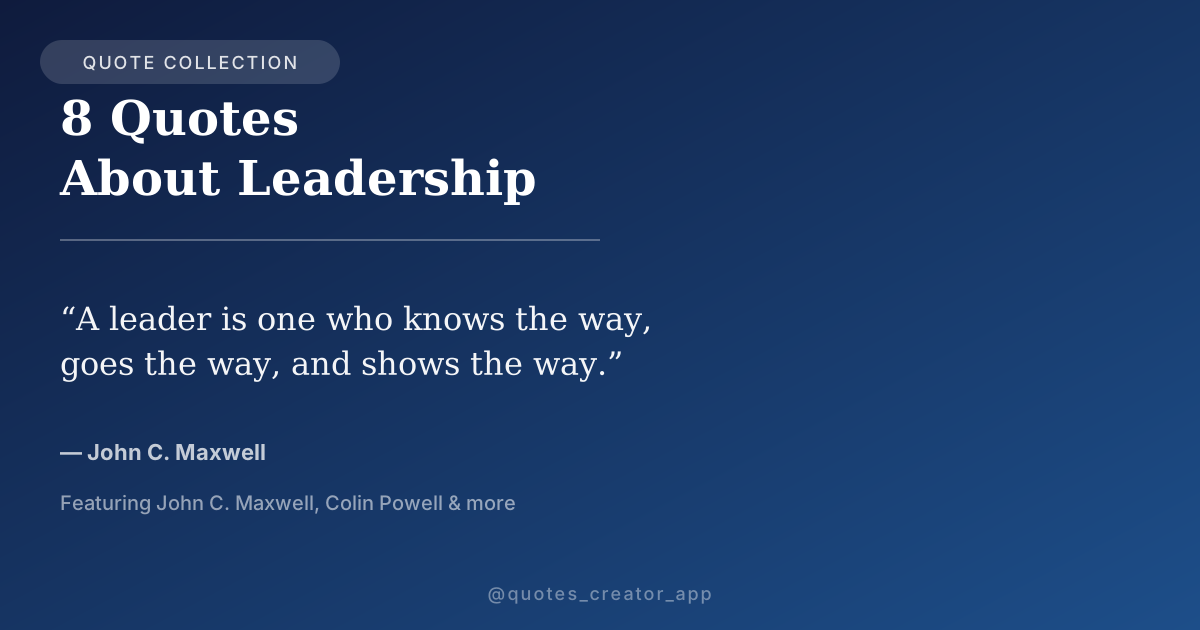
1. “A leader is one who knows the way, goes the way, and shows the way.”
John C. Maxwell has spent more than forty years distilling leadership into sentences people can carry with them, and this is the one most leaders repeat back to him. It is a definition built on three verbs rather than a single noun. Knowing the way is vision — seeing where the organization needs to go before anyone else does. Going the way is courage — being the first to walk into the uncertainty, not standing behind the team pointing at it. Showing the way is example — the thing most people miss. Maxwell’s point is that a leader never graduates from the first two steps. The title only arrives once people have watched you walk the path yourself.
— John C. Maxwell, The 21 Irrefutable Laws of Leadership (1998)
2. “Leadership is solving problems. The day soldiers stop bringing you their problems is the day you have stopped leading them.”
Colin Powell wrote this in A Leadership Primer, the four-page memo he handed to every new officer and every member of his staff. The sentence is a test disguised as a definition. When soldiers stop bringing you their problems, it is not because the problems stopped — it is because they stopped believing you could help, or because they have learned that bringing a problem to you is a way to get blamed for it. Powell’s point is that a leader’s real work is to make the floor safe enough for honest bad news to arrive. The day your people are quiet is the day you have stopped leading, no matter what your nameplate says.
— Colin Powell, A Leadership Primer (1989)
3. “Leadership is about making others better as a result of your presence and making sure that impact lasts in your absence.”
Sheryl Sandberg offers this line as the closest thing she has to a definition of leadership, and the second half is the part that separates it from being merely helpful. Anyone can be useful while they are in the room. The measure of a leader is whether the team still runs better after they have left — whether the capability, the standards, and the confidence outlast the person who built them. Sandberg’s framing is a quiet rebuke to the leader as indispensable hero. If everything collapses when you step away, you never led. You were just a very busy bottle-neck.
— Sheryl Sandberg, on the meaning of leadership
4. “Leadership is hard to define and good leadership even harder. But if you can get people to follow you to the ends of the earth, you are a great leader.”
Indra Nooyi, who rose from a middle-class home in Chennai to run PepsiCo for twelve years, is famously allergic to management jargon, and this sentence is her plain-spoken alternative. She watched countless executives confuse authority with leadership — people obeyed because of the title, not because they believed. The real test, she insists, is whether people follow you when nothing compels them to, when the path is hard and the reward uncertain. That kind of following cannot be ordered. It is only ever earned, through trust built over years and decisions made when nobody was watching.
— Indra Nooyi, on defining great leadership
5. “Leadership is not about titles, positions, or flowcharts. It is about one life influencing another.”
John Maxwell returns with the sentence that his students quote most, and it is the great leveler in his philosophy. By this definition, the person running a team, the parent at the dinner table, and the mentor who answers a late-night call are all doing the same work. The word that carries the whole weight is influence. A title can command compliance, but only influence changes behavior. Maxwell’s point is that leadership is a transfer of energy from one human being to another — and that anyone who touches another person’s decisions, choices, or self-belief is leading, whether the org chart knows it or not.
— John C. Maxwell, Developing the Leader Within You (1993)
6. “Perpetual optimism is a force multiplier.”
This is the shortest and most military sentence Colin Powell ever wrote, and it appears in the same leadership primer as the soldier test. A force multiplier is anything that makes a unit more effective than its raw numbers would suggest — better equipment, better tactics, better morale. Powell’s claim is that a leader’s visible confidence is one of those multipliers. When the people in charge believe the mission can succeed, the team performs beyond its strength; when the leader is visibly defeated, capable people perform below theirs. The optimism he means is not delusion. It is the disciplined choice to project belief because the team’s performance depends on it.
— Colin Powell, A Leadership Primer (1989)
7. “In the future, there will not be female leaders. There will just be leaders.”
Sheryl Sandberg wrote this in Lean In, and it is a vision of a destination she never pretended the world had reached. The sentence does not ask for special treatment or a quota. It asks for the day when leadership is judged by what someone does, not by what they are — when the modifier becomes irrelevant because the word “leader” finally carries all the information you need. It is a hopeful sentence, but an impatient one. The future she describes only arrives because people insist on it, seat by seat, boardroom by boardroom, until the label stops meaning anything at all.
— Sheryl Sandberg, Lean In (2013)
8. “Just because you are CEO, don’t think you have landed. You must continually increase your learning, your skill level, and your contribution to the firm.”
Indra Nooyi delivered this warning in a speech to business school graduates, and it is aimed at the most dangerous delusion a leader can hold: that the top of the ladder is a finish line. In her account, the moment you believe you have arrived is the moment you begin to coast, and coasting in a leadership role costs everyone below you. The sentence quietly redefines the CEO job as an apprenticeship that never ends — more learning, sharper skills, bigger contribution — which is exactly how a woman who started as a product manager kept running a global company for more than a decade without ever feeling she had landed.
— Indra Nooyi, on the leader’s endless apprenticeship
Create your own quote graphics
These quotes are meant to be shared. A well-designed quote graphic can stop a scroll, start a conversation, and inspire someone at the right moment. Whether you are posting on Instagram, creating Pinterest pins, or designing WhatsApp statuses, Quotes Creator gives you ready-made templates, beautiful fonts, and custom gradients to bring any of these quotes to life in minutes.
Designing quote graphics for “Leadership & Influence”
- ✓ Use deep navy melting into royal blue — they evoke authority, trust, and steady resolve
- ✓ Serif fonts lend leadership quotes a timeless, grounded confidence that suits matters of direction
- ✓ Lead with one strong line in bold text, then let the full quote breathe below
- ✓ Keep text to 2–3 lines maximum on mobile-sized graphics
- ✓ Export in landscape format for Twitter and square for Instagram
Why we curated this collection
We chose leadership because it is the word everyone claims and almost no one can define — and then we gathered four voices who spent their lives doing it. The pattern across all eight quotes is unmistakable. John Maxwell defines leadership as knowing, going, and showing the way, and reminds us it is one life influencing another. Colin Powell tests leaders by whether their people still bring them problems, and treats optimism as a tool of war. Sheryl Sandberg measures leadership by whether the impact outlasts the leader, and dares to imagine a world where the word stands alone. Indra Nooyi judges leaders by whether people would follow them to the ends of the earth, and warns that the top of the ladder is never a place to land. Four lives, one shared conclusion — leadership is not a position you hold. It is a practice you keep, an example you set, and an influence you earn from the people who choose to follow.
— ThinkPeak Studio Editorial Team
Create your own quote graphic with this quote
Turn this line into a shareable graphic in seconds — free, no signup needed. For video quotes and 100+ templates, try the Android app.
Advertisement
Enjoyed this article? Get more like it in your inbox.