On this page
- 1. “Be stubborn on your vision but flexible on the details.”
- 2. “You don’t want to go to war with a president. There’s a temptation that you have to fight to tell the president what you think he wants to hear. I’ve seen really good people do that.”
- 3. “The pressure I put myself under is bigger than any price tag.”
- 4. “I like to dance in the pressure storm.”
- 5. “I feel like I’m kind of built for this. The bigger the moment, the more I’m able to lock in.”
- 6. “You have to be kind with the pressure. You have to make friendship.”
- 7. “When the anecdotes and the data disagree, the anecdotes are usually right.”
- 8. “I’m never too interested in what people say because, honestly, people’s opinions change like the weather.”
- Designing quote graphics for “Leadership”
8 Quotes About Leadership From People Leading Right Now
Leadership is rarely about titles and almost never about commanding from the front. It is about how you behave the moment things get hard — whether that moment happens in a boardroom, a briefing room, a dressing room, or on Centre Court. The five people in this collection are not theorists of leadership. They are practitioners: a founder who built the largest company on earth, a physician who spoke science to seven presidents, a footballer who became the defining figure of his sport, a tennis player who dances in the pressure storm, and an athlete who redefined what strength means. These eight quotes are their working theories, tested in real time.
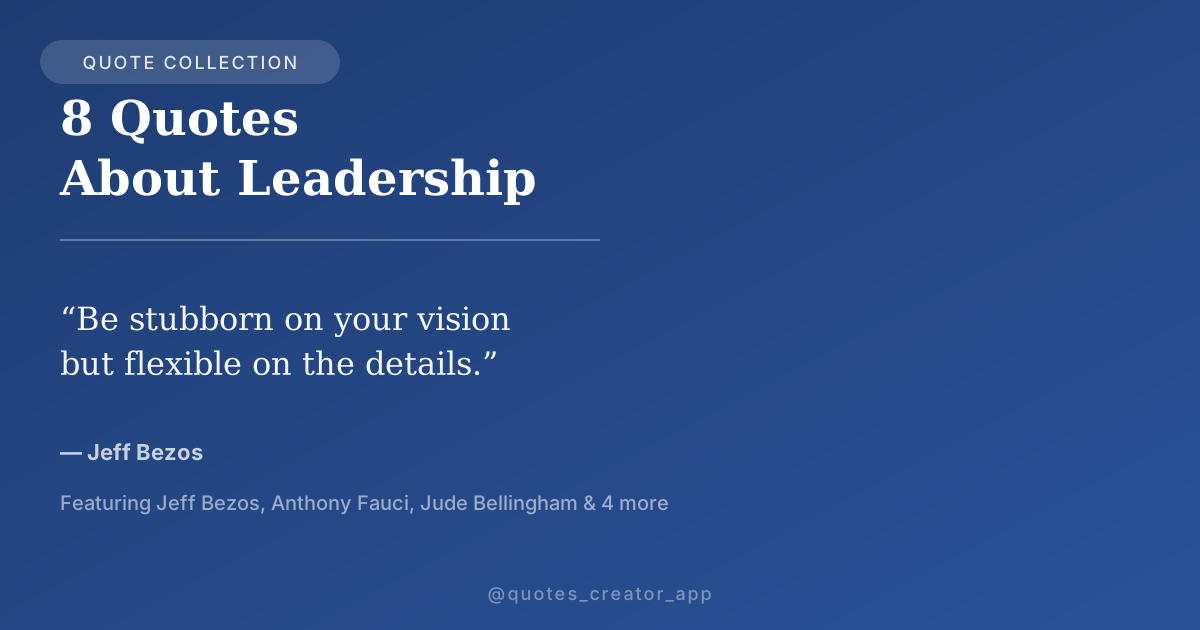
1. “Be stubborn on your vision but flexible on the details.”
Jeff Bezos offered this as his answer to one of the hardest puzzles in any ambitious undertaking: knowing when persistence becomes stubbornness and when adaptability becomes drift. His solution is to split the problem in two. The vision — the destination that justifies the whole journey — deserves near-irrational commitment. The details — the tactics, timelines, and product decisions along the way — deserve none at all. Amazon held its vision of being Earth’s most customer-centric company for three decades while cheerfully abandoning failed experiments within a year. The pairing is what makes the advice durable: it grants permission to be wrong in public about the small things, precisely because the big thing remains fixed. Defend the destination fiercely, and hold every map lightly.
— Jeff Bezos, The New Yorker interview (2019)
2. “You don’t want to go to war with a president. There’s a temptation that you have to fight to tell the president what you think he wants to hear. I’ve seen really good people do that.”
Anthony Fauci said this in a March 2020 Politico interview, and it became famous for what it said about navigating a particular White House, but its real subject is older and more universal: how to be honest inside a system that punishes honesty. Fauci had advised presidents since Reagan and had learned a specific kind of institutional survival — the ability to say “that is not what the data show” without ever saying “you are wrong.” The second sentence is the one that stays with people: “I’ve seen really good people do that.” It is a confession delivered as an observation. Smart, principled people tell a leader what they want to hear not because they are weak, but because the alternative seems worse. Fauci chose a third path: stay in the room, say what the evidence says, and accept that you will be contradicted in public. It is not the most heroic version of integrity. It may be the most effective one.
— Anthony Fauci, Politico interview (March 2020)
3. “The pressure I put myself under is bigger than any price tag.”
When Real Madrid paid €103 million for a 19-year-old midfielder, Jude Bellingham’s response to the debate over his value was this single sentence — one of the most psychologically sophisticated things any athlete has said about the relationship between money and performance. By locating the real pressure inside himself rather than in the transfer fee, he performed a kind of alchemy: the €103 million became irrelevant, not because he dismissed it, but because he had already set a higher bar internally than any external metric could impose. A price tag is a number negotiated between institutions; it has nothing to do with a player’s daily reality. Bellingham refused to let the abstraction of a transfer fee become the measure of his worth. The only pressure that mattered was the one he felt when he looked in the mirror: the pressure to improve, to deliver, to become the player he believed he could be.
— Jude Bellingham, on joining Real Madrid (June 2023)
4. “I like to dance in the pressure storm.”
In eight words, Jannik Sinner captured the philosophy that underpins his entire approach to elite sport. Pressure, for most athletes, is something to be endured — a storm to be weathered, a weight to be carried. Sinner reframes it entirely. To dance in the storm is not to resist it but to move with it, to find rhythm within chaos, to treat the thing that undoes others as a source of energy rather than a source of fear. It is the philosophy of someone who can save three consecutive match points and win, or come back from two sets down in a Grand Slam final and look utterly unbothered. It is also a definition of emotional mastery rather than detachment: not the absence of feeling, but the ability to feel everything and still execute. For any leader who has ever felt crushed by expectation, the alternative Sinner offers is quietly radical — you do not have to overcome the pressure. You can learn to move with it.
— Jannik Sinner, post-match press conference (2023)
5. “I feel like I’m kind of built for this. The bigger the moment, the more I’m able to lock in.”
Naomi Osaka said this after the 2020 US Open, describing her competitive temperament with the matter-of-factness she brings to every part of her game. Where many performers tighten under pressure, she narrows. She is identifying a direct correlation between stakes and clarity: the bigger the moment, the more precisely she focuses. That temperament is rare in any profession, and it helps explain how she won four Grand Slams before the age of 25, including two at the US Open where the spotlight is brightest and the noise is loudest. There is a leadership lesson hiding inside the modesty of the phrasing. Great performers do not pretend the pressure is not there. They train their relationship to it until the moment they once feared becomes the moment they are most present.
— Naomi Osaka, 2020 US Open press conference (September 2020)
6. “You have to be kind with the pressure. You have to make friendship.”
Jannik Sinner said this while discussing the expectations that come with being world No. 1, and the metaphor is worth sitting with. Pressure, he suggests, is not an enemy to be fought or a weight to be managed — it is a relationship to be cultivated. To make friendship with pressure is to stop treating it as an external threat and start treating it as a companion that sharpens you. This is a deeply counterintuitive leadership lesson in a world that tells us to conquer stress, eliminate anxiety, and push back against expectation. Sinner’s alternative is to welcome pressure as a sign that what you are doing matters, and to get so familiar with it that it stops being frightening. The leaders who last are rarely the ones who never feel the weight. They are the ones who learned to make friends with it early.
— Jannik Sinner, on managing the expectations of being world No. 1
7. “When the anecdotes and the data disagree, the anecdotes are usually right.”
Coming from the man who built one of the most data-driven companies on the planet, this is a startling confession. Bezos explained it while describing his practice of forwarding customer complaint emails to executives with a single character added: a question mark. When a dashboard says customers are happy but a single email says otherwise, Bezos learned to trust the email. Dashboards measure what you thought to measure; anecdotes reveal what you forgot to ask. The quote is a masterclass in intellectual humility for the analytics age. It does not reject data; it rejects the complacency of believing your instruments are the territory. Every organization eventually optimizes for its own metrics, and the customer’s lived experience quietly diverges from the numbers on the wall. A leader’s job is to hunt for that divergence rather than celebrate the dashboard.
— Jeff Bezos, Business Insider interview (2018)
8. “I’m never too interested in what people say because, honestly, people’s opinions change like the weather.”
Jude Bellingham made this remark during a 2022 interview, and it reveals a dimension of his mindset that is almost stoic in its detachment. At a time when a single poor performance can trigger days of social-media vitriol and a single brilliant goal can generate weeks of adulation, he has decided to opt out of the emotional rollercoaster entirely. The comparison to weather is precise: opinions are atmospheric, transient, and ultimately unconcerned with the truth of the person they are being projected onto. He is not dismissing criticism or praise; he is noting that neither is stable enough to build a sense of self upon. For a leader, this is a survival mechanism. Pay attention to the people who matter, ignore the rest, and trust that your own internal compass is more reliable than the fickle verdict of the crowd.
— Jude Bellingham, interview (2022)
Create your own quote graphics
These quotes are meant to be shared. A well-designed quote graphic can stop a scroll, start a conversation, and inspire someone at the right moment. Whether you are posting on Instagram, creating Pinterest pins, or designing WhatsApp statuses, Quotes Creator gives you ready-made templates, beautiful fonts, and custom gradients to bring any of these quotes to life in minutes.
Designing quote graphics for “Leadership”
- ✓ Use deep navy and royal blue gradients to evoke authority, clarity, and trust
- ✓ Serif fonts work best for leadership quotes — timeless, grounded, and confident
- ✓ Keep text to 2–3 lines maximum on mobile-sized graphics
- ✓ Pair quotes with geometric or abstract gradient backgrounds for maximum impact
- ✓ Export in landscape format for Twitter and square for Instagram
Why we curated this collection
Leadership is one of those subjects that everyone talks about but few define clearly. These eight quotes cut through the abstractions. Each one comes from someone who is actively leading right now — building companies, advising presidents, or redefining what excellence looks like under pressure. They are not retrospective reflections from retirement; they are working theories from people in the middle of the arena. Notice the thread that runs through all of them: leadership is less about telling people what to do than about managing yourself — your vision, your honesty, your relationship with pressure, and your ability to ignore the noise. That is why we collected them. They are tools being tested in real time, and we hope they serve you the same way.
— ThinkPeak Studio Editorial Team
Create your own quote graphic with this quote
Turn this line into a shareable graphic in seconds — free, no signup needed. For video quotes and 100+ templates, try the Android app.
Advertisement
Enjoyed this article? Get more like it in your inbox.