On this page
- 1. “Leadership is not about being in charge. It is about taking care of those in your charge.”
- 2. “When we tell people to do their jobs, we get workers. When we trust people to do their jobs, we get leaders.”
- 3. “Our industry does not respect tradition — it only respects innovation.”
- 4. “The C in CEO stands for culture.”
- 5. “A leader is anyone who takes responsibility for finding the potential in people and processes, and has the courage to develop that potential.”
- 6. “Clear is kind. Unclear is unkind.”
- 7. “We can do it.”
- 8. “I refuse to believe that you cannot be both compassionate and strong.”
- Designing quote graphics for “Leadership & Trust”
8 Quotes About Leadership & Trust From People Who Lead for Real
For decades we told ourselves that leadership was about being the loudest voice in the room — until the people who actually lead started telling us otherwise. A best-selling author who argues that leadership is care, not command. A CEO who rebuilt a company’s culture before its products. A researcher who made vulnerability a corporate skill. A chancellor who faced a continent’s crisis with four words. A prime minister who refused to choose between strength and kindness. This collection brings together eight of their most direct statements on what leadership really is — not the title, but the daily practice of trusting the people around you.
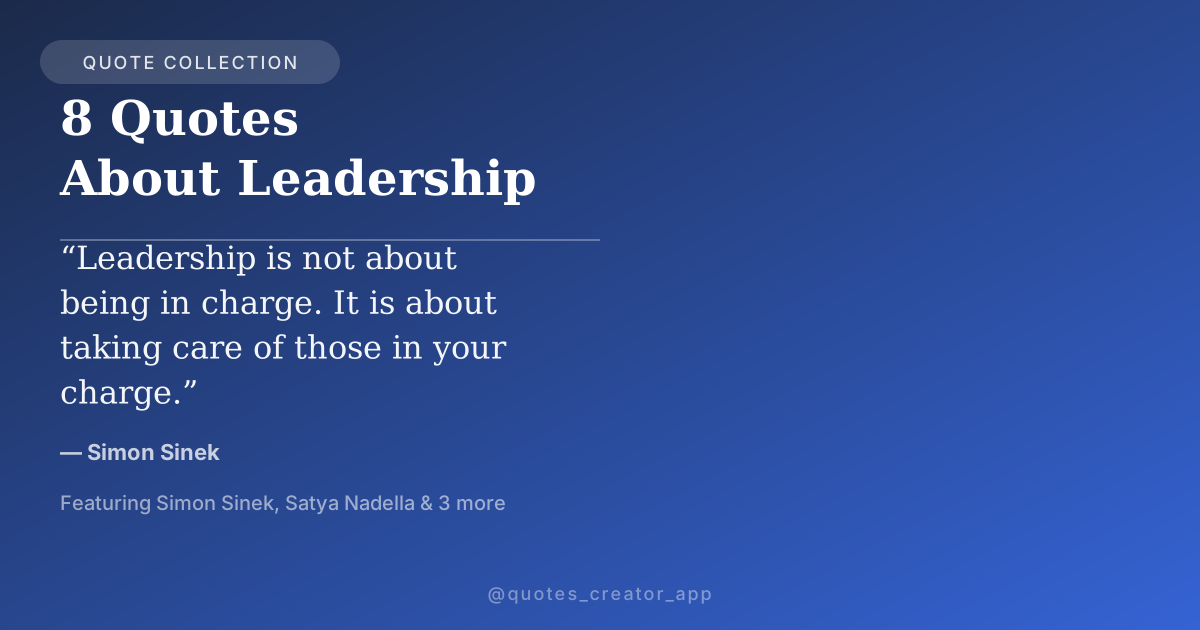
1. “Leadership is not about being in charge. It is about taking care of those in your charge.”
Simon Sinek has repeated this sentence in nearly every stage of his career, and each time it sounds less like a slogan and more like a correction. The traditional model of leadership runs on power: the person with the title gives orders, and the people below comply. Sinek inverts the whole picture. The leader’s real job is not to be served but to serve — to create the conditions in which the people around them can do their best work, safe from fear and blame. This is the quiet radicalism at the heart of his philosophy: care is not a soft skill. It is the entire job.
— Simon Sinek, on the true nature of leadership
2. “When we tell people to do their jobs, we get workers. When we trust people to do their jobs, we get leaders.”
This second Sinek line completes the first one. Telling people to do their jobs treats them as instruments — cogs that perform a task and then stop. Trusting people to do their jobs treats them as owners, which is precisely how you grow the next generation of leadership. It is a counterintuitive economic argument: the most efficient way to get more leaders is to stop controlling your current workers. Trust is not a risk you take when you can afford to. It is the investment that compounds into a team that no longer needs to be managed.
— Simon Sinek, on trust and delegation
3. “Our industry does not respect tradition — it only respects innovation.”
Satya Nadella wrote this line in Hit Refresh, and it quietly explains the most famous turnaround in modern business history. When he became CEO of Microsoft in 2014, the company had lost its way not because of bad products but because of a culture that defended the old ways. His diagnosis was brutal: tradition earns nothing. Only what you build next does. The quote is a leadership principle disguised as a market observation — the leader’s job is not to preserve the past but to keep the organization pointed at the future, even when that future threatens everything the company already knows.
— Satya Nadella, Hit Refresh (2017)
4. “The C in CEO stands for culture.”
Nadella’s sharpest one-liner comes from the same book and the same transformation. After watching Microsoft’s internal rivalries and finger-pointing nearly kill the company’s ability to innovate, he concluded that strategy, products, and market share all follow culture. Fix the culture and everything else gets easier; break the culture and everything else eventually fails. It is a leader’s version of the oldest management truth — you are not building software or selling services. You are building the environment in which your people choose every day whether to bring their best selves to work.
— Satya Nadella, on Microsoft’s culture reset
5. “A leader is anyone who takes responsibility for finding the potential in people and processes, and has the courage to develop that potential.”
Brené Brown opens Dare to Lead with this definition, and the deliberate broadening matters. Leadership, in her account, has nothing to do with titles. It is an act anyone can perform from any chair: seeing what someone could become and committing to help them get there. The word that does the heaviest lifting is courage. Finding potential is easy — you just look. Developing it is hard — it means giving feedback, having hard conversations, and taking responsibility when things go wrong. Brown’s definition is a challenge to every person who has ever said “I’m not a leader.”
— Brené Brown, Dare to Lead (2018)
6. “Clear is kind. Unclear is unkind.”
This is the sentence from Dare to Lead that people tattoo on their walls, and it is a masterclass in reframing. Most of us avoid hard truths to be nice — we soften the feedback, bury the criticism, and hope the message lands on its own. Brown flips the moral ledger. Withholding clarity is not kindness; it is a slow betrayal that leaves people guessing about expectations, defending invisible failures, and building resentment. Real care means saying the thing that is hard to hear, clearly and directly, because that is the only way people can improve. Kindness is not what you avoid saying. It is the courage to say it well.
— Brené Brown, Dare to Lead (2018)
7. “We can do it.”
Angela Merkel said these four words — Wir schaffen das — at a press conference in 2015, when over a million refugees were arriving in Germany and the country was dividing into camps. The sentence became the defining leadership moment of her era, not because it was complex but because it was a commitment. She did not promise the crisis would be easy, and she did not pretend everyone would agree. She simply stated what a leader has to believe: that the people she was accountable for could handle the hard thing. Leadership, in that moment, was not a policy. It was the decision to take responsibility in public and let the sentence be the stand.
— Angela Merkel, on the 2015 refugee crisis
8. “I refuse to believe that you cannot be both compassionate and strong.”
Jacinda Ardern said this in an interview while prime minister of New Zealand, and the sentence is aimed directly at an old prejudice: that empathy and decisiveness are opposites, and that a leader must choose one. Ardern built a governing style on refusing the trade-off — the woman who consoled a nation after the Christchurch shootings was the same leader who moved to ban military-style semi-automatic rifles within weeks. The quote is a promise that leadership does not require you to check your humanity at the door. The strongest leaders are often the ones who can feel the stakes of a decision and still make it.
— Jacinda Ardern, on compassionate leadership
Create your own quote graphics
These quotes are meant to be shared. A well-designed quote graphic can stop a scroll, start a conversation, and inspire someone at the right moment. Whether you are posting on Instagram, creating Pinterest pins, or designing WhatsApp statuses, Quotes Creator gives you ready-made templates, beautiful fonts, and custom gradients to bring any of these quotes to life in minutes.
Designing quote graphics for “Leadership & Trust”
- ✓ Use deep navy and royal blue gradients to evoke authority, clarity, and trust
- ✓ Serif fonts work best for leadership quotes — timeless, grounded, and confident
- ✓ Keep text to 2–3 lines maximum on mobile-sized graphics
- ✓ Pair quotes with geometric or abstract gradient backgrounds for maximum impact
- ✓ Export in landscape format for Twitter and square for Instagram
Why we curated this collection
Leadership is the most discussed subject in business and the least understood. These eight quotes cut through the abstractions by pointing at something all five authors share: a belief that leadership is not about the person in charge, but about the people around them. Sinek sees it as care. Nadella sees it as culture. Brown sees it as the courage to develop potential. Merkel sees it as taking responsibility in public. Ardern sees it as refusing to choose between empathy and strength. They come from radically different worlds — a writer, a CEO, a researcher, a chancellor, a prime minister — yet every quote lands on the same ground: leadership is a practice of trust. We curated these eight because they are not theories from the sidelines. They are lessons learned in the middle of the arena.
— ThinkPeak Studio Editorial Team
Create your own quote graphic with this quote
Turn this line into a shareable graphic in seconds — free, no signup needed. For video quotes and 100+ templates, try the Android app.
Advertisement
Enjoyed this article? Get more like it in your inbox.