On this page
- 1. “Waste no more time arguing about what a good man should be. Be one.”
- 2. “Do not act as if you had ten thousand years to throw away.”
- 3. “Tell me, what is it you plan to do with your one wild and precious life?”
- 4. “Attention is the beginning of devotion.”
- 5. “All we have to decide is what to do with the time that is given us.”
- 6. “Not all those who wander are lost.”
- 7. “Every action you take is a vote for the type of person you wish to become.”
- 8. “You do not rise to the level of your goals. You fall to the level of your systems.”
- Designing quote graphics for “Purpose & Meaning”
8 Quotes About Purpose From People Who Decided What Their Time Was For
Purpose is not discovered in a single flash of clarity — it is decided, again and again, in the ordinary hours of an ordinary day. The four voices in this collection come from radically different traditions, yet they keep arriving at the same startling claim: meaning is not something you find, it is something you choose, and then it is something you do. A Roman emperor who told himself to stop debating what a good man should be and simply be one. A poet who spent a lifetime teaching that attention itself is a form of devotion. A medievalist who survived the trenches and spent decades writing a mythology the world had no use for — until it did. And a habit researcher who reduced the whole question of becoming to a single vote you cast every day. These eight quotes are their answers to the oldest question there is: what is this life for?
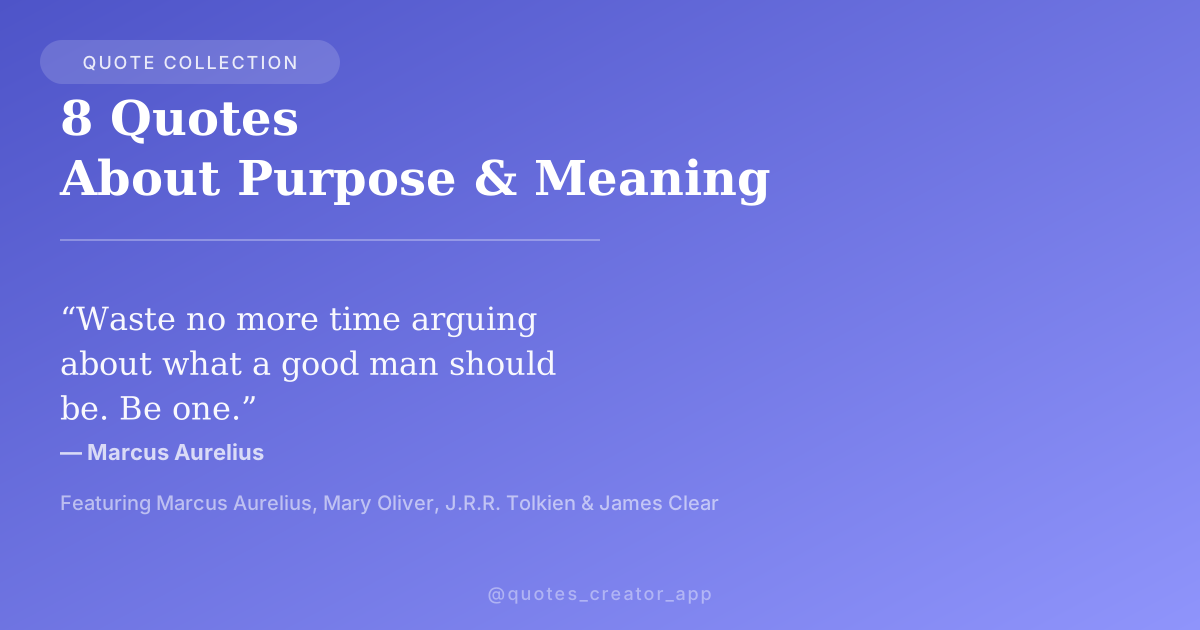
1. “Waste no more time arguing about what a good man should be. Be one.”
Marcus Aurelius wrote this to himself in his private journals, which he never intended to publish and which survive as the Meditations — the private notes of a Roman emperor doing the most unpopular work on Earth: holding himself accountable. The sentence is a rebuke aimed squarely at the most common form of procrastination there is. Most of us are fluent in theories about the good life — we can describe the kind of person we want to be, quote the values we admire, argue for hours about what excellence looks like. Aurelius catches himself doing exactly that and stops. Purpose, in his telling, is not a description; it is a decision, and it is made in the gap between knowing what is right and doing it. The gap is where every meaningful life is either built or abandoned. The emperor is not scolding the world. He is scolding himself, and he left the note where we could all read it.
— Marcus Aurelius, Meditations (c. 170–180 AD)
2. “Do not act as if you had ten thousand years to throw away.”
This is Aurelius at his most urgent, and it is the hidden engine behind everything the Stoics ever wrote. We do not usually waste our lives in dramatic catastrophes; we waste them slowly, in the conviction that there will always be a later. Tomorrow, next year, after the promotion, once the kids are older — the mind manufactures an endless supply of future selves, each one expected to finally start the work that matters. Aurelius dissolves the illusion with a single image: you do not actually have ten thousand years. The point is not to terrify you into productivity; it is to make you feel the weight of the day you are in. Purpose is what you do with the time that is actually yours, which is to say, the time you are in right now. Everything else is a postponement dressed up as a plan.
— Marcus Aurelius, Meditations (c. 170–180 AD)
3. “Tell me, what is it you plan to do with your one wild and precious life?”
Mary Oliver closes her poem The Summer Day with this question, and it has become one of the most shared lines in contemporary poetry precisely because it refuses to answer itself. Oliver spends the poem watching a grasshopper — eating, sleeping, moving through a summer morning with total absorption — and the question arrives as a kind of gift. What will you do with the one life you have? Not the life you wish you had, not the life you think you should have, but the wild and precious one that is actually happening. The word wild does the quiet work: it reminds you that your life is not a fixed script but something alive, unpredictable, and yours. The question does not demand a grand answer. It demands an honest one — and Oliver suggests that the honest answer is usually found in the same absorbed attention a grasshopper gives to a summer day.
— Mary Oliver, The Summer Day (1990)
4. “Attention is the beginning of devotion.”
In her essay collection Upstream, Mary Oliver compresses an entire spiritual practice into four words. We tend to imagine devotion as a grand commitment — a vocation, a calling, a life handed over to something enormous. Oliver flips the order. Devotion does not begin with the vow; it begins with attention, with the small act of truly looking at whatever is in front of you. Purpose, in her telling, is what you pay attention to. It is not decided once at the top of a mountain; it is re-decided every time you notice something fully — a poem, a person, a problem, a craft — and find yourself pulled toward it. The sentence is a warning against living in a blur, and it is also a promise: if you do not know your purpose yet, start by paying attention, and the devotion — and with it the meaning — will begin to take shape on its own.
— Mary Oliver, Upstream (2016)
5. “All we have to decide is what to do with the time that is given us.”
Gandalf says this to Frodo in The Fellowship of the Ring, and it is one of the most quietly radical sentences in modern literature because of what it refuses to promise. There is no guarantee of victory in it, no reassurance that the right decision will work out, no comfort that the odds are fair. There is only a statement about the scope of human responsibility: we do not get to decide the hand we are dealt — the time, the circumstances, the burden that falls to us — but we get to decide what to do with it. Tolkien wrote this line after surviving the Somme, and he had earned the right to it. It is the creed of a man who knew that meaning is not found in outcomes but in choices — that the one freedom no one can take from you is the freedom to decide what you will do with the time you are given.
— J.R.R. Tolkien, The Fellowship of the Ring (1954)
6. “Not all those who wander are lost.”
This line from The Riddle of Strider is usually quoted as a comfort for the aimless, but read in context it is the opposite — it is a defense of purpose carried in secret. The riddle is written about Aragorn, who spends decades wandering the wild in disguise, protecting lands whose people do not know his name, waiting for the moment when he can finally reveal himself. To everyone watching, he looks lost. In fact, he is the only person in the story who knows exactly where he is going. Tolkien is separating two things we habitually fuse together: purpose and visibility. A life does not need to look purposeful from the outside to be purposeful on the inside. Some of the most important work is done in the years when nothing seems to be happening — the long apprenticeship, the quiet preparation, the patient wandering that is actually, invisibly, the road home.
— J.R.R. Tolkien, The Riddle of Strider (1954)
7. “Every action you take is a vote for the type of person you wish to become.”
James Clear built an entire philosophy of change on this single image, and it is the most practical definition of purpose in this collection. Purpose, in the habit researcher’s telling, is not a declaration you make once — it is a series of ballots you cast constantly, with every action, every choice, every ordinary hour. You do not become a writer by deciding to be a writer; you become one by voting for it a hundred small times — writing the paragraph, finishing the page, showing up on the days you do not feel like it. This reframes purpose from a mystery to a practice. You do not need to know your whole life’s direction in advance; you need to know which direction to vote for today. Stack enough aligned votes and the person you wish to become stops being a wish and starts being the person you actually are.
— James Clear, Atomic Habits (2018)
8. “You do not rise to the level of your goals. You fall to the level of your systems.”
This is the counterintuitive heart of Atomic Habits, and it quietly dismantles the most popular theory of purpose there is — that meaning comes from setting a big enough goal. Clear’s point is that goals are just directions on a map; systems are the roads. A towering ambition, unsupported by daily structures, collapses back to the level of whatever the person actually does on a Tuesday. Purpose, then, is not something you aim at from a distance; it is something you engineer into the texture of your days. If you want a life of meaning, you do not need a more inspiring goal — you need more reliable systems, small repeated structures that make the meaningful choice the easy choice. The person with purpose is not the one with the grandest dream. It is the one whose ordinary days are pointed, habit by habit, at the thing they say they want.
— James Clear, Atomic Habits (2018)
Create your own quote graphics
These quotes are meant to be shared. A well-designed quote graphic can stop a scroll, start a conversation, and inspire someone at the right moment. Whether you are posting on Instagram, creating Pinterest pins, or designing WhatsApp statuses, Quotes Creator gives you ready-made templates, beautiful fonts, and custom gradients to bring any of these quotes to life in minutes.
Designing quote graphics for “Purpose & Meaning”
- ✓ Use indigo and violet gradients to evoke depth, reflection, and quiet conviction
- ✓ Serif fonts work beautifully for purpose quotes — timeless, weighty, and confident
- ✓ Pair quotes with imagery of open skies, mountain peaks, or still water for a contemplative mood
- ✓ Keep text to 2–3 lines maximum on mobile-sized graphics
- ✓ Export in landscape format for Twitter and square for Instagram
Why we curated this collection
Purpose is the one thing no one else can hand you, so instead of defining it for you we gathered four people who each answered the question from a different discipline — a Roman emperor who turned self-discipline into a daily practice, a poet who made attention the whole of her devotion, a medievalist who wrote a mythology for decades before the world caught up with him, and a habit researcher who found purpose in the mechanics of an ordinary day. Notice what unites them: none of them treat purpose as a feeling you wait for. Aurelius treats it as a decision. Oliver treats it as attention. Tolkien treats it as a choice made with the time given. Clear treats it as a vote you cast daily. They arrive at the same quiet conclusion — meaning is not discovered; it is built, one deliberate action at a time, and the building is the point.
— ThinkPeak Studio Editorial Team
Create your own quote graphic with this quote
Turn this line into a shareable graphic in seconds — free, no signup needed. For video quotes and 100+ templates, try the Android app.
Advertisement
Enjoyed this article? Get more like it in your inbox.