On this page
- 1. “It’s not how you start, but it’s how you finish.”
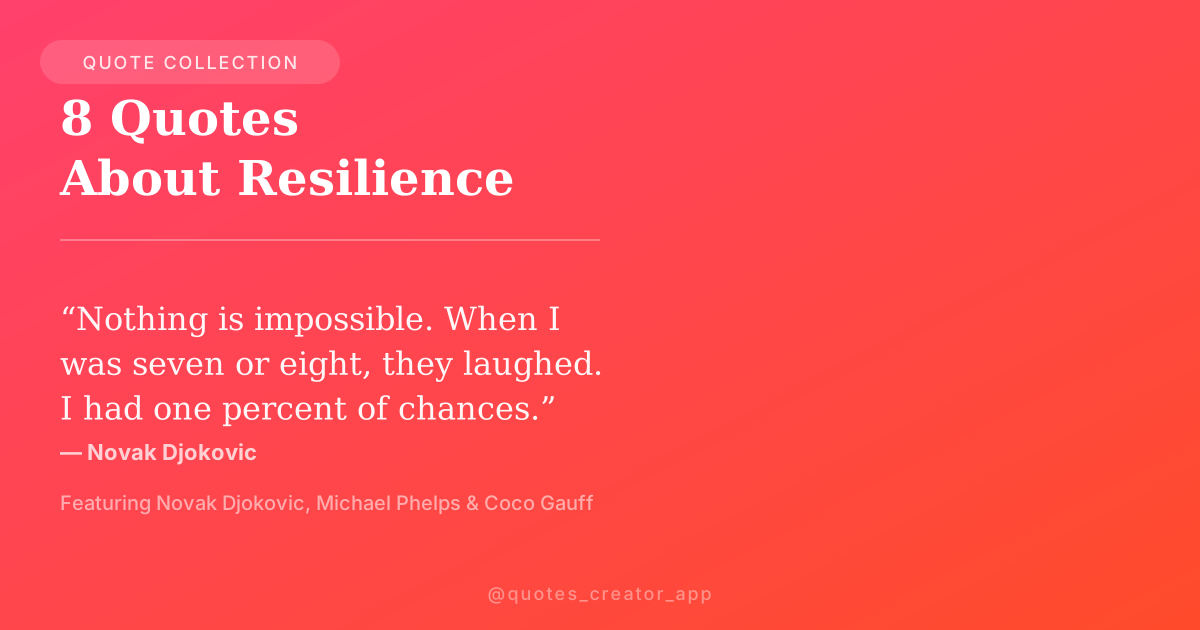
- 2. “Nothing is impossible. When I was seven or eight years old and I said I wanted to be No. 1 in the world, most of the people were laughing at me. It seemed like I had one percent of chances to do that — and I did it.”
- 3. “Every loss is something I learn from.”
- 4. “Which player is mentally stronger? Which player is going to fight the hardest in the big points? These are the things that determine who is the champion.”
- 5. “Dream as big as you can dream, and anything is possible.”
- 6. “If you can think it, you can do it. If you can dream it, you can do it. Just keep working hard. It won’t come easy and it will seem impossible, but if you keep working hard it will definitely happen.”
- 7. “Anybody can do anything that they set their mind to.”
- 8. “I embraced the process of becoming No. 1 of the world, which was long and difficult, but it’s sweeter in the end.”
- Designing quote graphics for “Resilience & Mental Toughness”
8 Quotes About Resilience From Athletes Who Refuse to Stay Down
Resilience is easy to admire and hard to define — until you watch someone who has been counted out refuse to believe the math. The three voices in this collection have spent their careers inside exactly that kind of pressure. A tennis player who was told at seven years old that his dream had a one percent chance of happening — and who won 24 Grand Slams anyway. A swimmer who turned the sport’s hardest lesson — it is not how you start, but how you finish — into a record nobody has touched since. And a young tennis prodigy who turned every loss into a lesson and every doubt into fuel. This collection brings together eight of their most direct statements on what resilience actually is — not the absence of failure, but the refusal to let failure have the final word.
1. “It’s not how you start, but it’s how you finish.”
Michael Phelps said this after winning four gold medals at the 2009 World Championships in Rome — a meet that opened with a silver medal and, to the outside world, a flicker of doubt. The sentence is a philosophy disguised as sports cliché. Most people quit based on the opening chapters of their story: the slow start, the early rejection, the first failure that they let define everything after it. Phelps inverts that instinct. Beginnings are mostly noise — luck, jitters, inexperience. What matters is the version of you that shows up when the story is nearly over, when everyone else has stopped watching. Resilience, in his telling, is not a sprint out of the blocks. It is the ability to make the last lap count, even when the first one went badly.
— Michael Phelps, 2009 World Championships (Rome)
2. “Nothing is impossible. When I was seven or eight years old and I said I wanted to be No. 1 in the world, most of the people were laughing at me. It seemed like I had one percent of chances to do that — and I did it.”
Novak Djokovic returned to this story again and again across his career, and each retelling added weight. He grew up in war-torn Serbia, a country without a tennis tradition, and announced an ambition that everyone around him treated as a child’s fantasy. The quote matters because it does not pretend the odds were good. He does not say “everyone believed in me.” He says the opposite — that the laughter was real and the probability was one percent. And he did it anyway. That is the deepest definition of resilience on offer: not ignoring the odds, but deciding that a one percent chance is still a chance, and then making the entire rest of your life about that slim opening. Twenty-four majors later, the laughter has become a legend.
— Novak Djokovic, on his path to No. 1
3. “Every loss is something I learn from.”
Coco Gauff said this early in her career, when she was still being introduced to the world as a teenage sensation rather than the champion she would become. The sentence sounds simple, but it contains a complete reframing of failure. A loss, in the ordinary telling, is a verdict — proof that you are not good enough, a bill you now owe. Gauff reads it as data. Every defeat is information: about a weakness to fix, a pattern to notice, a part of your game that was not ready. The distinction between the two readings is the difference between people who shrink after setbacks and people who use them as fuel. It is no accident that the player who said this has repeatedly come back from match point down — because for her, losing was never a destination. It was always just a report.
— Coco Gauff, on learning from defeat
4. “Which player is mentally stronger? Which player is going to fight the hardest in the big points? These are the things that determine who is the champion.”
Djokovic’s most honest assessment of his own dominance comes from the belief that at the highest level, the physical gap is almost nothing. Everyone is fit. Everyone has the shots. Everyone trained for years. So what separates the champion from the contender? His answer has nothing to do with talent and everything to do with will: who fights hardest when the score is tight, who keeps believing when the crowd has turned, who refuses to blink. This is resilience as a competitive weapon — not a soft virtue but a hard skill. It means the deciding factor in the biggest moments is not the quality of your forehand but the quality of your mind under stress. For anyone facing a “big point” of their own, the quote is a reminder that the fight is where the champion is made, not in the weeks of training before it.
— Novak Djokovic, on the mental game
5. “Dream as big as you can dream, and anything is possible.”
Michael Phelps said this in the same breath as his eighth gold medal at the 2008 Beijing Olympics — the single greatest performance in Olympic history. The quote is easy to misread as generic inspiration, but in context it is a precise account of how resilience is built. Phelps did not simply wish for eight gold medals; he and his coach wrote the dream down, broke it into daily workouts, and then spent four years executing a plan that his own body sometimes rejected. “Anything is possible” is not a statement about magic. It is a statement about the compounding power of a goal that is big enough to survive the inevitable bad days. Small dreams abandon you when things get hard. Big dreams give you a reason to get up, which is the whole engine of resilience.
— Michael Phelps, 2008 Olympic Games (Beijing)
6. “If you can think it, you can do it. If you can dream it, you can do it. Just keep working hard. It won’t come easy and it will seem impossible, but if you keep working hard it will definitely happen.”
Coco Gauff’s message to her younger fans captures the unglamorous truth at the center of every great comeback. Notice what she does not promise: she never says it will be quick, or easy, or comfortable. She says the opposite — that it will feel impossible and that the work will be relentless. The sentence is a contract between the dreamer and the grind. The first half gives you permission to aim high; the second half tells you the price. Resilience is the willingness to keep paying that price after the enthusiasm has worn off, after the “impossible” feeling has set in, and after everyone around you has moved on to something shinier. Gauff, who has lived this exact loop since she was a child, speaks with the authority of someone who has seen the far side of the doubt.
— Coco Gauff, on dreams and hard work
7. “Anybody can do anything that they set their mind to.”
Phelps paired this line with the most decorated career in Olympic history, and it is deliberately universal. He did not say “anybody born with this body type” or “anybody with this coaching.” He said anybody — which sounds like hyperbole until you consider the actual content of the claim. Setting your mind to something is not wishing; it is the systematic act of aligning your choices, your schedule, and your sacrifices with a goal over many years. That is a skill, not a gift, and it is available to anyone willing to practice it. Resilience, in this reading, is simply the long-term application of that skill — keeping your mind set on the thing when the initial motivation has faded and the reasons to quit have multiplied.
— Michael Phelps, on the power of commitment
8. “I embraced the process of becoming No. 1 of the world, which was long and difficult, but it’s sweeter in the end.”
Djokovic’s closing thought is the least dramatic and perhaps the most important sentence in this collection. It refuses the fantasy that resilience is about brilliant, cinematic moments. Instead it embraces the opposite: the long, difficult, unglamorous middle — the years of losing finals, changing diets, rebuilding his game, and listening to the people who said he would never match his rivals. The word that carries the weight is embraced. Resilience is not tolerating the process, gritting your teeth through it, or enduring it resentfully. It is choosing the process, trusting it, and letting the difficulty itself become part of the reward. The sweetness, he says, is directly proportional to the length and difficulty of the road — which is the best argument ever made for not quitting.
— Novak Djokovic, on embracing the journey
Create your own quote graphics
These quotes are meant to be shared. A well-designed quote graphic can stop a scroll, start a conversation, and inspire someone at the right moment. Whether you are posting on Instagram, creating Pinterest pins, or designing WhatsApp statuses, Quotes Creator gives you ready-made templates, beautiful fonts, and custom gradients to bring any of these quotes to life in minutes.
Designing quote graphics for “Resilience & Mental Toughness”
- ✓ Use bold, fiery gradients — deep reds and oranges evoke grit, fire, and inner strength
- ✓ Strong sans-serif fonts signal determination; pair them with an italic serif for the quote itself
- ✓ Pair quotes with imagery of comebacks, stadiums, or athletes mid-effort
- ✓ Keep text to 2–3 lines maximum on mobile-sized graphics
- ✓ Export in landscape format for Twitter and square for Instagram
Why we curated this collection
Resilience is the theme almost everyone asks for and almost no one can define — so instead of adding our own definition, we gathered three athletes who have lived it at the highest possible altitude. Notice what their quotes share: nobody describes resilience as a feeling, a mood, or a stroke of luck. Djokovic describes it as fighting hardest in the big points and embracing the long, difficult process. Phelps describes it as finishing what you started and keeping your mind set when it would be easier to quit. Gauff describes it as learning from every loss and working when it feels impossible. They come from three different eras and three different sports, yet they all arrive at the same quiet conclusion — resilience is not the absence of failure. It is the decision, made again and again, to let failure be information instead of an ending. We hope their words remind you that being knocked down is never the final chapter — the final chapter is what you do next.
— ThinkPeak Studio Editorial Team
Create your own quote graphic with this quote
Turn this line into a shareable graphic in seconds — free, no signup needed. For video quotes and 100+ templates, try the Android app.
Advertisement
Enjoyed this article? Get more like it in your inbox.