On this page
- 1. “Success isn’t always about greatness. It’s about consistency. Consistent hard work leads to success. Greatness will come.”
- 2. “Blood, sweat, and respect. The first two you give, the last one you earn.”
- 3. “I really think a champion is defined not by their wins but by how they can recover when they fall.”
- 4. “The success of every woman should be the inspiration to another. We should raise each other up.”
- 5. “I’d rather regret the risks that didn’t work out than regret not taking them at all.”
- 6. “It’s OK to not be OK. I’m proof of that.”
- 7. “Greatness is not intelligence. Greatness comes from character. And character is not formed out of smart people, it’s formed out of people who have suffered.”
- 8. “The pain and suffering that you’re experiencing right now, you can use it to your advantage.”
- Designing quote graphics for “Success”
8 Quotes About Success From People Who Built It
There is no single recipe for success, but there are shared ingredients. The four people in this collection have reached the top of wildly different arenas — Hollywood, tennis, gymnastics, and the technology industry — and every one of them will tell you the same thing: success is not a lucky break. It is consistency, recovery, risk, and the willingness to let hardship become fuel. These eight quotes are their working definitions, earned in real time and tested under the loudest spotlights in the world.
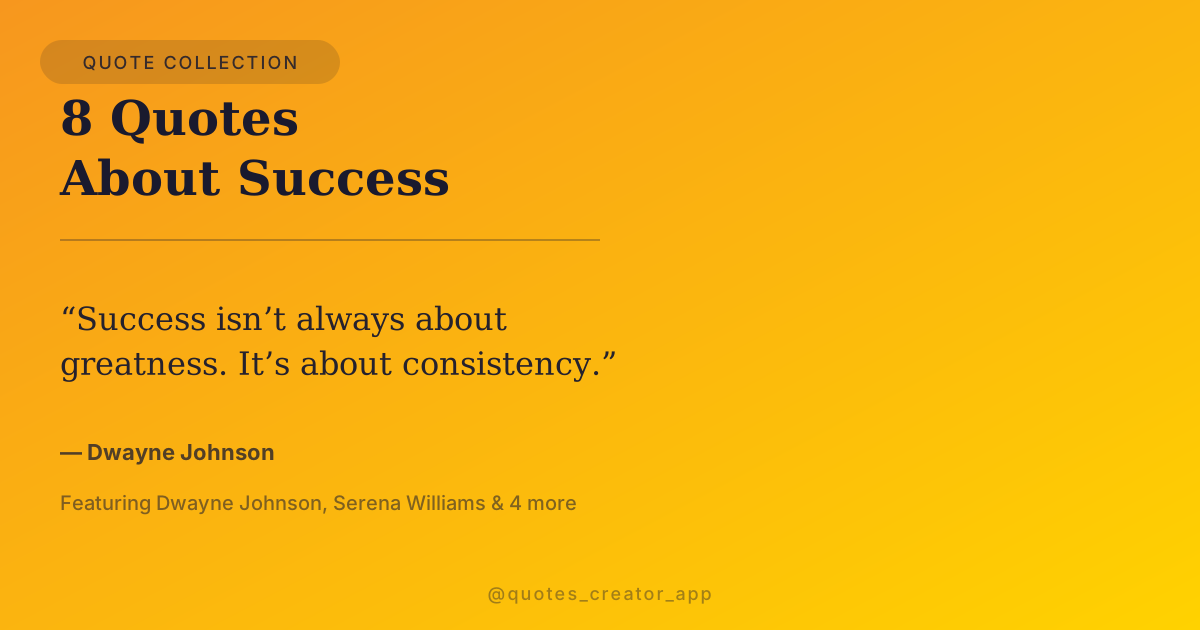
1. “Success isn’t always about greatness. It’s about consistency. Consistent hard work leads to success. Greatness will come.”
Dwayne Johnson offered this as the antidote to every story that makes success look like a single dramatic moment. The version we see — the sold-out arenas, the record-breaking box offices — is the visible tip of years of invisible repetition. Johnson is making a subtle but crucial distinction: greatness is not a quality you are born with, it is a result you are consistent enough to collect. The gym opened at 4 a.m. is not glamorous. Neither is the thousandth hour of practice or the hundredth pitch meeting. But success, in his telling, does not come from any one of those hours. It comes from the streak they form. Greatness is what consistency eventually looks like from the outside.
— Dwayne Johnson, interview (2018)
2. “Blood, sweat, and respect. The first two you give, the last one you earn.”
Few people have put the price of success into six words. Johnson’s aphorism describes an economy of effort: blood and sweat are what you deposit, and respect is what the world returns — but only after you have paid in full. It is a rejection of the entitlement mindset that expects recognition before the work. In a career that moved from a failed football tryout and $7 in his pocket to the highest-paid actor in the world, Johnson has lived the ledger on both sides of the equation. The sentence quietly answers the most common question about ambition — “how do I get respect?” — with a single, unglamorous instruction: give the first two, and wait.
— Dwayne Johnson
3. “I really think a champion is defined not by their wins but by how they can recover when they fall.”
Serena Williams said this with the authority of someone who has been counted out and has counted herself back in more times than almost anyone in sport. The line reframes the entire architecture of achievement: the trophy case is a record of moments, but the champion’s identity is forged in the gaps between them — in the losses, the injuries, the comebacks. Williams came back from a pulmonary embolism that nearly killed her, from motherhood, from a decade of challengers half her age. Each time, the defining act was not the winning but the returning. For anyone whose success has stalled, the quote is a permission slip: falling does not disqualify you. It is the qualification.
— Serena Williams, press conference
4. “The success of every woman should be the inspiration to another. We should raise each other up.”
Williams wrote this in a 2016 essay, and it quietly dismantles one of the most damaging myths about achievement — that success is a zero-sum game. In the version of success most of us were raised on, one person’s rise implies another’s fall. Williams offers a different arithmetic: achievement compounds when it is shared. A woman who wins becomes a reference point, a proof of possibility, for the next one. This is success as an ecosystem rather than a ladder — and it explains why Williams has spent as much energy championing other players as she has beating them. The most generous thing a successful person can do is become the evidence that someone else’s goal is possible.
— Serena Williams, essay (2016)
5. “I’d rather regret the risks that didn’t work out than regret not taking them at all.”
Simone Biles built a career on risk that looks like physics defied — vaults no other woman has ever attempted, landing with the certainty of a law of nature. But her philosophy of risk is psychological, not physical. The sentence performs a neat trick: it compares two kinds of regret and asks which one you can live with. The risk you took that failed leaves a bruise, but the risk you never took leaves a question mark that never stops asking. Biles has consistently chosen the bruise. It is the orientation of someone who understands that security is a mirage — the moment you stop taking risk is the moment you start declining, quietly, from the inside.
— Simone Biles, interview
6. “It’s OK to not be OK. I’m proof of that.”
At the 2020 Tokyo Olympics, Simone Biles did the most radical thing an athlete at the peak of her sport can do: she stepped back and told the world why. In doing so, she redefined what success even means — separating it from medals, from records, from other people’s expectations of what a champion should be. This line, delivered as she championed mental health, is the quiet sequel to that decision. The culture that equates success with an unbroken run of peak performance is the culture Biles publicly refused. Her version of success is harder to measure and more honest: know your limits, honor them, and let that be a strength rather than a failure.
— Simone Biles, on mental health (2021)
7. “Greatness is not intelligence. Greatness comes from character. And character is not formed out of smart people, it’s formed out of people who have suffered.”
Jensen Huang, the founder of NVIDIA, offered this in a 2013 talk, years before his company became the most valuable in the world. It is a strikingly counterintuitive claim from a technology executive — an industry that worships intelligence as the master input. Huang is arguing that intelligence is cheap; the market is full of brilliant people. What separates them is what they do when they are tested. Character, in his account, is not an inherited trait but a material built under pressure, the way coal becomes diamond. This is the philosophy behind NVIDIA’s famous willingness to endure near-death moments — the company survived being bet against, written off, and out-teched, and each episode forged the resolve that later powered its ascent.
— Jensen Huang, talk (2013)
8. “The pain and suffering that you’re experiencing right now, you can use it to your advantage.”
Huang has said some version of this for decades, and it reads as the summary of his entire career. He was born in a country that expelled his family, sent to a reform school in Kentucky at nine, and told early that his dreams were out of reach. Every obstacle became feedstock. The claim is not that suffering is good — it is that suffering, once it has happened, can be converted. It can become empathy, resilience, caution, or the particular kind of hunger that only the underestimated possess. The most successful people are rarely the ones who suffered least; they are the ones who learned to metabolize difficulty into advantage instead of letting it become bitterness. Pain is unavoidable. What you build with it is a choice.
— Jensen Huang, interview (2023)
Create your own quote graphics
These quotes are meant to be shared. A well-designed quote graphic can stop a scroll, start a conversation, and inspire someone at the right moment. Whether you are posting on Instagram, creating Pinterest pins, or designing WhatsApp statuses, Quotes Creator gives you ready-made templates, beautiful fonts, and custom gradients to bring any of these quotes to life in minutes.
Designing quote graphics for “Success”
- ✓ Use amber and gold gradients to evoke victory, ambition, and triumph
- ✓ Bold serif fonts work best for success quotes — authoritative and timeless
- ✓ Pair quotes with achievement-focused imagery like stadiums, trophies, or mountain peaks
- ✓ Keep text to 2–3 lines maximum on mobile-sized graphics
- ✓ Export in landscape format for Twitter and square for Instagram
Why we curated this collection
Success is the most chased and least defined word in the modern vocabulary. So instead of adding our own definition, we gathered four people who have actually lived it — a wrestler-turned-global-movie-star, a tennis legend, a gymnast who rewrote her sport, and the founder of the world’s most valuable company. Notice what their quotes have in common: nobody mentions luck. Instead they describe consistency, the courage to risk, the discipline to recover, and the alchemy of turning hardship into fuel. These are not theories from a lecture hall; they are operating principles, forged under pressure and tested in public. We hope they redefine success for you the way they redefined it for us.
— ThinkPeak Studio Editorial Team
Create your own quote graphic with this quote
Turn this line into a shareable graphic in seconds — free, no signup needed. For video quotes and 100+ templates, try the Android app.
Advertisement
Enjoyed this article? Get more like it in your inbox.