On this page
- 1. “You have power over your mind — not outside events. Realize this, and you will find strength.”
- 2. “The impediment to action advances action. What stands in the way becomes the way.”
- 3. “Seek wisdom, not knowledge. Knowledge is knowing that a tomato is a fruit. Wisdom is not putting it in a fruit salad.”
- 4. “Read what you love until you love to read.”
- 5. “You do not rise to the level of your goals. You fall to the level of your systems.”
- 6. “Every action you take is a vote for the type of person you wish to become.”
- 7. “The obstacle in the path becomes the path. Never forget, within every obstacle is an opportunity to improve our condition.”
- 8. “Ego is the enemy.”
- Designing quote graphics for “Wisdom”
8 Quotes About Wisdom & Clear Thinking From Modern Stoics
Wisdom is not the accumulation of facts. It is the ability to see clearly, act deliberately, and refuse to be rattled by the noise of the world. The four voices in this collection — a Roman emperor, a bestselling philosopher of resilience, a Silicon Valley thinker, and the author of Atomic Habits — all arrive at the same conclusion from different directions: wisdom is a practice, not a possession. These eight quotes are the distilled operating manual for thinking clearly under pressure.
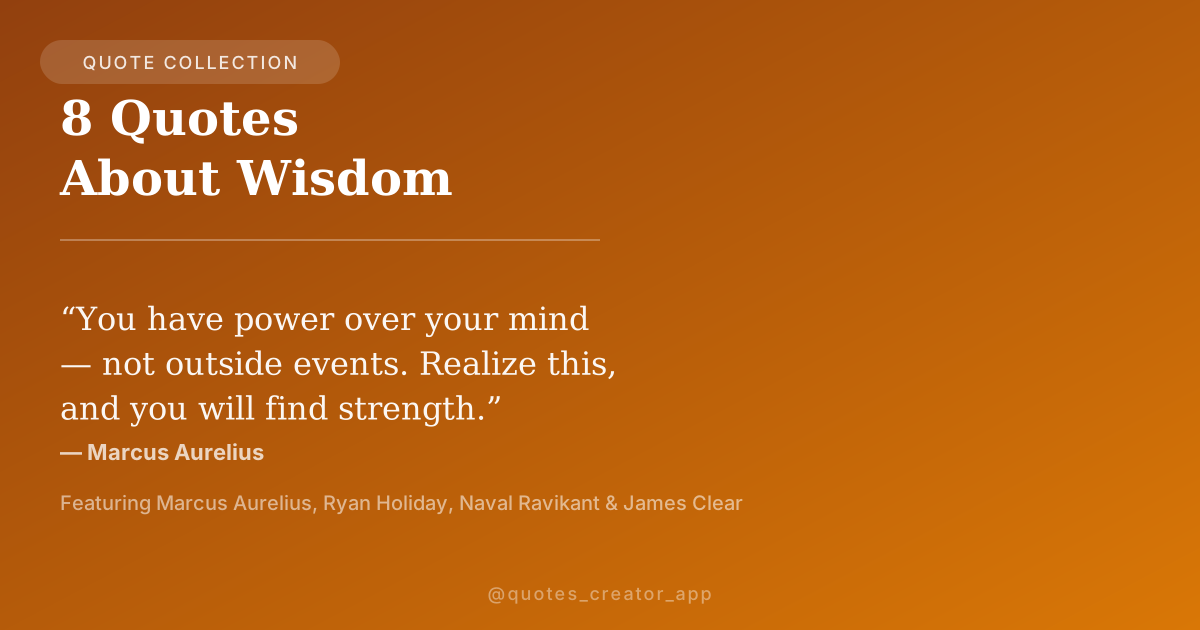
1. “You have power over your mind — not outside events. Realize this, and you will find strength.”
Marcus Aurelius wrote the Meditations not for publication but as private notes to himself, composed in army tents and palace chambers while ruling the largest empire on earth. This line is the cornerstone of Stoic psychology and arguably the single most useful sentence ever written about emotional resilience. It draws a clean line between the two halves of every experience: the external event, over which you have zero control, and your internal response, over which you have complete control. Most suffering, the emperor argues, does not come from the event itself but from the story you tell yourself about it. The storm is the storm; your panic is optional. Wisdom begins the moment you stop trying to control the weather and start mastering your reaction to it.
— Marcus Aurelius, Meditations (c. 180 CE)
2. “The impediment to action advances action. What stands in the way becomes the way.”
This is the single most quoted passage from the Meditations, and it is the philosophical engine behind an entire genre of modern resilience literature. The counterintuitive claim is that obstacles are not roadblocks but raw material. A setback does not merely block your path — it reveals a better path, strengthens the muscle you needed anyway, and eliminates everything that was not essential. The ship that runs aground on a reef learns what its hull is made of. The project that fails teaches you more than the one that glides through. Marcus Aurelius is not offering cheap optimism; he is describing a perceptual shift available in any moment, a way of looking at trouble that converts it from enemy to teacher.
— Marcus Aurelius, Meditations (c. 180 CE)
3. “Seek wisdom, not knowledge. Knowledge is knowing that a tomato is a fruit. Wisdom is not putting it in a fruit salad.”
Naval Ravikant, the angel investor and philosopher of the tech generation, delivers one of the most practical definitions of wisdom ever written with a joke. Knowledge is the raw data — facts, definitions, the correct answers on a quiz. Wisdom is knowing how to use that data in real situations where context, judgment, and timing matter. Plenty of people are walking encyclopedias who still make terrible decisions, because knowledge without application is just storage. Naval’s deeper point is that wisdom is gained through experience, not memorization — you cannot read your way to good judgment. You earn it by acting, failing, reflecting, and adjusting, until the right move becomes instinct.
— Naval Ravikant, tweet (2020)
4. “Read what you love until you love to read.”
This line is Naval Ravikant’s complete theory of self-education, and its genius is in the word “until.” Most people treat reading as a duty — a stack of important books they should finish, a chore to be endured. Naval inverts this: read for pleasure first, and let the love of reading compound into breadth. Once the habit is built on enjoyment rather than obligation, you will naturally chase curiosity across disciplines, and that cross-pollination is where wisdom actually lives. He is famously self-taught, having dropped out of school after losing a scholarship and building one of the most successful careers in technology through voracious, unstructured reading. The point is not what you read. The point is that you read enough, joyfully enough, that learning becomes a permanent feature of your life.
— Naval Ravikant, podcast interview (2019)
5. “You do not rise to the level of your goals. You fall to the level of your systems.”
James Clear, whose Atomic Habits has sold tens of millions of copies, is making a claim that sounds like bad news and is actually liberating. Goals are destinations; systems are the daily processes that take you there. New Year’s resolutions fail not because people lack ambition but because they lack infrastructure — the environment, cues, and routines that make the right behavior automatic. The wise person stops obsessing over the outcome and starts designing the input: the tiny, repeatable actions performed badly enough times that eventually become impossible to perform badly. This is wisdom applied to behavior itself, a recognition that we are not creatures of intention but creatures of repetition.
— James Clear, Atomic Habits (2018)
6. “Every action you take is a vote for the type of person you wish to become.”
Clear’s reframing of identity is one of the most quietly powerful ideas in modern psychology. Instead of asking “what do I want to achieve?”, wisdom asks “who do I want to become?” — and then treats every single choice as a ballot cast in that election. One workout is not enough to make you an athlete, and one bad meal does not make you unhealthy, but a thousand small votes eventually determine the verdict. This dissolves the pressure of perfection: no single action defines you, which means no single failure disqualifies you either. It also makes identity a matter of daily design rather than destiny — you are continuously authoring who you are through the choices you make when nobody is watching.
— James Clear, Atomic Habits (2018)
7. “The obstacle in the path becomes the path. Never forget, within every obstacle is an opportunity to improve our condition.”
Ryan Holiday, who built a publishing career by translating ancient Stoicism for modern readers, distills Marcus Aurelius into a single actionable line. The people who impress us most are not the ones who never encounter problems — they are the ones who treat problems as the material of progress. A blocked writer becomes a more disciplined writer. A company facing bankruptcy learns exactly which of its costs were essential. Holiday’s phrase “improve our condition” is the key: adversity does not merely test you, it upgrades you, forcing clarity, humility, and resourcefulness that comfort never provides. The wise person does not ask for fewer obstacles. They ask for the strength to see each one as an opportunity in disguise.
— Ryan Holiday, The Obstacle Is the Way (2014)
8. “Ego is the enemy.”
Ryan Holiday’s three-word book title is a complete philosophy of wisdom in miniature. Every failure of judgment — the overconfident bet, the defensive response, the refusal to learn from criticism — can be traced back to ego, the part of us that cares more about appearing right than being right. Ego inflates before success (making us careless), shatters after failure (making us bitter), and interrupts learning at every stage (making us close ourselves off to feedback). Wisdom, by contrast, is a form of humility: the willingness to be wrong, to listen, to admit you do not know. Holiday’s line is a daily test. When you are about to speak, act, or decide, ask one question — am I doing this because it is right, or because it flatters my ego? The gap between those two answers is where wisdom lives.
— Ryan Holiday, Ego Is the Enemy (2016)
Create your own quote graphics
These quotes are meant to be shared. A well-designed quote graphic can stop a scroll, start a conversation, and inspire someone at the right moment. Whether you are posting on Instagram, creating Pinterest pins, or designing WhatsApp statuses, Quotes Creator gives you ready-made templates, beautiful fonts, and custom gradients to bring any of these quotes to life in minutes.
Designing quote graphics for “Wisdom”
- ✓ Use warm amber and gold gradients — rich, timeless tones that evoke depth and reflection
- ✓ Serif fonts work best for wisdom quotes — classical, weighty, and authoritative
- ✓ Keep the layout minimal; wisdom feels most powerful when there is room to breathe
- ✓ Keep text to 2–3 lines maximum on mobile-sized graphics
- ✓ Export in square format for Instagram and portrait for Pinterest
Why we curated this collection
Wisdom is the rarest of the intellectual virtues because it cannot be taught in a classroom — only practiced. The four voices here represent four distinct traditions of that practice: the Roman emperor who wrote his private meditations by lamplight, the Silicon Valley thinker who turned reading into a discipline, the habit scientist who redesigned the mechanics of daily life, and the modern Stoic who made ancient philosophy useful to millions. They agree on the fundamentals: control your response, not the event; treat obstacles as material; prefer judgment to information; design systems, not resolutions; and keep your ego out of the driver’s seat. We hope these words help you think a little more clearly today — and act a little more wisely.
— ThinkPeak Studio Editorial Team
Create your own quote graphic with this quote
Turn this line into a shareable graphic in seconds — free, no signup needed. For video quotes and 100+ templates, try the Android app.
Advertisement
Enjoyed this article? Get more like it in your inbox.