On this page
- 1. “Science progresses best when observations force us to alter our preconceptions.”
- 2. “We have peered into a new world and have seen that it is more mysterious and more complex than we had imagined. Still more mysteries of the universe remain hidden. Their discovery awaits the adventurous scientists of the future. I like it this way.”
- 3. “There are two kinds of truth: the truth that lights the way and the truth that warms the heart. The first of these is science, and the second is art. Neither is independent of the other or more important than the other. Without art, science would be as useless as a pair of high forceps in the hands of a plumber. Without science, art would become a crude mess of folklore and emotional quackery.”
- 4. “Everything written with vitality expresses that vitality: there are no dull subjects, only dull minds.”
- 5. “If you read quickly to get through a poem to what it means, you have missed the body of the poem.”
- 6. “Life without literature is a life reduced to penury. It expands you in every way. It illuminates what you’re doing. It shows you possibilities you haven’t thought of. It enables you to live the lives of other people than yourself. It broadens you, it makes you more human.”
- 7. “How much does one imagine, how much observe? One can no more separate those functions than divide light from air, or wetness from water.”
- 8. “Be both a speaker of words and a doer of deeds.”
- Designing quote graphics for “Wisdom & Knowledge”
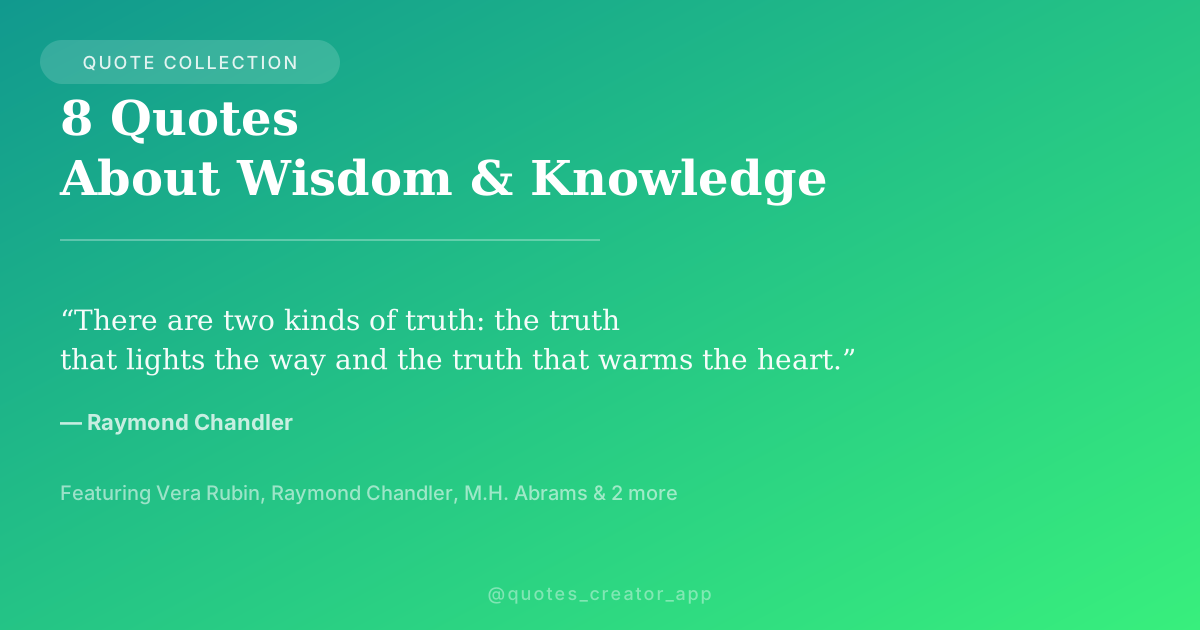
8 Quotes About Wisdom & Knowledge to Expand Your Mind
What does it mean to truly know something? Is wisdom the accumulation of facts, or is it something deeper — the ability to discern, to connect, to see beyond the surface? From an astronomer who mapped the invisible universe to a crime novelist who understood the poetry of truth, these eight voices offer remarkably different answers to the same ancient question. Together, they form a mosaic of what it means to think, to question, and to grow wiser.
1. “Science progresses best when observations force us to alter our preconceptions.”
Vera Rubin spent decades measuring how galaxies spin, and what she found upended everything astronomers thought they knew. Her observations of flat rotation curves contradicted the prevailing model, and instead of dismissing the data, she followed it to a revolutionary conclusion: most of the universe is made of invisible dark matter. This quote is a masterclass in intellectual humility — the willingness to let evidence override cherished beliefs is the very engine of discovery. True wisdom requires surrendering comfortable assumptions when reality demands it.
— Vera Rubin, In Quest of the Universe (2007)
2. “We have peered into a new world and have seen that it is more mysterious and more complex than we had imagined. Still more mysteries of the universe remain hidden. Their discovery awaits the adventurous scientists of the future. I like it this way.”
Rubin celebrates a paradox at the heart of all true knowledge: the more we learn, the more we realize how much remains unknown. Far from discouraging her, this boundless mystery is a source of exhilaration. Wisdom is not about arriving at final answers but about embracing the unknown with curiosity rather than fear. The universe will never be fully mapped, and Rubin finds that beautiful — a reminder that the pursuit of knowledge is itself the greatest reward.
— Vera Rubin, Bright Galaxies, Dark Matters (1997)
3. “There are two kinds of truth: the truth that lights the way and the truth that warms the heart. The first of these is science, and the second is art. Neither is independent of the other or more important than the other. Without art, science would be as useless as a pair of high forceps in the hands of a plumber. Without science, art would become a crude mess of folklore and emotional quackery.”
Raymond Chandler, best known for his hard-boiled detective novels, was also a sharp philosopher of knowledge. This passage dismantles the false war between science and the humanities. Objective truth (science) and subjective meaning (art) are not rivals but partners — each needs the other to be complete. Chandler’s wit is on full display, but beneath it lies a profound epistemological insight: a wise mind does not choose between reason and imagination but holds both together.
— Raymond Chandler, “Great Thought” (1938), from The Notebooks of Raymond Chandler (1976)
4. “Everything written with vitality expresses that vitality: there are no dull subjects, only dull minds.”
Chandler rejects the idea that some topics are inherently boring. True knowledge, he insists, is not a property of the subject matter but of the mind that engages with it. A curious, alert intelligence can find depth and meaning anywhere. This is a call to approach learning with energy and imagination rather than passive consumption — wisdom is not about what you study but how you study it.
— Raymond Chandler, “The Simple Art of Murder” (1945)
5. “If you read quickly to get through a poem to what it means, you have missed the body of the poem.”
M. H. Abrams, who edited The Norton Anthology of English Literature for decades, understood that real understanding cannot be rushed. In an age that prizes speed and efficiency, this is a quiet radicalism: meaning is not a destination to arrive at but an experience to inhabit. To skim a poem for its “message” is to miss the texture, the sound, the feeling — everything that makes it a poem. Deep knowing requires patience, attention, and presence.
— M. H. Abrams, Cornell Chronicle interview (June 1999)
6. “Life without literature is a life reduced to penury. It expands you in every way. It illuminates what you’re doing. It shows you possibilities you haven’t thought of. It enables you to live the lives of other people than yourself. It broadens you, it makes you more human.”
For Abrams, knowledge is not data accumulation — it is an expansion of the self. Literature grants access to perspectives, eras, and experiences beyond our own, and this enlarges our capacity for empathy and understanding. Wisdom, in this view, is not measured by how much you know but by how fully you can inhabit the lives and minds of others. The well-read mind is a more generous, more human mind.
— M. H. Abrams, dialogue with Stephen Greenblatt, The New York Times (August 2012)
7. “How much does one imagine, how much observe? One can no more separate those functions than divide light from air, or wetness from water.”
Elspeth Huxley, who chronicled life in British Kenya with a journalist’s eye and a novelist’s heart, dissolves the boundary between objective observation and subjective imagination. Understanding, she argues, is not a purely mechanical recording of facts. It is an inseparable blend of what we see and what we bring to seeing. This is a deeply wise insight into perception itself: we are always participants in what we claim to know, and acknowledging that participation is the beginning of true wisdom.
— Elspeth Huxley, The Flame Trees of Thika (1959)
8. “Be both a speaker of words and a doer of deeds.”
This ancient charge from Homer’s Iliad distills a timeless wisdom principle into a single line. Spoken by Phoenix to the young Achilles, it is the original call to integrate knowledge with action. Words without deeds are hollow; deeds without words are blind. Homer, whose epics sit at the very fountainhead of Western literature, reminds us that true wisdom is not merely theoretical. It must be embodied, tested, and lived — a lesson as urgent today as it was nearly three thousand years ago.
— Homer, Iliad, Book IX (c. 8th century BCE)
Create your own quote graphics
These quotes are meant to be shared. A well-designed quote graphic can stop a scroll, start a conversation, and inspire someone at the right moment. Whether you are posting on Instagram, creating Pinterest pins, or designing WhatsApp statuses, Quotes Creator gives you ready-made templates, beautiful fonts, and custom gradients to bring any of these quotes to life in minutes.
Designing quote graphics for “Wisdom & Knowledge”
- ✓ Use teal and sage green tones to match the calm, thoughtful mood of this collection
- ✓ Serif fonts work best for wisdom and knowledge quotes — classical, timeless, authoritative
- ✓ Pair quotes with natural or abstract gradient backgrounds for maximum impact
- ✓ Keep text to 2–3 lines maximum on mobile-sized graphics
- ✓ Export in square format for Instagram and portrait for Pinterest
Why we curated this collection
Wisdom is not the same as intelligence. Intelligence solves problems; wisdom knows which problems are worth solving. The eight quotes in this collection come from an astronomer, a novelist, a literary critic, a memoirist, and an epic poet — five minds from five different worlds who all arrived at the same conclusion: that knowing is not a passive act but an active, demanding, and endlessly rewarding one. We chose these particular voices because they represent different ways of knowing, and together they remind us that the pursuit of wisdom is perhaps the most human thing we do.
— ThinkPeak Studio Editorial Team
Create your own quote graphic with this quote
Turn this line into a shareable graphic in seconds — free, no signup needed. For video quotes and 100+ templates, try the Android app.
Advertisement
Enjoyed this article? Get more like it in your inbox.