On this page
- 1. “Not everything that is faced can be changed, but nothing can be changed until it is faced.”
- 2. “The most dangerous creation of any society is the man who has nothing to lose.”
- 3. “If there is a book that you want to read, but it hasn’t been written yet, then you must write it.”
- 4. “Freeing yourself was one thing; claiming ownership of that freed self was another.”
- 5. “A woman must have money and a room of her own if she is to write fiction.”
- 6. “I am rooted, but I flow.”
- 7. “You have power over your mind — not outside events. Realize this, and you will find strength.”
- 8. “The happiness of your life depends upon the quality of your thoughts.”
- Designing quote graphics for “Wisdom & Knowledge”
8 Quotes About Wisdom & Knowledge to Expand Your Mind
Wisdom is the art of living well — knowing what matters, acting with integrity, and understanding that true knowledge begins with self-awareness. From a Roman emperor to a modernist novelist, these eight voices span two millennia and four continents, yet they all arrive at the same truth: the examined life is the only one worth living.
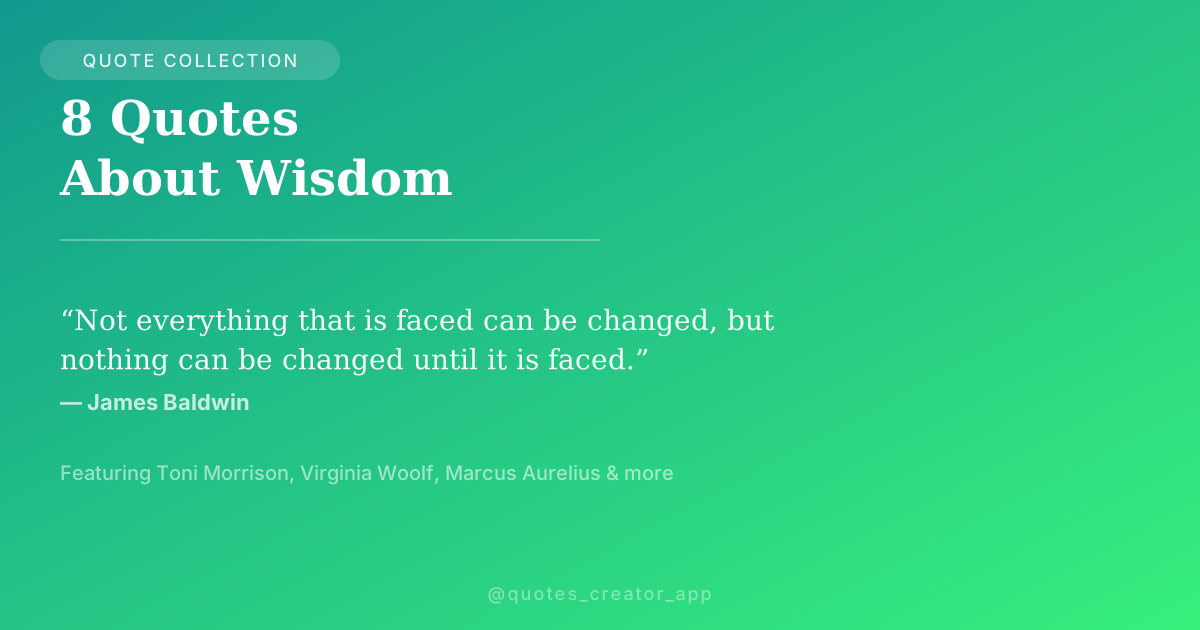
1. “Not everything that is faced can be changed, but nothing can be changed until it is faced.”
James Baldwin wrote this in 1962 for The New York Times Book Review, and it has become one of his most quoted lines for good reason. The sentence performs a kind of moral arithmetic: it acknowledges the limits of human agency while refusing to let those limits become an excuse for inaction. Baldwin understood that the civil rights movement required people to confront brutal truths — about racism, about history, about themselves — without any guarantee that confrontation would produce change. What he insisted on was the inverse: change is impossible without confrontation. Wisdom begins with the courage to look, even when looking hurts.
— James Baldwin, “As Much Truth As One Can Bear” in The New York Times Book Review (January 14, 1962)
2. “The most dangerous creation of any society is the man who has nothing to lose.”
This line from Baldwin’s 1963 essay collection The Fire Next Time is a sharp piece of social psychology. Baldwin recognized that systems of oppression do not merely inflict material harm; they create a class of people for whom the social contract has no meaning. When you have nothing to lose, you have no stake in stability, no reason to play by rules that have always been stacked against you. The wisdom here is double-edged: it is both a warning to those in power and a lament for those pushed to the margins. A wise society does not manufacture people with nothing to lose.
— James Baldwin, The Fire Next Time (1963)
3. “If there is a book that you want to read, but it hasn’t been written yet, then you must write it.”
Toni Morrison said this at a 1981 talk at the Ohio Arts Council, and it captures the essence of creative courage. Morrison was not just talking about writing novels — she was talking about the obligation to create what is missing from the world. As a Black woman in publishing, she knew firsthand that the literary canon had gaps where her stories and her people’s stories should be. The quote is a call to intellectual self-reliance: do not wait for permission, do not wait for someone else to fill the void. If the knowledge you seek does not exist, go out and generate it. That is the essence of wisdom in action.
— Toni Morrison, Address at the Ohio Arts Council (September 1981)
4. “Freeing yourself was one thing; claiming ownership of that freed self was another.”
From Morrison’s 1987 masterpiece Beloved, this line distills a profound psychological insight into a single sentence. The novel tells the story of Sethe, a former slave who has escaped physical bondage but must still reckon with the internal scars of her past. Morrison understood that liberation is not a single event but a process. You can walk out of a prison and still carry the prison inside you. Claiming ownership of yourself — believing that your life is truly yours, that your choices matter, that you deserve joy — is a second, harder emancipation. True wisdom is knowing the difference between the two.
— Toni Morrison, Beloved (1987)
5. “A woman must have money and a room of her own if she is to write fiction.”
Virginia Woolf published A Room of One’s Own in 1929, and this declaration became a cornerstone of feminist thought. The sentence is deceptively simple — it is not really about money or rooms. It is about the material conditions required for intellectual freedom. Woolf argued that creativity does not emerge from pure genius; it requires economic independence, physical space, and the psychological safety that comes with both. She was writing about women, but the insight applies to anyone whose voice has been silenced by a lack of resources. Wisdom, Woolf reminds us, is not purely spiritual — it is grounded in the material realities of who gets to think, and who does not.
— Virginia Woolf, A Room of One’s Own (1929)
6. “I am rooted, but I flow.”
These four words from Woolf’s 1931 novel The Waves contain an entire philosophy of identity. The speaker, Bernard, is a character who spends the novel trying to pin down who he is, only to conclude that identity is both fixed and fluid. You are rooted in your history, your body, your relationships — but you also flow through time, change your mind, outgrow old versions of yourself. The paradox is that both statements are true simultaneously. Wisdom, Woolf suggests, is the capacity to hold both truths without forcing a resolution. You do not have to choose between stability and growth; you can be rooted and flowing at the same time.
— Virginia Woolf, The Waves (1931)
7. “You have power over your mind — not outside events. Realize this, and you will find strength.”
Marcus Aurelius wrote this in his private journal, later published as Meditations, while serving as Roman emperor during a period of war and plague. It is the cornerstone of Stoic philosophy: the distinction between what is within your control and what is not. Aurelius did not mean that you should be passive in the face of injustice. He meant that your mental and moral responses to events are the only things you fully control, and that obsessing over outcomes you cannot command is a recipe for misery. The strength he promises is not the strength to dominate the world but the strength to remain intact while the world does what it does. That is wisdom of the most practical kind.
— Marcus Aurelius, Meditations, Book 4 (c. 170 AD)
8. “The happiness of your life depends upon the quality of your thoughts.”
This line from the Meditations is perhaps the most direct summary of Stoic ethics ever written. Aurelius was not a naive optimist — he spent years fighting wars on the empire’s frontiers while a plague ravaged Rome. He knew that external circumstances could be brutal and unpredictable. His claim was not that positive thinking would solve all problems, but that the quality of your inner life determines the quality of your lived experience, regardless of what happens outside. If your thoughts are tangled in resentment, envy, or fear, no amount of external success will bring happiness. If your thoughts are disciplined, generous, and clear, no amount of external hardship can destroy your peace. That is the final wisdom of a man who had everything and understood that none of it mattered without the right mind.
— Marcus Aurelius, Meditations, Book 5 (c. 170 AD)
Create your own quote graphics
These quotes are meant to be shared. A well-designed quote graphic can stop a scroll, start a conversation, and inspire someone at the right moment. Whether you are posting on Instagram, creating Pinterest pins, or designing WhatsApp statuses, Quotes Creator gives you ready-made templates, beautiful fonts, and custom gradients to bring any of these quotes to life in minutes.
Designing quote graphics for “Wisdom & Knowledge”
- ✓ Use teal and sage green tones to match the calm, thoughtful mood of this collection
- ✓ Serif fonts work best for wisdom and knowledge quotes — classical, timeless, authoritative
- ✓ Pair quotes with natural or abstract gradient backgrounds for maximum impact
- ✓ Keep text to 2–3 lines maximum on mobile-sized graphics
- ✓ Export in square format for Instagram and portrait for Pinterest
Why we curated this collection
Wisdom is not the same as intelligence. Intelligence solves problems; wisdom knows which problems are worth solving. The eight quotes in this collection come from writers, philosophers, and activists who spent their lives asking the hardest questions — about identity, freedom, power, and meaning. They do not always agree with each other, but they share a refusal to settle for easy answers. We chose these particular voices because they represent different eras, different struggles, and different ways of knowing. Together, they form a kind of conversation across time about what it means to live wisely. We hope they spark something in you.
— ThinkPeak Studio Editorial Team
Create your own quote graphic
Turn this line into a shareable graphic in seconds — free, no signup needed. For video quotes and 100+ templates, try the Android app.
Advertisement
Enjoyed this article? Get more like it in your inbox.